
Skills in the City: financial services sector looks to the future

To what extent should organisations that compete fiercely to attract new recruits (and for business overall) be collaborating when it comes to enhancing their workforces’ skillsets?
It’s tricky to imagine many of the Square Mile’s biggest names freely sharing their training programmes outside their own four walls. ‘Sure, we’ll just send you what we do in a pdf’ doesn’t seem like a particularly likely email exchange between rival firms’ HR departments.
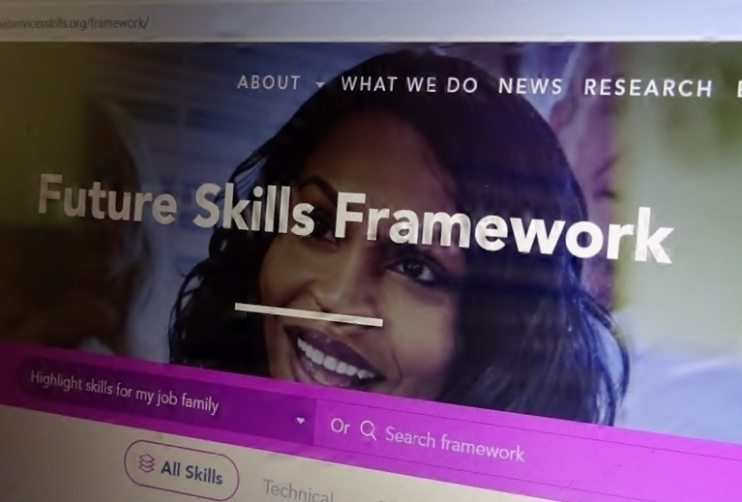
But – with skills shortages increasingly apparent across the economy – a ray of light in a collaborative direction has emerged in the form of the ‘Future Skills Framework’ developed by the Financial Services Skills Commission (FSSC).
The online tool, launched this month, focuses on eight skills (four technical and four behavioural) where there are ‘acute shortages or where there is rapid and growing demand’: user experience; machine learning/artificial intelligence; agile; cyber-security; empathy; adaptability; relationship management; and teamwork.
The ultimate aim is tackling what the FSSC, an independent member-led UK body, describes as an ongoing shortage of technology, cyber and digital skills, as well as ‘increasing the supply of talent for the long term’.
‘In all our interests to grow the pool together’
Formed a year-and-a-half ago following a recommendation of the Financial Services Skills Taskforce (2018-2020), the FSSC has members including banks such as HSBC, Barclays and Lloyds, as well as professional services firms including EY.
But are financial services’ leading businesses really willing to join forces when it comes to tackling the skills challenge?
“This was certainly a consideration when we were setting up: how far do we think that individual firms’ work on skills development is competitive advantage?” FSSC chief executive Claire Tunley said, during a webinar to launch the framework, in response to a question from Morning Wire. “What we have found, though, is that actually most firms are willing to share and collaborate on this type of work. That’s really in recognition that we are all facing the same challenges and, actually, the areas for competitive advantage are quite limited.”
She describes the new framework as an ‘industry-wide statement’ that, in effect, amounts to significantly more than the sum of its parts.
“If we can align on common definitions, common proficiency levels, that’s really powerful when we talk to the education and training sector, talk to professional bodies and when we talk internally. People move within the industry and move into the industry from outside, and it’s in all our interests to grow the talent pool together. No firm can do that on its own,” Tunley told the webinar’s audience.
‘We are all fighting for the same talent’
The Chartered Insurance Institute (CII)’s customer director, Ian Simons, made a similar observation during the online discussion (held on 7 October).
“We believe there is huge value in having commonality of language and priorities across the wider financial services sector,” he said. “We all benefit from that transferability and common focus, particularly when it comes to encouraging wider talent into the financial services sector. We are all fighting for the same talent and benefit from a joined-up effort.”
NatWest is among the FSSC’s founder members and the bank’s chief HR officer, Helen Cook, has been impressed by the way those who contributed to the framework from competing businesses were willing to work hand in hand.
“In 30 years this is probably the most collaborative thing I have worked on across the industry and I think that’s because the need is so strong,” Cook said during the webinar. “More often than not companies are all doing the same things anyhow – there’s more in common than is different.”
She also shared a broader reflection. “While there is clearly competition between firms, there is competition between industries,” she pointed out. “If we [financial services] as an industry don’t come together to create the talent and gene pool that we need we will be losing more and more of our skills to other sectors, such as technology.”
‘It’s a strategic longer-term shift’
The framework, which is part of a growing set of skills tools designed by the FSSC, will evolve, in the same way that skills demanded by employers – and the skills that people need just to get by in everyday life – evolve.
The framework will be updated with a new set of priority skills next year while the FSSC is also planning to unveil a ‘skills gap analysis toolkit’ in the coming months.
The FSSC also sees the framework’s launch as the “starting point for dialogue with education and training providers, guiding course content to help us ensure we adapt and ensure new training offerings are developed to meet industry needs”, Cook said.
The broader vision reflects the FSSC’s own mission of enabling financial services organisations to be fit for the future.
“We need to build skills for the long-term,” Tunley said. “It’s a strategic longer-term shift, not a one- or two-year plan. It’s all about a shift towards an ongoing culture of learning and development that the sector really needs to get behind.”
‘Banking’s got talent? Digital disrupts the City’s skills requirements’: Ian Hall explored the remit of the FSSC and its plans for the framework on 24 June as part of a broader look at the challenges and opportunities created by digital transformation in financial services