Skip to content
Sunday 9 August 2026London --:--Frankfurt --:--Zurich --:--
NewslettersSearchEN · DE
MorningWire

European business, markets and politics

FTSE 100
10,901.09
+0.31%
DAX
26,319.45
+0.69%
CAC 40
8,714.93
+0.17%
STOXX 50
6,523.86
+0.33%
  • Europe
  • Markets
  • Business
  • Economy
  • Technology
  • Politics
  • Opinion
More
GermanyFranceBankingAIEnergyFintechPropertyCapital Markets
  • Germany
  • France
  • Europe
  • Markets
  • Business
  • Economy
  • Technology
  • Politics
  • Opinion
  • DE
Tuesday 01 October 2019 6:03 am  |  Updated:  Tuesday 01 October 2019 12:20 pm

How business rates reform can thwart the retail apocalypse

By: Annabel Denham

Add as a preferred source on Google
Retail
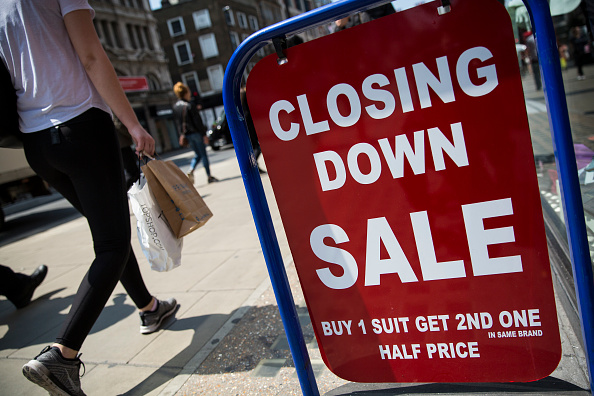
LONDON, ENGLAND - JUNE 09: A closing down sale sign is seen outside a men's clothing shop on Oxford Street on June 9, 2016 in London, England. Conditions are tough for the High Street as retailers recorded a 1.9% drop in May. The warmer weather saw customers shopping for summer clothes, food for outdoor dining and toys. However shoppers are expected to remain cautious and the British Retail Consortium predicts volatile sales figures for the time being. (Photo by Jack Taylor/Getty Images)

When businesses like Thomas Cook fail to adapt, they are smited by new technologies with leaner business models and more efficient practices. This is Joseph Schumpeter’s creative destruction in action.

Yet there is something profoundly bleak about boarded-up shops or “clearance sales” posters in the windows of once thriving businesses – particularly as the demise of all high streets isn’t inevitable.

As more and more household names fold, retailers and unions have called for the government to step in and find some way of alleviating retail’s woes. 

Some have suggested a digital sales tax – in essence penalising tech firms for carving out a more efficient business model, one from which consumers benefit in the form of lower prices and added convenience. Jeremy Corbyn, meanwhile, wants to forcibly seize property from landlords and hand it to community projects and coops. Both are wrong-headed. 

But claims of a so-called retail apocalypse mask a hidden truth: there are things we can do to restore some high streets to health. 

Pumping money into the Stronger Towns Fund, however, won’t make a difference, because it ignores why these towns are being left behind and the broader relationship between city economies and the vibrancy of their high streets. 

Nor can the decline of some town centres be blamed on the might of the internet. It’s down to a mix of factors, from housing to transport to the jobs available in certain areas. 

Tackling these issues, by liberalising housing supply and investing in transport links between towns and cities to give people access to the best jobs from a far wider area, will have more of an impact than focusing on high streets alone.

Read more

Brits dodge the high street as heatwave boosts online shopping

Shoppers carrying various retail bags, including New Look and M&S Food, on a paved street, indicating retail sales activity.

Retailers face myriad challenges and we at The Entrepreneurs Network have long called for business rates reform. Blanket cuts will only benefit the biggest landowners like the Duke of Westminster rather than high street shops or their customers. Instead we need to reassess rateable values upon the underlying land value of a commercial site.

As research from Centre for Cities highlights, not all high streets are struggling. In Brighton, vacancy rates are as low as seven per cent.

Online sales currently make up just 17 per cent of the total British retail spend, and tech giants are themselves moving into physical retailing: Apple has stores across the world, and in June Amazon began opening pop-up shops across the UK.

This demonstrates that online and physical shouldn’t be an either-or proposition. Instead, retailers should look to innovative tech and online shopping to increase sales. The role of physical stores may increasingly be that of a “shop window” or community space. 

High streets need flexibility: if bricks-and-mortar retail is becoming a smaller presence, making change of use – to food, drink, leisure and entertainment – easier is vital.

Indeed, space earmarked for retail doesn’t have to be that way forever. We have vacant shops and a housing crisis: by defending and expanding Permitted Development Rights, which allow change of use, the two can be the answer to each other’s problems.

Yesterday’s boarded-up shop front could be tomorrow’s family home, bringing vibrancy and vitality back to Britain’s high streets without the heavy hand of the state.

Main image credit: Jack Taylor/Getty Images

Read more

Heatwave slows retail sales but World Cup boosts online shopping

Scorching sun over urban skyline during intense heatwave, highlighting climate change impact on city infrastructure.

Share this article

  • Facebook
  • X
  • LinkedIn
  • WhatsApp
  • Email

Similarly tagged content:

Sections

  • News
  • Opinion

Categories

  • Opinion
  • Politics
  • Retail

Related Topics

  • UK business rates

Trending Articles

  • Thames Water faces fresh threat to survival after pensions regulation breach

  • PwC’s Embankment HQ to get major makeover ahead of Canary Wharf move

  • Family feud: London estate agent Winkworth sues chair over plot with wife to oust son from board

  • As it happened: Stocks rise despite new tensions in Strait of Hormuz; Oil price climbs

  • A tribute to wine legend Matthew Jukes by his friend Libby Brodie

More from Morning Wire

  • Brits dodge the high street as heatwave boosts online shopping

    Retail
    Shoppers carrying various retail bags, including New Look and M&S Food, on a paved street, indicating retail sales activity.
  • Heatwave slows retail sales but World Cup boosts online shopping

    Retail
    Scorching sun over urban skyline during intense heatwave, highlighting climate change impact on city infrastructure.
  • Burnham’s high street tax plan carries £880m price tag

    Retail
    High streets emptied out as retail sales fell in May.
  • We’re being taxed out of existence, companies warn

    Economics
    Rachel Reeves speaking at an IOD event.
  • Burnham urged to go further to fix ‘broken’ business rates

    Retail
    Burnham cityscape at sunset with historic buildings and bustling streets, highlighting the vibrant urban landscape
  • Policing alone won’t solve London’s shoplifting epidemic

    Opinion
    Shoplifting incident in retail store with security camera footage showing suspect concealing merchandise in jacket
  • Retailers urge Burnham to slash tax and back youth employment

    Retail
    Burnham cityscape at sunset with historic buildings and bustling streets, highlighting the vibrant urban landscape
  • Ban foreign stocks from Isa wrapper, says top pensions boss

    Investing
    Nicholas Lyons, former Lord Mayor of London, speaking at a podium with microphones, discussing fresh ISA rules.
MorningWire

Independent European business, markets and political news for decision-makers.

Morning Briefing

Europe

  • Germany
  • France
  • Europe
  • UK & Ireland

Business

  • Markets
  • Banking
  • Technology
  • Energy
  • Property
  • Fintech

Editorial

  • Opinion
  • Editorial Policy
  • Corrections
  • Contact

Company

  • About Morning Wire
  • Privacy Policy
  • Terms of Use
  • Cookie Policy
© 2026 Morning Wire Ltd · Published by Morning Wire Media, Bahnhofstrasse 65, 8001 Zürich, Switzerland
Privacy · Terms · Cookies · Facebook