Starmer refuses to commit 3 per cent defence spending despite ‘battle-ready’ claim

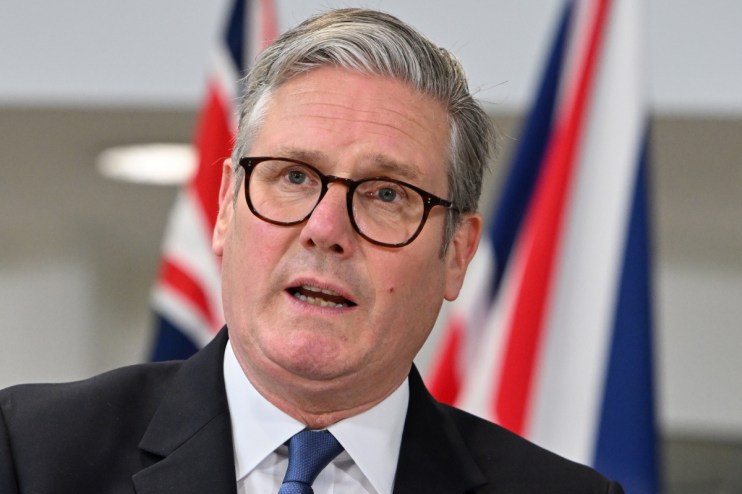
Keir Starmer has been criticised for failing to commit to increasing defence spending to 3 per cent of GDP.
The Prime Minister vowed to put in place the “largest sustained increase in defence spending since the Cold War,” with a 2.5 per cent share of GDP going to defence.
However, the PM maintained that hitting 3 per cent was an “ambition” that the government hopes will be achieved in the next parliament – following an election which must take place by 2029.
On Monday, Starmer announced the government’s much-awaited Strategic Defence Review (SDR).
He outlined the government’s ambition to build a “battle-ready, armour-clad nation, with the strongest alliances and the most advanced capabilities.”
In terms of hard numbers, Starmer promised to build 12 new attack submarines – one to be delivered every 18 months – in addition to building six new munitions factories, pledges which he promised will create thousands of jobs.
Building “thousands of new long-range weapons” will “support around 800 more jobs,” Starmer stated.
Spending concerns
This hike in defence funding to 2.5 per cent was announced earlier this year, signalling a shift in government priorities as other areas of public spending – like international aid – are squeezed.
However, opposition parties have cast doubt on the government’s commitment and ability to achieve 3 per cent on defence spending.
Alex Burghart, shadow Cabinet Office minister, said that “without the money,” the defence plan is “just words.”
The PM rebutted concerns that his plans are “shaky;” claiming he is “100 per cent confident” that these plans will be delivered, and that the government’s commitment is both “huge” and firm.
Conservative leader Kemi Badenoch criticised the government for having found “BILLIONS for the Chagos surrender” but not committing to “properly funding our Armed Forces.”
“Scrap Chagos. Fund defence,” Badenoch added.
Jeremy Hunt, chancellor under Rishi Sunak, said “it is not leadership to ‘accept’ the recommendations of a defence review whose authors say it requires 3% of GDP but *NOT* commit to the £ to pay for it. If Denmark, Sweden, Latvia, Lithuania, Estonia, Poland even Greece can do this, why not [the UK]?”
Lib Dem leader Ed Davey also chimed in, citing a “concerning lack of urgency on reaching 3 per cent.”
“With Putin waging war, Trump undermining NATO and conflicts raging,” not hitting the 3 per cent mark “faster than 2035” would be a “dereliction of duty,” Davey added.
SNP leader in Westminster, Stephen Flynn, said Labour were “making it up as they go along,” and called the new defence strategy the “stuff of student politics.”
Andy Haldane, formerly chief economist at the Bank of England, suggested that “it is directionally good that we are spending more on defence,” but said today’s announcement constituted the “absolute bare minimum” to “get Keir Starmer through a meeting with Donald Trump.”
Speaking on LBC, Haldane said “we now look like a laggard on defence spend relative to much of the rest of the world.”
When asked by LBC’s Nick Ferrari how the government could fund the increase in defense spending, Haldane recommended that “we’ll need a bit more borrowing, a bit more taxation and a loosening of our fiscal shackles.”
Additional taxation is unlikely to be a popular measure among businesses and the public, in light of recent opposition to the tax raids floated by deputy PM Angela Rayner.
Backing Nato
The Military Alliance between North America and European countries was at the forefront of Starmer’s announcement.
“Our defence policy will always be Nato-first,” Starmer said, announcing that under the new plan, the government will be making “Britain’s biggest contribution to Nato since its creation.”
President Donald Trump has repeatedly warned European nations should be doing more to pull their weight as part of the alliance, lest the US withdraw.
Starmer said the Strategic Defence Review constitutes a step towards “strengthening our bridge to the US as Britain’s first partner in defence.”
The PM promised that “everything we do will add to the strength of Nato,” and that the UK will “step up to take greater responsibility for our collective defence,” becoming Nato’s “fastest innovator.”
War in Europe
Starmer repeatedly stressed the UK’s plan to move to “warfighting readiness,” while emphasising that the move is aimed at strengthening the UK’s deterrent capabilities.
“We face war in Europe, new nuclear risks, daily cyberattacks, growing Russian aggression in our waters, menacing out skies, their reckless actions driving up the cost of living here at home, creating economic pain and hitting working people the hardest,” Starmer said.
The PM’s emphasis on the centrality of the UK’s fleet of submarines on defence stems from the nature of Russia’s threat.
Russian espionage in British waters has sounded the alarm that Russian submarines could target sub-sea internet and electricity cables.
When asked whether this could lead to internet and power outages, Starmer said the government is working with allies “to ensure that we can protect all of our infrastructure and all of our capabilities.”
On the BBC’s Radio 4 programme, Starmer reiterated that the UK’s nuclear deterrent is the “cornerstone” of the nation’s defence capabilities, and that the government is “100 per cent” committed to it.
The nation’s forces
The government also wants to create more “unity” by “integrating” military capabilities.
In this vein, the Royal Navy will become ‘hybridised,’ “blending drones with warships, submarines and aircraft.”
The armed forces will receive their “biggest” pay rise “in 20 years,” and will be “backed by a stronger strategic reserve.