Straight Line Crazy sees Ralph Fiennes on fine form as NYC architect Robert Moses

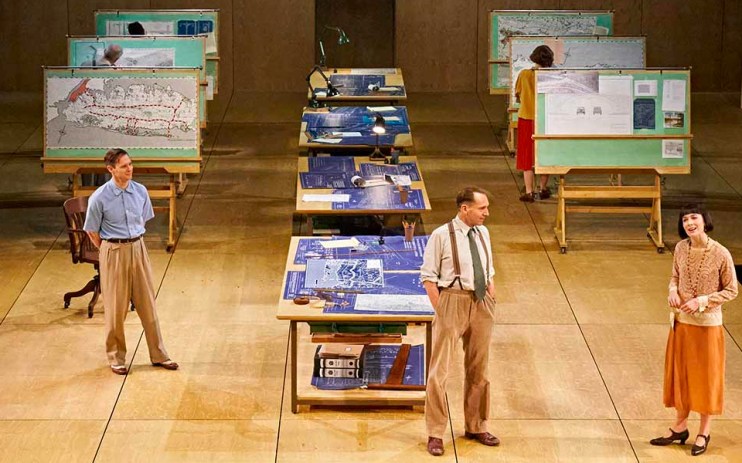
While Straight Line Crazy is ostensibly a historical play about Robert Moses, the New York architect whose car-friendly vision is still in evidence across much of the north eastern United States, David Hare’s latest play for the Bridge Theatre is equally interested in drawing contemporary parallels, touching on issues including environmentalism, gentrification and systemic racism.
Hare worked on the 2016 version of Ibsen’s The Master Builder at the Old Vic, also starring Ralph Fiennes, and there are elements of homage to the Norwegian modernist (Hare also updated Ibsen’s poem Peer Gynt for the National in 2019, although the less said about that the better). Both plays focus on a dissatisfied, ageing architect obsessed with their legacy and unable to connect with the younger generation, although Moses is a far more formidable character.
A self-described “ditch digger”, Moses was a man with a plan, believing absolutely that he was on the right side of history. One character compares him to Napoleon, which feels appropriate given the play is split into two key conflicts: the battle of Long Island and the battle of Washington Park. These two hotly-contested architecture projects are the focus of each of the play’s two distinct halves. In the first we’re presented with a generally sympathetic view of Moses who, despite his belligerent nature, seems like a genuine idealist, intent on forcing through his dream of Americans pursuing the new phenomenon of “leisure time”.
A natural born trouble-maker, Moses captured the imagination of Governor Al Smith, a wheeler-dealer politician played here by Danny Webb as part Al Capone, part Winston Churchill. Together they set about the legally dubious task of reclaiming land on Long Island from the Vanderbilts and the JP Morgans, creating a series of national parks and, crucially, the miles and miles of new roads required to link them up. Flanked by two charismatic young underlings in Finnuala Connell (Siobhan Cullen) and Ariel Porter (Samuel Barnett), Moses is presented as an almost countercultural figure, taking land from the rich and giving it back to the poor.
The second half, picking up 30 years later, sets about dismantling this legacy. After winning the battle of Long Island, Moses spent decades building highways across poor, predominantly black New York City neighbourhoods, resulting in thousands of people being turfed out of their tenement homes. His ultimate goal was a New York dominated by expressways (the titular straight lines are the quickest way between two points, so beloved of architects), of which Washington Square was only the first step.
With the benefit of 70 years of hindsight, the flaws in Moses’ plans are clear: his blueprint was replicated across the US, playing a part in the country’s reliance on cars and chronic shortage of public transport. Even in his lifetime his legacy was beginning to crumble, with the new generation of educated working classes realising his vision excluded anyone who didn’t look like Moses.
There are clear parallels with today’s generation of young people dissatisfied with the cultural and governmental institutions that claim to have their interests at heart. Indeed these parallels are pushed so far that they compete with the character study at the centre of the play, with subplots such as the decline of Moses’ alcoholic wife feeling a little sidelined. The line-up of secondary players introduced in the last half also feel starved of oxygen, not least Jane Jacobs, whose cameo in the opening moments hints at a more important role than she ends up getting.
But you can forgive a lot when Fiennes is on this kind of form. His energetic, physical performance leaves you in no doubt as to Moses’ singular nature, bringing to life a man willing to almost literally hoist the world onto his shoulders in order to achieve his dubious goals.