Sunak’s reshuffle is the latest attempt to relaunch Tory politics

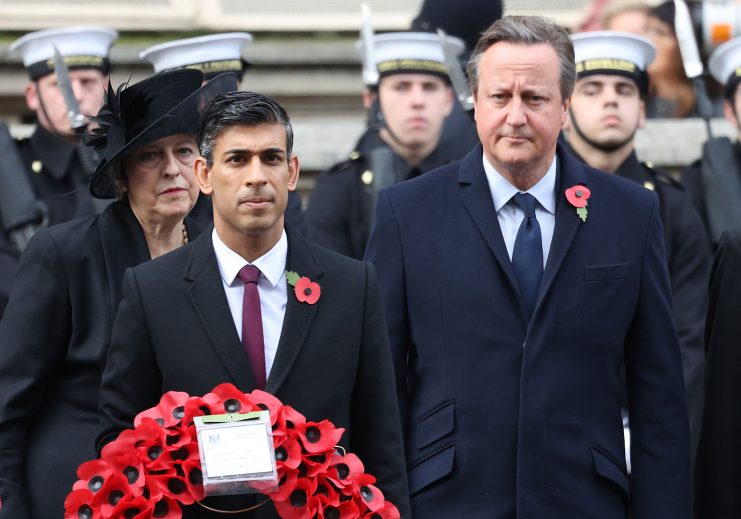
Rishi Sunak’s reshuffle was his third attempt to relaunch the Conservative Party, and this time he’s also reheating David Cameron’s career, writes Will Cooling
Rishi Sunak is a prime minister with nowhere left to run. Neither David Cameron’s shock return nor the long overdue second departure of Suella Braverman from government should obscure this fact. Indeed, they underline that Sunak has frittered away the past year and is now left desperately trying to salvage something from the wreckage.
His premiership was born of the need for the Tory Party to relaunch itself, following the short-lived, chaotic era of Liz Truss, which was in itself, a relaunch from the chaotic era of Boris Johnson. But once he had stemmed the bleeding from the mini-budget, Sunak lacked the coherent policy rationale needed to give his government purpose.
First he latched onto the idea that he could define himself as a technocratic problem solver, applying the hands-on approach he had taken as a former Chancellor to the preparation of Jeremy Hunt’s emergency financial package to other urgent policy areas. He began the year by launching his own personal five pledges while heavily briefing his obsession with policy detail.
But a government is constantly faced with so many problems that they can’t have the Prime Minister directly intervening to address them all. As a result of the under-pressure public finances, Sunak has failed to provide the capital to reduce the pressure on the public sector, whether it be crumbling buildings or NHS backlogs.
Nor has he been able to sufficiently reduce the deficit to stop high inflation and the ensuing sky-high interest rates implemented by the Bank of England. These twin failures meant that whatever progress his personal efforts had made to address specific issues, the Tory Party went down to a crushing defeat in May’s local elections. Subsequent by-elections have proved just as damaging.
The sensible move would have been for Sunak to take a step back from micromanaging frontline delivery and consider what he wanted his government to achieve as a collective. That would have involved a coherent “refresh” with a reshuffle before the summer recess, a launch of a new slate of policies when the party met for its annual gathering in October, with the details unveiled in the King’s Speech. That way Sunak’s team could have used the summer to stress-test and fine-tune their new approach, to ensure it was a success.
Sunak repeatedly put off a full restructure of his cabinet, instead doing mini-reshuffles as ministers resigned in disgrace or retired in disappointment. With no fresh thinking or central direction, Tory Party Conference became an advert for all that’s unpleasant in today’s Tories. From Kemi Badenoch to the now former Home Secretary Suella Braverman, minister after minister played to the base instincts of the party with bad jokes and mean asides about minorities and middle-class liberals.
Sunak pledged to haphazardly end the governing consensus of the past thirty years as he watered down the plans he had inherited for infrastructure development and the green energy transition.
Barely six weeks later, he has brought back the Tory who perhaps most embodies that consensus.And for good reason, as the party’s desperate gyrations in Manchester failed to win the Tories any favours in the polls, with them once again polling below 25 per cent.
David Cameron set the stage for this period of Tory-led governance by convincing Middle England that the Tories were no longer the nasty party. Seven years after Cameron was forced into premature retirement by Brexit, and a year into a premiership that looks increasingly barren, Rishi Sunak is forced to hope against all expectation that the veteran has some of the old magic left.