Surfing the Thames: How Uber boats came to rule the river

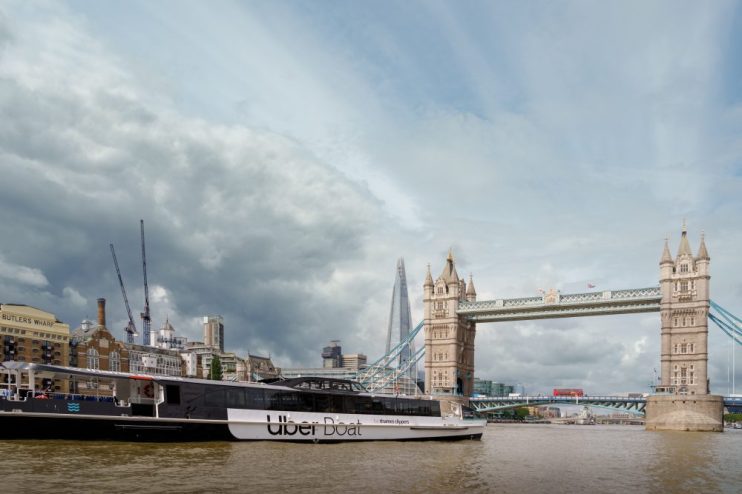
“Looking out at the river, I was struck by how empty it was,” Sean Collins tells me. This was in 1994, when he had just been made redundant from his previous role as an apprentice waterman on the Thames. All that empty water stretching through the middle of London – it was a “waste”. But he had an idea.
In 1993 the firm he was working for, Thamesline – which ran a boat service from the developing docklands to the City – had disbanded. Its main backers Olympia and York (the property developers behind Canary Wharf) had gone into administration and saw the not-for-profit partnership it was backed by as unsustainable. It was the 14th casualty of the Thames watercraft dynasty.
Somehow, despite the rich history of boats in the capital, sustaining a river boat business on the Thames in the late 20th century had become a near impossibility. So, how did Collins go on to launch the Thames Clippers, which has become the now de facto London commuter boat service? It’s a tale of timing and partnerships – not least a deal with Uber in 2020. But it’s also a testament to London’s geographical growth.
The ideal vessels
Collins knew the value of a good vessel. And of the 11 that made up Thamesline’s now-defunct fleet in 1993, there were three boats that were but weeks old and “ideal” for the river – and had been specially made on the Isle of Wight. So Collins walked away from property development and launched the Clipper (named after the Cutty Sark) in 1999.
In many ways, timing swung it. In the last two decades huge property developments have sprung up – conveniently – on the river banks. Thirty years ago Southbank was a wasteland, Collins tells me. Canary Wharf had just sprung up when the Clipper set sail. “The original route was from Embankment to London Bridge then over to Canary Wharf and back.”
“In 1999 it was the right time: Canary wharf was well established by then. Docklands had really started to roll… Greenland pier in Surrey Quays and Canary Wharf pier were sitting there relatively dormant, so I thought we’ll get those services started and it was a great success,” he says.
Collins says “it was the developments along the river that made it work – the Dome, partnerships. The Southbank was a non-entity 30 years ago,” he points out. Canary Wharf, too, was built up in this time – a key stop on the Thames Clipper route.
Public and private investment
Private investment funnelled in has also been critical. “The business has been based on partnerships. I took that model of the property developers back in the river bus days and expanding and evolving that and in 2006 that’s when I found our new majority shareholder, AEG that developed the Dome.” They bought the firm for £7m and invested £20m in six new boats. For AEG, it’s a win as they have a vested interest in people accessing Greenwich with ease.
Yet the Clippers have also been propped up by public money, in the form of subsidies from Transport for London (TfL). Various councils have made deals to support guaranteed commuter services, such as with the Greenwich-Woolwich and Putney-Blackfriars services. Councils and the mayoral office justify this due to the essential services being provided: commuting. Support from TfL led to another boon – their addition to the Oyster card circuit in 2005.
Nowadays, it’s east of the river that’s being built up: Royal Wharf, Barking. And that’s where Clippers are expanding. They acquired Gravesend Pier 18 months ago, which will mark the furthest eastern spot on the route so far. As London expands, so does Collins’s empire.
London was once awhirl with boats
In a way, it’s surprising this trajectory was so complex. London was once awhirl with boats. The Thames was for centuries full of vessels of all sizes: wherries, row boats, gigs, sloops and cutters all swirled around the river. For those who wanted to cross, there were no tunnels. In the early mediaeval times, it was cheaper to travel on water than by road. And there were few bridges: in fact there was just one (London Bridge) until the mid 1700s when two more (Blackfriars, Westminster) were built. But London Bridge was jammed, being essentially a mini village for much of its existence – hardly a quick and easy cut across. No Tube, either. So, the river.
Were you to amble down to the riverside in the late 14th century, say, you would be greeted by cries of “oars, oars, sculls, oars, oars” as watermen jostled for your custom. You might be there to cross the river or, perhaps, to send off some cargo. Watermen waded through a murky world full of “boatmen”, who were sometimes also thieves and connivers. What happened in the dark on the water was easy to hide. In 1598, when London had a population of 200,000, there were 2,000 wherries and other small boats in use on the Thames.
After 1815 when passenger steamboats were introduced, long-distance river travel took off. You could hitch a ride from far out of London – Gravesend, Margate and Ramsgate into the capital via Greenwich and Woolwich. Over the next few decades, steamboats carried several million passengers a year. Some 15,000 people travelled to work by steamboat every single day.
But the river’s popularity drooped: as the railways began to be built in the 19th century, trainlines took over transport of the goods that had previously been flowing over the waves. Passenger ferries went out of style when other transport improved, and people looked to make longer distance journeys, not just step across the river.
The idiosyncrasies of the Thames
I’ll admit that, despite living in London for 20 years, I have never thought to hop on a vessel. Why not? It’s a little pricey, at over £10 for a single on most routes. Plus, it’s often seen as a tourist trap – although Collins tells me that 75 per cent of journeys are domestic, and 25 per cent are made by foreigners – “a healthy commercial mix”. In fact “part of the Uber attraction was that they would promote the boats, as half of their ridership is inbound,” Collins says.
Yet I think I am a believer in their vision. A lot of their successful expansion to the east of London comes from the fact that after Tower Bridge, there are no other crossings bar two foot tunnels (which flood). This is due to historic poverty in East London, the widening of the Thames and marshy riverbanks to the east. If you’re wanting to get to the capital from Gravesend, the boat may be cheaper and more reliable than the train.
Even in London, “if you went by Royal Wharf to Barking by any other means it would be a nightmare,” Collins says. I can believe that. One of the most geographically desperate situations I have ever found myself in was reaching North Greenwich, having run there from Peckham, only to find the foot tunnel – my way of crossing the river back south – flooded. The only option available was a public car ferry, the Woolwich ferry, which had a 30-minute wait time (disturbingly, the only fellow passenger was an active fire truck). A Clipper could have saved me.