Skip to content
Monday 24 August 2026London --:--Frankfurt --:--Zurich --:--
NewslettersSearchEN · DE · FR
MorningWire

European business, markets and politics

FTSE 100
10,813.43
-0.03%
DAX
26,061.97
-0.29%
CAC 40
8,467.39
-0.20%
STOXX 50
6,446.79
-0.24%
  • Europe
  • Markets
  • Business
  • Economy
  • Regulation
  • Politics
  • Opinion
More
GermanyFranceEU InstitutionsCompetitionPublic AffairsBankingTechnologyEnergy
  • Germany
  • France
  • Europe
  • Markets
  • Business
  • Economy
  • Regulation
  • Politics
  • Opinion
  • DE
Monday 24 August 2015 4:26 pm

TfL Tube strike 26 and 28 August 2015: Tube strikes cost London nearly £60m in lost man hours

By: Catherine Neilan

Add as a preferred source on Google

Talks are going to the wire, but unless something miraculous happens, London is staring down the barrel of a double-whammy of strike action this week. 
 
As it stands Tube staff members of RMT, TSSA and Unite are planning to walk out from 6:30pm on Tuesday and for the whole of the following day (25 to 26 August). They will then repeat this on the Thursday and Friday (27 to 28 August). Tube drivers union Aslef is not participating, which means the action could be less severe than it was last time around; however it is still expected to be hugely disruptive. 
 
All that means plenty of delays and a whole lot of extra time travelling – not forgetting the eye-watering cost to the economy of just one strike.
 
Whether you're being a diligent employee and allowing that to eat into your personal time off, or whether you're slightly more gung-ho about turning up late, TfL estimates that during February's strike those working in the capital “lost” a total of 3.48m hours. 
 
 
Research carried out by Morning Wire shows that based on the average weekly wage – which for full time employees in London is £660.50 – those lost man hours equate to a whopping £59.16m. A second strike in April would have cost the economy (or frustrated workers) around £54.4m. 
 
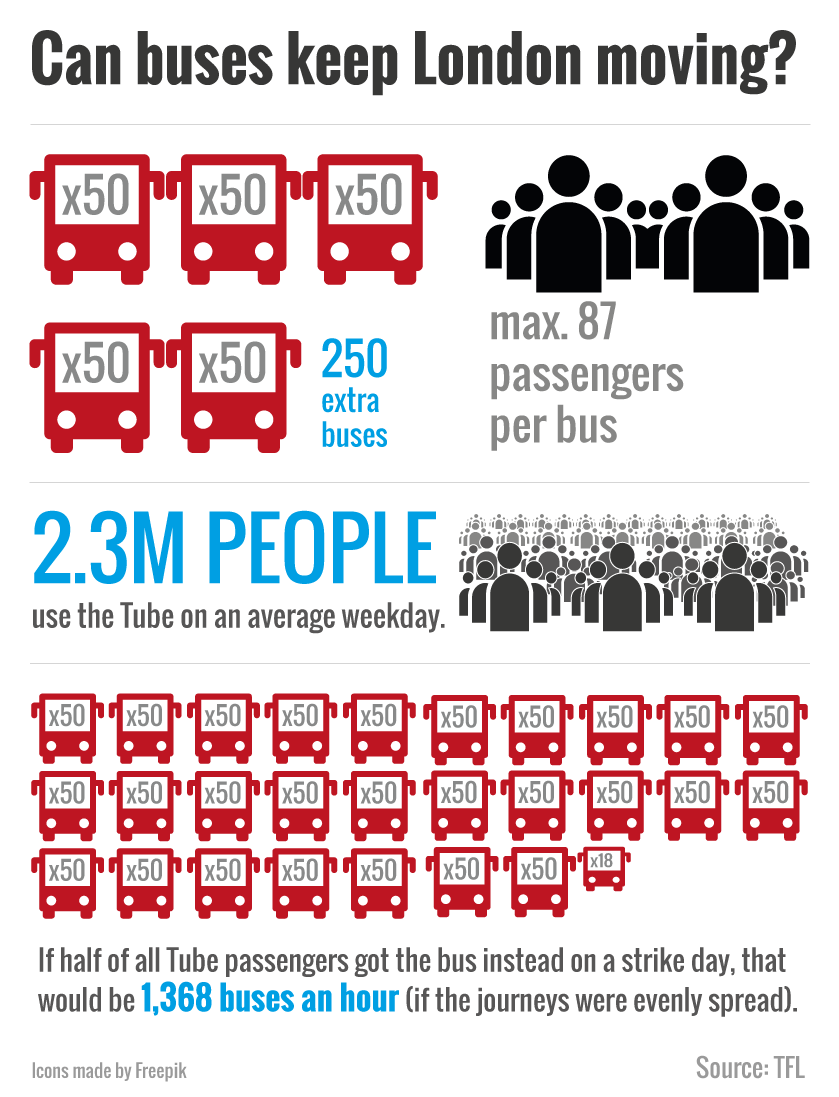
Transport for London has been clear about what it is doing to mitigate that: as with the previous strike a further 250 buses will be deployed to keep the city moving, while all of TfL's other services – DLR, London Overground and such like – will be running as normal. 
 
But just how far that will go in making commuters' journeys in any easier?
 
As you might have guessed, 250 extra buses is nowhere near enough. On an average day, more than 2.26m people use the Tube on an average weekday. 
 
Assuming each extra bus is a double-decker, they can take 87 people before reaching full capacity.
 
That means TfL would need 1,368 buses doing a full route an hour each to cover just half the displaced Tube commuters – assuming the journeys are spread evenly across the whole 19 hours the Tube is open, which of course they wouldn't. 
 

Share this article

  • Facebook
  • X
  • LinkedIn
  • WhatsApp
  • Email

Similarly tagged content:

Sections

  • News

Categories

  • Business
  • Transport & Infrastructure

Related Topics

  • Night Tube
  • Transport for London
  • Travel delays and disruption

Trending Articles

  • Can debt-ridden Morrisons become a Big Four supermarket again?

  • Ratcliffe’s Ineos saves Runcorn plant

  • Amazon says it buys books in bulk to ‘improve products’

  • House prices in wealthy London boroughs fall by up to £300,000

  • HMRC mansion tax inspectors to target homes for property valuations

More from Morning Wire

  • Point2 Completes $136M Series B Funding with Arm, LB Investment, and Maverick Silicon

    Business Wire
  • Which is the smelliest Tube line?

    Opinion
    Passenger wearing a blue surgical mask and coat on a London Underground train.
  • Summer loving! 9 amazing things to do in London this August

    Life&Style
    Three revelers in vibrant feathered costumes celebrating at Notting Hill Carnival.
  • Doctors union tops up £1m reserve pot for strikes

    Healthcare
    GettyImages 2246649047: Business professionals discussing strategy at a conference table, highlighting teamwork and collab...
  • What’s on in London August

    Sponsored
    Collage of London attractions: Tower Bridge, outdoor dining, rock climbing, museum, afternoon tea, and spa.
  • The BBC shouldn’t push Londoners to accept antisocial phone behaviour 

    Opinion
    Passengers inside a graffiti-covered London Underground train car, some looking at phones, others observing the interior.
  • UK economy’s rebound fails to stem two years of mass job losses 

    Economics
    LONDON, UNITED KINGDOM - JANUARY 31: The Shard is seen on the horizon as commuters cross London Bridge during the morning rush hour on January 31, 2023 in London, United Kingdom. The IMF reports that the UK economy will contract by 0.6% in 2023, as opposed to the previous prediction it might grow, and will perform worse than many other advanced economies, including Russia.The cost of living continues to hit households with grocery inflation for the first four weeks of 2023 rising to 16.7% which would add a further £788 per year to family food bills. (Photo by Leon Neal/Getty Images)
  • Burnham’s devolution drive could ‘push 90,000 jobs out of London’

    Economics
    In 2022, rolling Tube strikes led to massive queues for crowded buses. (Photo by Chris J Ratcliffe/Getty Images)
MorningWire

Independent European business, markets and political news for decision-makers.

Morning Briefing

Europe

  • Germany
  • France
  • EU Institutions
  • Europe

Business

  • Markets
  • Business
  • Economy
  • Regulation
  • Competition
  • Public Affairs

Editorial

  • Opinion
  • Editorial Policy
  • Corrections
  • Contact

Company

  • About Morning Wire
  • Privacy Policy
  • Terms of Use
  • Cookie Policy
© 2026 Morning Wire Ltd · Published by Morning Wire Media, Bahnhofstrasse 65, 8001 Zürich, Switzerland
Privacy · Terms · Cookies · Facebook