The downfall of the Roman empire and the future of American democracy

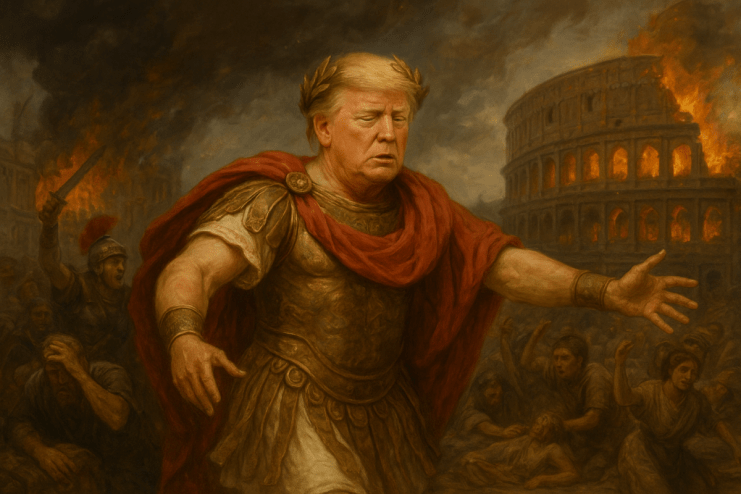
An erratic leader, a weak Senate and ill-judged economic policies leading to a contraction in world trade. The fall of the Roman Empire was followed by over 1000 years of stagnation. Donald Trump should take note, says George Maher
Donald Trump’s state visit will be accompanied by much debate about what his Presidency means for the future of free speech, free trade and democracy itself. But perhaps it is instructive to look for lessons in the downfall of the civilisation on which the American republic is modelled: the Roman Empire.
Let’s start with trade. President Trump has agreed a tariff on imports from India of 25 per cent. There is nothing new about that. That was exactly the tariff charged on the import of goods from India into the Roman Empire.
Arguments about tariffs are also nothing new. In AD 58 the Emperor Nero, whose approach to tariffs was different to President Trump’s, tried to put pressure on the Senate to remove all tariffs. Business men had been complaining to him about the unfair costs. The Senate resisted successfully. They pointed out that if they gave way on this there would be complaints about all the other taxes. Most importantly, they said, they ran a balanced budget and without the customs income they could not pay for essential services such as the army. The tariffs stuck.
Modern archaeological evidence enables us to quantify the importance of the Roman tariff income. Financial contracts preserved on excavated papyri, evidence of ship sizes, ancient documentary evidence on numbers of voyages enable us to estimate the value of goods imported into the Roman Empire. The tariff from India, for example, was over $2.5bn per annum in our terms; the conversion is based on a comparison of prices for equivalent goods and labour. This tariff was levied on items such as spices, perfumes, diamonds, ivory and high quality cloth most of which were difficult to source in the empire. It was settled through a sophisticated banking system.
The tariff on the Indian trade alone paid for well over half the expenditure of the state in the first century AD.
Out of control spending
Most of Roman state expenditure was on the army. The army, after the reforms initiated under Augustus, were state employees not volunteers recruited in times of war. They were permanent employees serving a contracted term of 25 years. During their service they received the benefits of bed and board and a modest income. Most of their financial reward was payable at the end of their service as a pension lump sum of $120,000 in our terms.
Through the first century hardly any of those soldiers fought in battle for more than a year or two. The borders of the empire had largely been settled and it had been transformed from an empire of conquest into an empire of trade. The soldiers learned crafts and business skills, they were a reserve pool of engineers, they acted as police and protected the borders. They were a labour pool used in the state’s construction projects. They protected the warehouses that stored goods imported from abroad and, like the US navy in the Red Sea today, they protected trade routes.
Through the first century AD this system stayed in balance. Pushback from a strong, well-informed Senate enabled it to do so. However with time things changed. The Roman people became complacent. From the beginning of the second century we feel the energy seeping out of the system. Growth slowed down, the construction of infrastructure reduced, archaeological evidence of commercial activities such as glass manufacturing shows production levelling off. It was not tariffs that did it for this economic powerhouse but the failure of political will. Towards the end of the second century a new emperor Commodus, who like Nero was young and inexperienced, got a measure past the senators that their predecessors would have stopped. To gain favour with the soldiers he substantially increased army pay.
Trade had depended on a sound banking system and a respected currency. With uncertain contract enforcement and a debased currency business activity and wealth creation reduced sharply. And a great stagnation began which was to last one thousand and six hundred years
This was an increase in recurring annual expenditure which could only be afforded with cutbacks in other items of expenditure, increases in taxation, confiscation and debasing of the currency. All of this happened.
The most significant consequence, however, of the Senate’s weakness was the undermining of discipline. State employees who for generations had been content to wait 25 years for the bulk of their reward now demanded more, and then more again. State expenditure went out of control.
| Emperor | Reign starts | Annual state expenditure in today’s money |
| Augustus | 27 BC | $3.6 billion |
| Domitian | AD 81 | $4.5 billion |
| Commodus | AD 177 | $7.0 billion |
| Septimius Severus | AD 193 | $11.2 billion |
| Caracalla | AD 211 | $25.2 billion |
In this ill-disciplined world trade suffered. The archaeological evidence shows that the ports from which ships left for India fell into disuse. Trade had depended on a sound banking system and a respected currency. With uncertain contract enforcement and a debased currency business activity and wealth creation reduced sharply. And a great stagnation began which was to last one thousand and six hundred years.
For all the noise and the heat of today’s debates the important questions are: Do those who are running our system know what they are doing, and do they care?
George Maher PhD is an actuary and author of Pugnare: Economic Success and Failure, which uses the Roman Empire as a parable for our time