The office is not dead – far from it, say City insiders

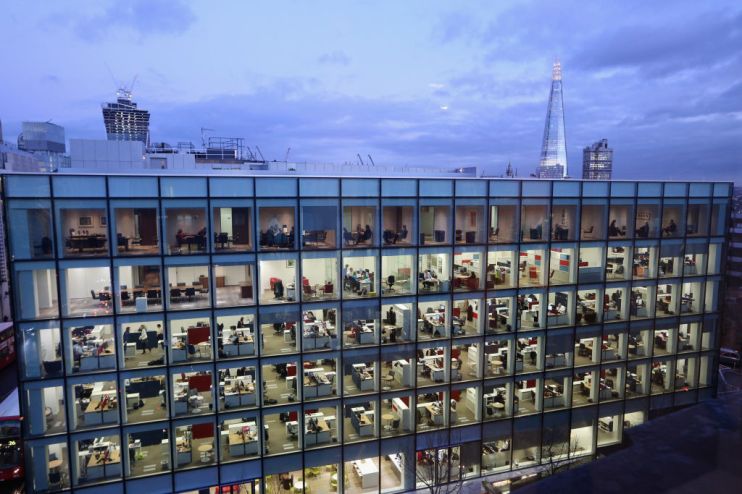
As the economy starts to reopen, the City is slowly coming back to life. A range of banks and Square Mile-based firms have started to formalise work from home policies and implemented flexible working arrangements.
Businesses in every sector have been debating concepts of what the post-Covid office could look like with pessimists doubting its future existence.
No matter your opinion, the vaccination programme’s success means the haze engulfing big questions such as: ‘what will happen to the office and will I ever go back to work’ should clear and be answered imminently.
Despite this shift towards hybrid working, the office is far from dead, according to Mike Gedye, head of technology sector vertical at real estate giant CBRE, and Simon Dudley, head of analyst relations at Logitech Video Collaboration.
In an exclusive sitdown with Morning Wire, they explain why – rather than the office dying a slow and painful dead – the office will become the heart of culture and connections. They both conclude that firms need to build their company cultures in a physical space.
With Simon an introvert and mostly home-based and Mike an extrovert who favours a more hybrid balance, they are aligned in that the office won’t become a relic of the past. But it’ll evolve, at speed, into a destination.
Values, culture and corporate purpose
“Look at the biggest companies in the world, their brand has manifested in their physical environments,” said Gedye, pointing out that their culture is defined by more than just a strap line on their website, but driven by a team’s willingness to help others collaborate on projects, have a spontaneous drink at the pub or a line manager lunch.
“Activities that establish a culture are more physical than virtual,” he said.
It’s true some of this can be done with a virtual beer, but a corporate purpose, sense of community and togetherness that an employee feels when part of an organisation must come from physical human interaction.
CBRE’s recent Workforce Sentiment Survey indicated that 67 per cent of employees would favour a balance of in-office and remote work.
“Yes there will be hybrid working in most companies moving forwards, but there’s a real desire for more of a balance than we’re able to experience right now. Not long ago the ongoing lockdown was described by Howard Dawber, Head of Strategy at the Canary Wharf Group as leaving people ‘fatigued’, an opinion which resonated with me too,” Gedye noted.
When the pandemic hit us we essentially lifted office life as we knew it and put it into a digital environment in a synchronous way, he continued.
“We lost the serendipity of creativity, the energy from real-life meets, and we still haven’t quite pinpointed how we can bring some of this back in a more asynchronous fashion. This will be key to hybrid work life, providing employees with two work worlds from home to office,” Gedye said.
Virtual life
Dudley said that his company’s CEO gives regular video updates to employees which helps to set the tone of our company culture.
“It’s an example set by leadership that helps make virtual life more normal, an everyday experience for all employees and it helps to make our CEO accessible and approachable,” he noted.
“It is important for teams distributed globally but even domestically across functions and verticals such as design and engineering, to have this capability.2”
As his company is building products that are useful to people’s everyday lives, Dudley’s employees must meet in digital and physical environments to innovate as our customers occupy both worlds.
“Other companies will need to keep office space so that sales teams can build relationships, while financial groups will want the excitement and experience brought back to the trading floor,” he stressed.
A PHD approach no longer works
The office used to be built prioritising the Physical space first, the Humans inside it second and the installation of Digital technologies last, a so-called PHD approach.
“Design concepts are now moving to an HDP model, a recognition that whatever the solution is for the future office, organisations must have a far greater understanding of their people,” Gedye said.
“This includes having a better awareness of personas, functions and the preferences of the talent they’re trying to attract and retain.”
Let’s think about juniors and new starters, he suggested. “These are people who are trying to find their feet in the world of work while their employers attempt to create an engaging digital workplace that nurtures loyalty.”
“My son has just spent the first year as a graduate and it’s all been on Zoom. So while, in his experience at least, this has been good for short, focused meetings; it’s been less practical for ad-hoc on-the-fly chats with peers, seniors and socialising in breaks,” Gedye explained.
For many at this career stage the training session’s Pret sandwiches, the gym membership benefits and colleague friendships are not something that are easily replicated in online-only settings.
Therefore, “I believe working from home has more benefits for senior members of the team. These are people like Simon and I who are established in roles, can draw on global networks with ease and make connections day-to-day,” he said.
Dudley added that “sitting at home has made me realise the fortunate position I’m in too with my network.”
“But then I wonder, I think a certain way, know who my friends are – so what is to stop me from deleting people on my personal and professional networks who share different politics and business ideas that I disagree with? For how long sitting at home could we keep these vast networks going?”
Networking has its benefits offline and online, and many of us will need to go back into the office at some point to freshen relationships that could be better grown in person, he continued.
“When this isn’t possible, we need to think about the digital technologies that can equip us to do business remotely,” Dudley added.
Transformation
Gedye recalls that pre-Covid it was typical for people to regard those in offices as the most important. Worst case remote workers would join a call but participants in the meeting room would forget their attendance.
“We will not be going back to this. Not just because we’ve been equipped with video and personal workplace technologies that mean we’re as equipped as the in-office worker,” he said.
“But it’s also because no matter an employee’s job role, function or age, most people will choose to work from home two or three days a week.”
“So, while there’ll be a change of office physical design so meeting rooms can manage half of participants joining virtually, there will be a bigger focus on company culture and how it can be nourished going forwards,” Gedye explained.
This is going to require an industrial transformation of the real estate industry/ This time last year most of the corporate world got up at 6am, took the train, bus or drove to work to access the internet and sit at their desks in the office by 8.30am.
“But now people have a home office, the city version has to offer something better, more than just a fast broadband connection. Perhaps it’ll be the human physical interaction that gets us there – a cultural injection that cannot be experienced from a garden shed,” Gedye concluded.