The first Europe referendum proved that the people don’t always know better than politicians

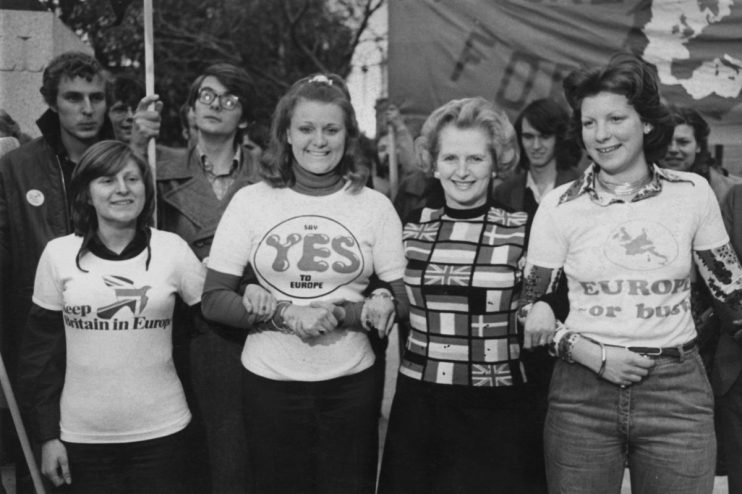
50 years ago today, the British public voted decisively to stay in the European Economic Community. The winning side in a referendum always think they have settled the question, but the 1975 vote proves how wrong they are, says Eliot Wilson
Fifty years ago today, on Thursday 5 June 1975, British voters did something unheard of in the country’s history. They voted in a nationwide referendum. It was held by Harold Wilson’s Labour government to determine, prophetically, whether the United Kingdom should stay in or leave the European Economic Community.
Britain had been a late and awkward arrival at the European party. A decision not to join the European Coal and Steel Community had been taken in May 1950 at a poorly attended cabinet meeting of only eight of 18 members; the Prime Minister, Clement Attlee, and the foreign secretary, Ernie Bevin, were both absent. But the attitude had been summed up in a perhaps-apocryphal remark by the Foreign Office’s Europe expert, Roger Makins. He had told visiting European officials “We’re not ready, and you won’t succeed”.
The 1957 Treaty of Rome transformed the ECSC into the European Economic Community. The UK was invited to the preliminary negotiations but decided again not to participate. By 1961, however, Prime Minister Harold Macmillan decided to apply for British membership, only to be vetoed by President de Gaulle in 1963 in a long statement which never actually used the word “non”. De Gaulle torpedoed a second application in 1967; in 1970, after the General’s retirement, Edward Heath’s Conservative government made it third time lucky. It steered the European Communities Act 1972 through Parliament and the United Kingdom joined the EEC in January 1973.
Europe — this may sound familiar — had been a divisive issue within political parties, more in Labour than among Conservatives. Harold Wilson, having opposed the 1961-63 application then, as Prime Minister, made his own application in 1967, was not deeply committed. As a tool of party management, he had promised renegotiation then a referendum at both general elections in 1974. The government endorsed the UK’s membership but ministers were freed from collective responsibility and could campaign on either side.
A decisive result
Unlike its progeny of 2016, the referendum of 1975 delivered a clear result. “Britain in Europe” was supported by most senior ministers, the new Conservative leader Margaret Thatcher and most of her MPs, her predecessor Edward Heath, the CBI and every major daily newspaper except the Morning Star. Some 17,378,581 voters, 67.2 per cent, preferred to stay in the EEC.
Wilson’s innovative trick had worked in helping Labour navigate a divisive issue. The referendum had delivered a clear result on a specific question: given the renegotiation of the UK’s membership, “Do you think the United Kingdom should stay in the European Community (the Common Market)?”
Since then we have only held two other UK-wide referendums. The 2011 poll on introducing the Alternative Vote saw the proposition rejected by 68 per cent, but the turnout was low and very few people really cared. The other was the Brexit referendum in June 2016, with the consequences of which we are still living.
In legal terms all of these referendums have been advisory and non-binding, though realpolitik meant no government could simply have ignored their results. Some unreconciled Remainers want a second referendum on EU membership, and the Scottish government has sought another poll on independence after 2014. Among the electorate, there is a vague sense of weary anxiety.
Referendums are all but incompatible with parliamentary government, which rests on the assumption that we elect MPs who represent us in Parliament and use their judgement on our behalf. After five years we pass our verdict on their performance, sometimes brutally.
A constitutional impossibility
Enoch Powell, who was wrong about many things but knew intimately how Parliament worked, skewered the issue mordantly in 1972.
“The essence of our own responsible parliamentary democracy is that the Government are held totally responsible to the House of Commons, and the House is held totally responsible to the electorate… if a referendum is held upon a subject in which otherwise the responsibility of government would be engaged, that responsibility is short-circuited… the Administration would then be entitled to confront a complaining electorate and say ‘It is no fault of ours. We would have acted differently, but the question was submitted to you and you decided it otherwise. So it is you, not we, who are responsible.’ That is the reverse route to the true flow of responsibility in our parliamentary system.”
That was the essence of the Brexit referendum and the constitutional sturm und drang which followed. No-one had ownership of the result because responsibility had been abdicated. Our relationship with Europe was regarded as too difficult and too toxic, and politicians – with some exceptions – were too afraid to take a clear, firm stance. Representatives of the people said “Let the people decide” but what they meant was “I’m not going to be responsible for what happens”.
The winning side in a referendum always believes it will settle the question for a generation, while the losers regroup. The 1975 referendum “settled” nothing: it was a snapshot of public opinion, but its use as a padlock on Britain’s membership of the EEC and the EU probably contributed to the swing of the pendulum in the other direction in 2016.
A.V. Dicey observed in 1885 that Parliament cannot bind its successors. Advocates of referendums have tried instead to allow the voters to do that. It has failed spectacularly, and if we need any confirmation of that, today’s anniversary of the confirmation of Britain’s place in the Common Market could not be clearer.
Eliot Wilson is writer and contributing editor at Defence On The Brink