The London taxi trade is dying, and it only has itself to blame

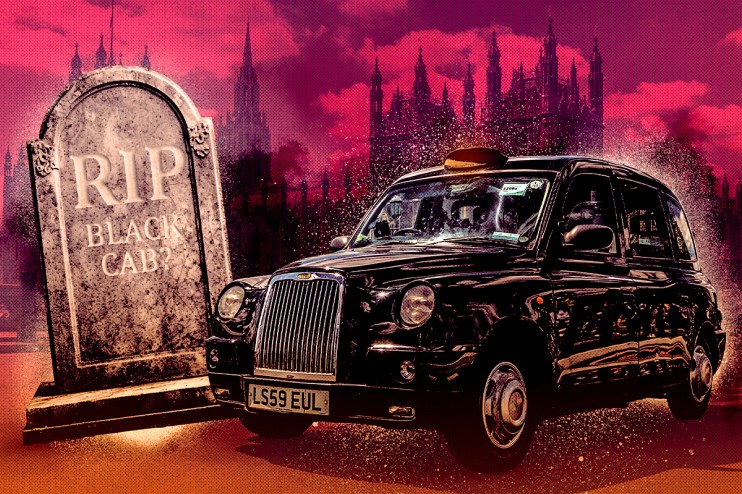
A new report has predicted the demise of the iconic London taxi but it is the cab trade itself – not Uber – that is to blame, writes James Ford
London’s black cab industry is dying. That is the stark warning from a recent report by the Centre for London, which predicts that the traditional London taxi trade could be dead within two decades. The think tank report cites a fall in the number of taxis licensed by Transport for London (TfL) from 22,810 to just 14,525 in the decade between 2013-14 and 2023-24.
It may be almost sacrilegious of me to ask, but should London care?
Being ‘iconic’ is not enough
London’s black taxis (or, more properly, Hackney carriages) are iconic. We know this, in part, because the Centre for London’s report tells us so three times in its introductory page. I doubt anyone would challenge the London taxi’s status as a design icon. However, being iconic is not the same as being competitively priced. Or customer-focused. And it’s a long way from being modern, efficient, technology-enabled or data-driven.
Indeed, the London taxi trade has long struggled with the modern world. In 1831 Section 51 of the Hackney Carriage Act enshrined in law a requirement that London’s cabs had to carry a bale of hay in order to feed the horses that drew them. An eminently sensible regulation, I am sure we would all agree, in the age of horse-powered transport. However, this legal regulation was not changed until 1976, which means that for some 50 years after the internal combustion engine became commonplace, London’s black cabs still had to carry a bale of hay in their boot.
Whilst the English legal code includes many archaic, antediluvian anomalies – for example, it is illegal to shake or beat a carpet (or a rug or a mat) in the streets of London before 8am thanks to the Metropolitan Police Act of 1839 (you have been warned) – the example of petrol-powered taxis carrying a bale of hay in their boot less than 50 years ago is an instructive prism through which to view cabbies’ continued insistence that memorising every street in London is a better system of navigation than just buying a satnav.
London taxis have long ignored the customer
It is tempting to view the decline of the London taxi trade purely as a question of technology versus tradition. But it is perhaps too easy to depict cabbies as the dinosaurs and Uber as the asteroid whose arrival proves to be an extinction-level event. The triumph of the raid-hailing app is merely a symptom. The cause of the cab trade’s demise is actually what the app represents: customer power. And, in many ways, the Centre for London’s report repeats the same mistake that the cab trade has been making for years: it ignores the customer.
For far too long the cab trade has remained an industry run for the benefit of cabbies rather than their passengers
The report’s acknowledgements thank all the ‘usual suspects’ that feature in policy discussions about the cab trade: City Hall, TfL, the Licensed Taxi Drivers Association (LTDA) which represents cab drivers, the London Electric Vehicle Company (which makes black taxis), and taxi app services (in this case Sherbet and Freenow, the latter of which funded the report). No passenger groups or non-cab trade business groups (some 15 per cent of taxi and private hire journeys nationwide are made by people commuting to work) were involved.
Where opinion surveys are cited in this latest report, they invariably gauge the views of current ‘taxi users’ when it would probably be more illuminating to seek the views of the thousands of ‘former taxi users’ that are now customers of Uber (or any of the other private hire ride-hailing apps operating in London). Why a significant number of Londoners no longer patronise black cabs (and what needs to be done to lure them back) is precisely the question the cab trade should be asking, and it speaks volumes that no one thought to use this report to get an answer. Little surprise, then, that the report’s findings focus on supply-side reforms and ignore the vital issue of dwindling customer demand.
If London taxis want to beat Uber, they need to tell us why they’re better
For far too long the cab trade has remained an industry run for the benefit of cabbies rather than their passengers. The trade in London has opted to rely on regulation and protectionism to preserve its privileged position on the capital’s streets. This is not the fault of rank-and-file drivers but a failure of leadership by those who claim to speak for the industry. Unfortunately, scrappage subsidies, tinkering with The Knowledge, a tight turning circle and more taxi ranks are unlikely to save the black cab in a world where it is not only easier, cheaper and more reliable to hail a ride on an app but you can also give the driver a star rating. And lobbying for even higher fares is certainly the wrong approach.
The capital’s cab trade has been far too happy to ask what London can do for cabbies rather than what the taxi trade can do for London. Rather than taking Uber to court, the trade would have been better served to come forward with its own proposals for a radical, customer-focused shakeup of its practices. When trade is slow, drivers should be encouraged to advertise generous discounts on the usual metered fares – effectively inverting Uber’s ‘surge pricing’ model. If declining driving numbers are an issue, why then has the industry done nothing to widen access to its ranks?
According to TfL figures in 2017, just 2.3 per cent of licensed cabbies in the capital were women, 13 per cent were non-white and, for every working cabbie aged under 30, there were three aged over 70. (Indeed, there were a rather impressive 119 cab drivers aged over 80). Every black cab in London is wheelchair accessible (compared to just one per cent of minicabs) but you will hear little of this from the industry’s marketing.
If the death of the black cab is now inevitable, the taxi trade has no one to blame but itself. And any Londoners tempted to mourn will, I imagine, take an Uber to the wake.
James Ford is a public affairs consultant and former advisor on transport policy to then mayor of London Boris Johnson