The pact between Australia, UK and the US is a historic face-off with China and proof of Global Britain

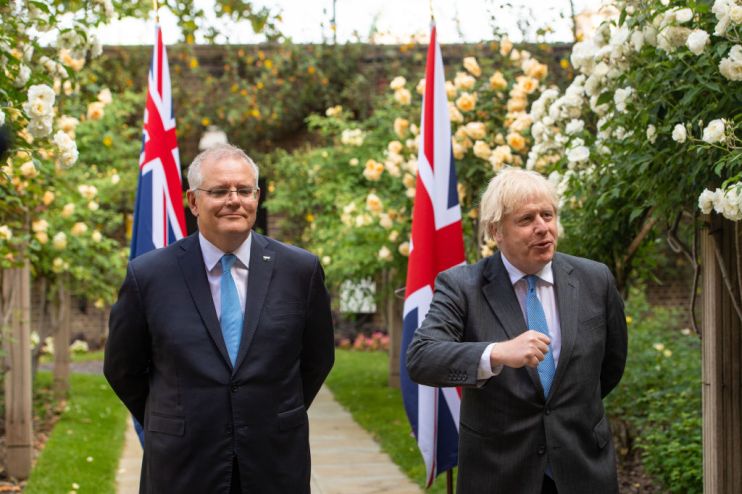
In a joint speech by Boris Johnson, Scott Morrison and Joe Biden, the United Kingdom, Australia and the United States announced a historical pact dubbed AUKUS. It will allow the Royal Australian Navy to construct and operate nuclear-powered attack submarines. But AUKUS is about more than just what powers Australia’s submarines. The agreement also covers the joint development of quantum computing, artificial intelligence and other revolutionary military technologies.
As Sir Stephen Lovegrove, the UK National Security Advisor, said in a speech at the Council of Geostrategy yesterday: “It is perhaps the most significant capability collaboration anywhere in the world in the past six decades.” AUKUS is significant because constructing and operating nuclear-powered submarines is a serious investment of time, resources and political capital. It requires deep and permanent cooperation to work and to have longevity measured not in years but in decades. It requires a great faith and trust between partners in an increasingly polarised world.
Consequently, AUKUS represents the commitment of the three nations to bind themselves into a common endeavour to work permanently together in pursuit of a free Indo-Pacific region in the twenty-first century. The “Indo-Pacific” is a new geopolitical framework, first devised by Japan, but now embraced by many Indo-Pacific democracies; its aim is to shape the region and prevent authoritarian, revisionist powers, such as the regimes in China and Russia, from making aggressive claims on maritime spaces or using their power to shove aside smaller nations.
The pact confirms Australia’s acceptance of a changed geopolitical environment. The Chinese Communist Party’s aggressive behaviour towards Australia has transformed the country’s strategic posture. As the analyst Iskander Rehman puts it, after many years “down under”, Australia is now placing itself “top centre”. With the AUKUS agreement, the Australians have confirmed that they are now stepping up, at significant cost, to underpin the regional order. But they can only do it with help from their British and American allies.
For the United States, the pact reconfirms Washington’s aim to rebalance its global geostrategic posture to focus more on the Indo-Pacific. And for the United Kingdom, AUKUS is the strongest sign yet of the emergence not only of “Global Britain” but also of the British “tilt” towards the Indo-Pacific – the new fulcrum of the global economy and international geopolitics.
With AUKUS, surely nobody can still argue that “Global Britain” is merely a slogan or that the Indo-Pacific “tilt” is just a delusion? When it was bandied around, it was largely seen as a trade mission. A post-Brexit promise to maintain British influence through new economic ties with other countries – even China. This pact a hopeful sign it strikes much deeper and goes to the core of the rest of our obligations.
Over the past year, Britain has undertaken a number of concrete measures to bring its Indo-Pacific ambitions to fruition. Earlier this year, the UK deployed HMS Queen Elizabeth and the Carrier Strike Group to East Asia, as well asa handful of other naval ships to South-East Asia – some for up to five years. There has been a renewed focus on the Five Power Defence Arrangements, and the Five Eyes alliance, as well as a new trade agreement with Japan. This is all part of a strategic plan to exert British influence in the area and prevent autocrats bullying democracies into submission.
Whether or not AUKUS is the final destination for Global Britain or just the start of a new Indo-Pacific era is a mystery to all of us. But close Indo-Pacific allies stand ready, and the UK must not shirk away from engaging with them – even if it means drawing the ire of China.