The state is bad at picking winners. GB Energy will prove that

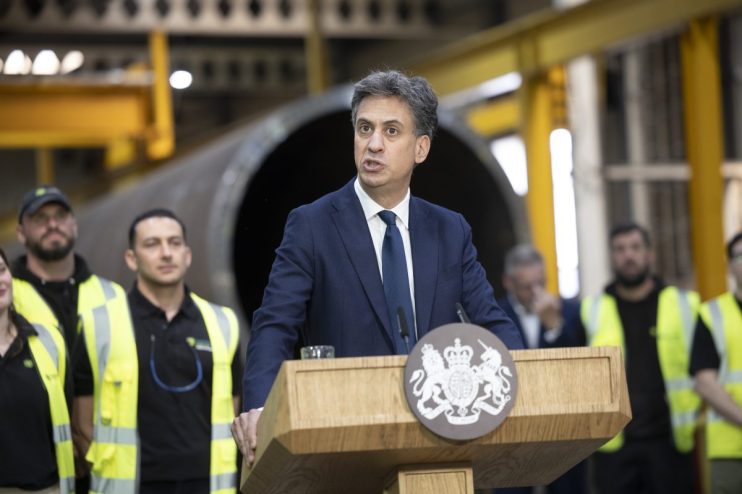
GB Energy makes for good rhetoric, but £8.3bn for this public project means it has a lot to prove, writes Eliot Wilson
He may have failed to become prime minister all those years ago in 2015, but Ed Miliband is a satisfyingly busy man. The Secretary of State for Energy Security and Net Zero last month unveiled the Great British Energy Bill, a short piece of legislation, a slender eight clauses, which will establish a publicly owned company called Great British Energy. This body will have four objectives: boosting “clean energy” supplies; reducing emissions; contributing to greater energy efficiency; and increasing the security of the UK’s energy supply.
Over the course of this parliament, GB Energy will receive £8.3bn in public money – the government calls this “catalysing investment” – although ministers claim, with admirable optimism, that this will result in a further £60bn of investment from the private sector. Stripped of the “laser-focused”, “mission-led” verbiage, however, GB Energy represents a traditional exercise in dirigisme, an expression of belief that the state can and should play a decisive and transformative role in the development of a critical section of the economy.
No-one in Whitehall is careless enough to use the phrase, but GB Energy is a reiteration of the idea that the government can “pick winners” in terms of investing in new and developing technologies. A cursory review of Britain’s post-War industrial history shows that this is at best a dubious proposition: it is hard to argue that British Steel, British Leyland or British Shipbuilders embodied all that was best in British innovation, efficiency and dynamism.
Not only is the state generally slow and unresponsive, as well as immune to the immediate imperatives of profit and loss, but government bodies are peculiarly more susceptible to lobbying and the siren call of “unquantifiable outputs” than the private sector.
This is not to say the state has absolutely no role to play. Governments are critical in acting as prime movers for revolutionary developments of international and historic importance, like the Manhattan Project or NASA’s Apollo programme. (That said, it was state support which created Concorde: a magnificent example of advanced technology but a commercial disaster which ultimately had virtually no impact on civil aviation.)
An argument can be made for the government providing small amounts of initial capital for projects which will have a long-term benefit. This is one of the ambitions of GB Energy, but £8.3bn, even over a five-year parliament, is a substantial sum of money in pursuit of a fiercely contested policy objective.
Moreover, this hefty injection of public capital comes at a time when the government is trimming investment elsewhere, often of much smaller sums which are likely to have a more immediate effect. The Department for Science, Innovation and Technology has cancelled plans to provide £800m for an “exascale” supercomputer at the University of Edinburgh, which would have provided world-leading computing capability for research, science and industry.
It has also scrapped a proposed investment of £500m in an AI Research Resource, which would have created two supercomputers in Bristol and Cambridge. The chancellor, Rachel Reeves, is even reported to be seeking to cut £20m from the support promised to Astrazeneca for a manufacturing plant on Merseyside which makes vaccines against childhood illnesses; there are suggestions that the company could now move its operation to France instead.
Last month, the government also announced it would not provide a £200m loan guarantee to Belfast shipbuilders Harland and Wolff as the struggling firm sought to restructure its operations. The company is now feared to be on the verge of pre-pack administration.
While the exact role and modus operandi of GB Energy are still unclear, the unavoidable impression is of a government which is shedding smaller investment commitments in projects which offer relatively immediate returns in capability and capacity; instead, it is pursuing a much grander strategic role directing a whole sector.
Even if you have drained the last drop of Keynesian Flavor Aid, there is a glaring risk that £8.3bn in public money will not be enough to achieve GB Energy’s goals and that it will fail to “catalyse” the bruited £60bn in private-sector cash. While concrete proposals like supercomputers and vaccine plants fall by the wayside or move abroad, Ed Miliband is in danger of committing substantial public expenditure to chase a “net zero” vibe. Right now, he bears a heavy burden of proof.
Eliot Wilson is co-founder of Pivot Point Group