Skip to content
Saturday 8 August 2026London --:--Frankfurt --:--Zurich --:--
NewslettersSearchEN · DE
MorningWire

European business, markets and politics

FTSE 100
10,901.09
+0.31%
DAX
26,319.45
+0.69%
CAC 40
8,714.93
+0.17%
STOXX 50
6,523.86
+0.33%
  • Europe
  • Markets
  • Business
  • Economy
  • Technology
  • Politics
  • Opinion
More
GermanyFranceBankingAIEnergyFintechPropertyCapital Markets
  • Germany
  • France
  • Europe
  • Markets
  • Business
  • Economy
  • Technology
  • Politics
  • Opinion
  • DE
Thursday 28 November 2024 6:00 am  |  Updated:  Wednesday 27 November 2024 6:54 pm

The truth about wealth inequality

By: Chris Dorrell

Add as a preferred source on Google

The distribution of wealth in the economy has attracted more and more attention among economists following a wealth boom that lasted for four decades.

Between 1980 and 2019, British household wealth increased from three to seven-times national income, as cheap credit helped to fuel consistent rises in house prices.

“For much of the past four decades, Britain has enjoyed an uninterrupted wealth boom,” Simon Pittaway, senior economist at the Resolution Foundation, said.

But new research from the left-leaning think tank suggests that the UK has actually not seen a big increase in overall wealth inequality, making it relatively unusual among rich economies.

In the US, for example, the share of wealth owned by the top one per cent increased by 12 percentage points between 1980-2019, while in the UK the equivalent figure was less than one percentage point.
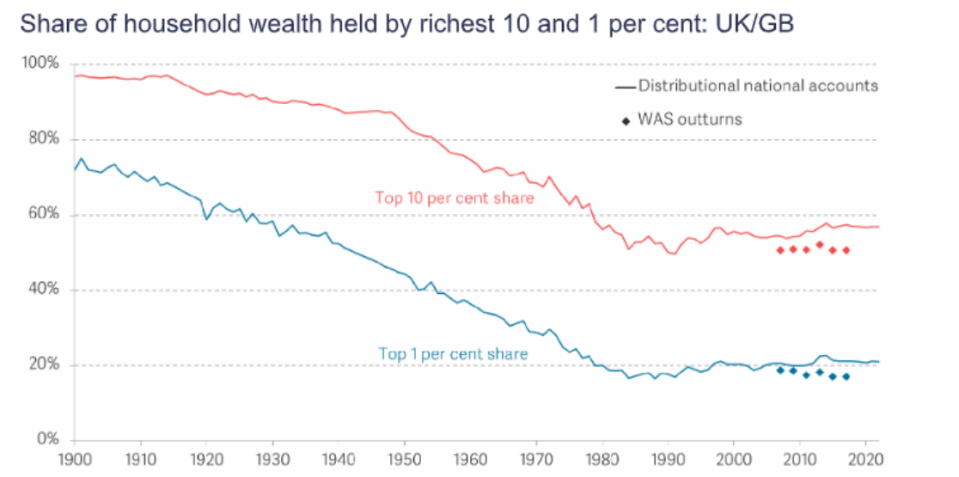
Source: Resolution Foundation

Inequality was “conspicuously stable,” Pittaway said.

Dig a little deeper, however, and the data shows that questions about distribution have not gone away.

While overall inequality has not deteriorated over the years of the UK’s wealth boom, inequality between the generations has worsened significantly.

In 2018-20, average wealth among Britons in their 60s was 55 per cent higher in real terms than among those of the same age in 2006-08, whereas median wealth for those in their 30s was a third lower.

As a result, in 2018-20, the average person in their 60s was nine-times more wealthy than the average person in their 30s, up from four-times in 2006-08.

How could overall wealth inequality remain relatively stable, even as inter-generational gaps widened?

“Greater home ownership has reduced inequality among older households, though later falls in home ownership have widened wealth gaps between them and younger households,” Pittaway explained.

Read more

Burnham opens door to wealth tax

Andy Burnham engaged in discussion with Goalhanger, highlighting key insights and perspectives in a dynamic news setting.

In other words, falling inequality within age groups helped to offset the impact of rising inequality between age groups.

That was the state of play on the eve of the pandemic. But this trend was brought to a halt by the rapid rise in interest rates. From December 2021, the Bank of England hiked the benchmark Bank Rate rising from near zero to a peak of 5.25 per cent last summer.

This had a big impact on household wealth. Between 2021 and 2023, household wealth fell from eight to six-times national income – with a peak-to-trough fall of £2.6trn in cash terms.

Just over three-quarters of this came as a result of the fall in assets underlying pension valuations, such as government bonds.

“Because this is largely concentrated in Defined Benefit schemes, recipients won’t be materially worse off due to their lower pension wealth,” the report noted.

Nevertheless, it still means that the typical household wealth of someone in their 60s has fallen by 16 per cent between 2018/20 and 2024, from £470,000 to £390,000. For someone in their 30s, in contrast, typical wealth has increased by 17 per cent over the same period, from £50,000 to £59,000.

This means the gap in typical wealth between the two age groups has shrunk by £86,000 in real terms, to its smallest level in more than a decade.

Still, the Resolution Foundation cautioned that the transfer of wealth between generations would be a key determinant of how wealth inequality progresses from here.

Martin Haq, chief executive of abrdn’s financial fairness trust, suggested that inequality would likely increase as gifts from older generations “cascade down”.

“Not only are the wealthiest more likely to receive an inheritance or gift but they also gain larger sums. The richest fifth were three-times more likely to receive an inheritance of over £100,000 than those in the bottom fifth.”

“Such windfalls can be critical in determining who is able to step onto the housing ladder,” Haq added.

Read more

Surely Gary Stevenson is smart enough to know a wealth tax won’t work?

Gary Stevenson speaking at a Patriotic Millionaires event, addressing wealth inequality and economic reform proposals.

Share this article

  • Facebook
  • X
  • LinkedIn
  • WhatsApp
  • Email

Similarly tagged content:

Sections

  • News

Categories

  • Economics

People & Organisations

  • inequality
  • Inheritance Tax
  • Resolution Foundation
  • UK economy
  • wealth

Trending Articles

  • WPP slashes jobs as revenue continues to fall

  • Liverpool owners tipped to sell – but not to Amazon boss Bezos – by former CEO

  • Revolut founder’s wealth set to balloon amid talks of share award at $500bn valuation

  • Starling plans to ‘come out swinging’ in diversification bid

  • As it happened: Stocks rise despite new tensions in Strait of Hormuz; Oil price climbs

More from Morning Wire

  • Burnham opens door to wealth tax

    Tax
    Andy Burnham engaged in discussion with Goalhanger, highlighting key insights and perspectives in a dynamic news setting.
  • Surely Gary Stevenson is smart enough to know a wealth tax won’t work?

    Opinion
    Gary Stevenson speaking at a Patriotic Millionaires event, addressing wealth inequality and economic reform proposals.
  • Here’s an idea for you Gary Stevenson: a 0 per cent wealth tax

    Opinion
    Gary Stevenson debates economist Dr Kristian Niemietz on wealth tax issues during a live event.
  • Schroders sells financial planning arm as it accelerates high net-worth shift

    Investing
    Schroders office building exterior with modern architecture and company logo prominently displayed in a business district ...
  • The Rest Is… for the Treasury: Gary Lineker backs wealth tax for rich

    Sport Business
    Gary Lineker in a suit and tie, smiling with glasses and a goatee, against a blurred background.
  • We should all get behind this wealth tax

    Opinion
    LONDON, ENGLAND - JUNE 01: A general view of a house along Kensington Palace Gardens, which has been named as Britain's most expensive street on June 1, 2011 in London, England. Many of the mansions are occupied by billionaire businessmen, embassies and ambassadorial residences. (Photo by Oli Scarff/Getty Images)
  • Britain has the lowest level of millionaires since the financial crisis – and that’s no accident

    Opinion
    Experts believe an exit tax could stem to flow of wealthy residents leaving the UK
  • Rathbones suffers near £1bn net outflows as it braces for FCA probe fallout

    Investing
    Business professionals in formal attire engaged in a lively discussion at a corporate meeting in a modern office setting.
MorningWire

Independent European business, markets and political news for decision-makers.

Morning Briefing

Europe

  • Germany
  • France
  • Europe
  • UK & Ireland

Business

  • Markets
  • Banking
  • Technology
  • Energy
  • Property
  • Fintech

Editorial

  • Opinion
  • Editorial Policy
  • Corrections
  • Contact

Company

  • About Morning Wire
  • Privacy Policy
  • Terms of Use
  • Cookie Policy
© 2026 Morning Wire Ltd · Published by Morning Wire Media, Bahnhofstrasse 65, 8001 Zürich, Switzerland
Privacy · Terms · Cookies · Facebook