The UK film industry isn’t ready for AI animation

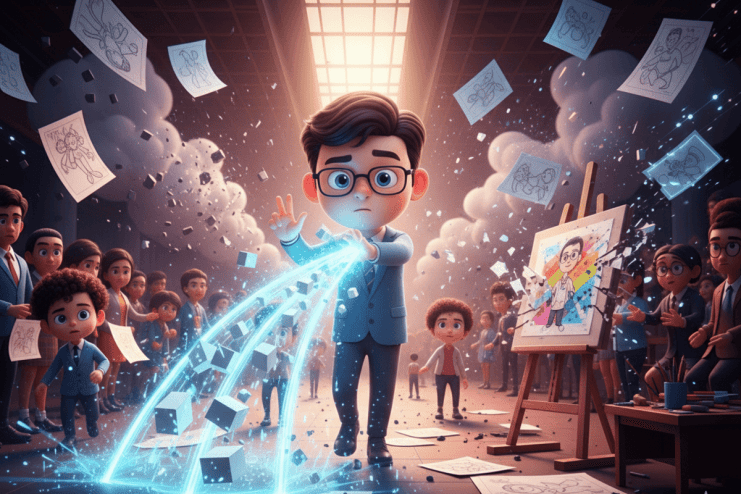
Critterz is a fully AI-generated animated film made for a fraction of what Disney or Dreamworks would spend on a comparable feature, says Paul Armstrong
OpenAI has chosen film as the next showcase for what its models can do, backing Critterz, a fully AI-generated animated feature scheduled for release in 2026 and aiming for a premiere at Cannes. The reported production budget is under $30m, a fraction of what Disney or Dreamworks would spend on a comparable project. The message is clear: generative systems are going beyond the writers’ room faster than people predicted, and it’s not just Hollywood that should be worried. Businesses have an interesting role to play here.
Budgets tell the real story. Disney’s Elemental cost around $200m. Dreamworks’ Puss in Boots: The Last Wish came in at close to $90m. If Critterz reaches global distribution at one-tenth the cost of a Pixar feature, the attraction for investors and studios will be undeniable. Animation has always been a high-margin but high-risk category, dependent on long pipelines, complex rendering and vast teams of artists. Compressing those workflows through AI shifts the balance of power inside Hollywood, with studios less reliant on armies of specialists and more reliant on engineers managing synthetic production pipelines.
The attraction isn’t just outlay. AI pipelines promise tighter control and repeatability. A feature could be localised for multiple markets in parallel, swapping dialogue, lip-sync, and cultural references at minimal cost. Sequels or spin-offs could be built in months rather than years. To a studio accountant, this is a dream scenario: higher utilisation of assets, faster monetisation of IP, and fewer delays from creative or contractual bottlenecks. For VFX artists, voice actors (but maybe not the ones Critterz uses) and animators, it looks like more time will be spent with lawyers, if they get called.
Audiences may not reward efficiency as a feature in its own right. Hollywood is famed for thrilling audiences with technical prowess. The cycles of 3/4D this and that, or motion-capture fatigue, suggest that audiences reward originality and narrative quality, not internal economics. Early reactions to Critterz teaser footage suggest visual spectacle is possible, but ‘questions’ remain on coherence, tone and emotional connection. Efficiency may win headlines, but it sure doesn’t guarantee box office returns, or awards.
For businesses outside entertainment, the lesson to learn is about signalling. OpenAI isn’t building a sustainable studio. Altman and co are building a proof-of-concept for global media, designed to demonstrate to executives in advertising, corporate training, education and gaming that generative models can deliver long-form content at a fraction of the cost. Even a middling box office performance becomes a powerful sales pitch for AI-driven media pipelines across dozens of other industries. Just pay right here, get hooked, and boom, repeating revenue for years.
The strategic challenge for agencies and production firms is immediate. Clients will not wait for Cannes if the numbers look compelling. A marketing director who sees an AI feature produced for a tenth of the usual price will ask why training videos, branded shorts, or campaigns should still be commissioned through human-heavy pipelines. Agencies that survive will embrace hybrid workflows that feature generative efficiency combined with human creativity, rights management and cultural insight. Agencies that cling to manual production models will see margins squeezed as platforms automate both creative and distribution.
Governance risks are, of course, yet be resolved, but are in motion. Training data for generative models includes billions of copyrighted assets, raising questions of ownership and liability. If an AI-generated character resembles an existing design or dialogue mirrors a known work, who carries responsibility: the model creator, the producer, or the distributor? Regulators are already signalling interest in disclosure requirements, provenance standards, and ethical rules for synthetic media. Businesses entering this space must assess not only creative potential but legal terrain. Reputational damage from governance failures could erase financial savings. Will big tech’s ‘pay the fine, do the crime’ attitude work with Hollywood? So far it has.
Democratisation of storytelling?
Arguments in favour of AI-generated films often frame them as democratisation of storytelling, giving smaller studios and independent creators once reserved for billion-dollar firm tools. Obviously, that framing is attractive. The counterpoint is a little sharper: democratisation at the top of the funnel will likely hollow out thousands of skilled jobs, concentrating revenue in the hands of a few technology providers and distributors. More stories may be told, but the economics will benefit fewer players.
The UK has positioned itself as a global outsourcing hub for VFX and animation, with clusters in Soho, Pinewood and Cardiff supplying labour-intensive services to US studios. Thousands of jobs depend on that pipeline. If AI lets US studios collapse production pipelines back in-house, the UK loses export earnings and undermines one of its most globally integrated creative clusters. Subsidies like BFI funding and tax relief that the film industry gets only compound the issue. No headcount, no subsidies. Although these will go to emerging industries like gaming, AR, and immersive content where human skills still matter. Talent drain is also a big issue for the UK, but then it’s hard to find an industry where that’s not the case right now.
Jamie Denman, CEO of Sliced Bread Animation, and animation industry veteran believes this offers creatives an opportunity too; “Hollywood has always been a battlefield between creativity and finance, and AI redraws the map. If a $30m feature can rival a $200m Pixar film, studios will ask – why spend more? The danger is that filmmaking becomes prompt-based production lines. The opportunity is that AI becomes a tool to strip out costs and free creatives to take bigger risks. Audiences will, as ever, decide.”Readers of ‘What Did OpenAI Do This Week?’ will know that the Cannes premiere is Altman theatre at its best. The real audience isn’t families buying tickets but executives, investors and policymakers. OpenAI isn’t dabbling in cinema, it’s detonating a signal flare. Critterz is not about Cannes or box office glory, it’s about proving that generative AI can gut the cost structures of one of the most entrenched creative industries on earth. The same playbook that’s hitting advertising, training, education and beyond. For the UK, that means a cornerstone export sector is staring down obsolescence. For global business leaders, it’s a blunt warning: synthetic media is no longer speculative. If you’re still debating whether AI belongs in your pipeline, you’re debating the wrong thing and are now behind.