They’re already a way of life for tens of thousands of people, but are water cities the answer to climate change, rising sea levels and the housing crisis?

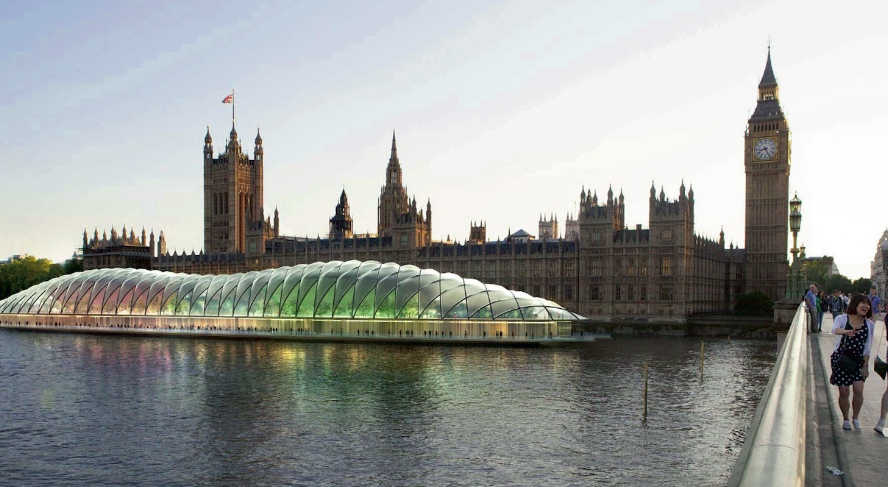
How do you solve a problem like the Houses of Parliament? The neo-Gothic palace, parts of which are nearly a thousand years old, is crumbling and MPs voted recently to decant to another building for around six years – most likely to nearby Whitehall – while refurbishment works are carried out. So far, so pedestrian.
But one of the world’s largest architecture firms, Gensler, has a far more eye-catching solution. The MPs wouldn’t have to travel far, as Gensler’s proposed modular structure would sit adjacent to Parliament on the River Thames alongside the existing Member’s terrace.
Taking cues from the hammer-beam roof of Westminster Hall, the largest medieval timber roof in northern Europe, the 250-metre long temporary building would be supported by a series of steel platforms, with direct access to the existing central lobby, and it would be a high-tech wooden-framed structure that could house both the Commons, the Lords and all their requisite offices.
The river, they argue, is a natural defence mechanism – though the design does incorporate a number of additional security measures – and it could be built in less than three years across various UK shipyards, then assembled on the river, saving the British taxpayer, Gensler claims, more than £1.8bn, based on the House Committee’s own estimates.
In Uros Floating Village in Peru people craft their island homes from dried totora reeds that grow in Lake Titicaca; they have to rebuild every 30 years because the reeds decompose.
“Once the refurbishment of the Palace is complete, the modular structure could be relocated and adapted to provide a permanent legacy as a Museum of Democracy or, alternatively, a new parliament for an emerging overseas democracy.” This radical proposal was first put forward in 2016 and it hasn’t been taken into serious consideration as yet, but then neither has the refurbishment as a whole.
If commissioned, it would be the first large-scale, high profile example of ‘aquatecture’ in Britain, a concept that’s already firmly established in many other parts of the world – especially in flood-prone regions like The Netherlands.
Unsurprisingly, fishing is both business and a means of survival in remote, water-logged parts of the world, where entire water cities have bobbed into existence. Ganvie in Benin is the largest lake village in Africa. Established around the 17th century, it comprises 3,000 buildings on stilts in the middle of Lake Nuokoué, with a population of around 30,000. With little tourism due to its remote location, the people survive by fishing and use canoes called pirogues to get around.
Migingo, another water-based village in Africa of about 130 people, is on Lake Victoria but is claimed by both Kenya and Uganda who want access to the area’s potentially lucrative fishing rights. Ko Panyi in Thailand is also built on stilts and it’s populated by 2,000 people, descended from just two families. Impressively, the children have even built a football pitch on the water from wood scraps and fishing rafts.
Other similarly impressive water amenities include floating gardens in Kar Lar Ywa in Myanmar, where 100,000 residents live and work from wooden houses on bamboo stilts, and even a floating school for the water community of Makoko in Nigeria, built by design practice NLÉ, although that collapsed in 2016 “due to deterioration resulting from a lack of proper maintenance and collective management.”
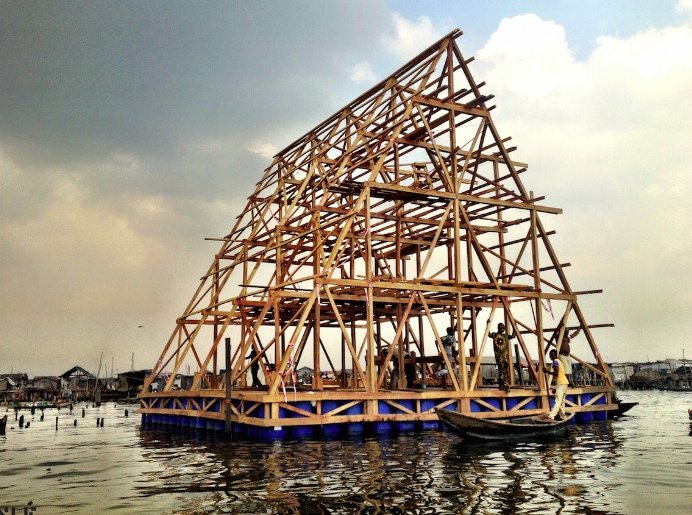
A prototype by NLE in Lagos up close
NLÉ also worked on the Lagos Water Communities project in 2012, a concept from Nigerian-born architect Kunlé Adeyemi, who wanted to transform an existing slum in Makoko that stretched out underneath a busy bridge. The family units were conceived as floating A frames that would work in a similar way to earthquake proof buildings; in this case, their shape would absorb the shocks arising from flooding and rising water levels. The idea was that people would be able to keep their floating community, but with better living conditions in a structure that was built to combat the effects of climate change.
Aquatecture isn’t all wooden houses on stilts, however. Some of these communities are built from naturally occurring materials found in the area, such as Fadiouth in Senegal, where an island is made from thousands of clam shells. Upon this are granaries producing millet for export. There’s even a separate clam shell island for the village’s cemetery. In Uros Floating Village in Peru people craft their island homes from dried totora reeds that grow in Lake Titicaca; they have to rebuild every 30 years because the reeds decompose.
Back in the UK, Baca Architects has been trying to solve London’s housing crisis with a series of concepts involving floating communities on the docks and canals. The Bermondsey-based firm won a competition by think tank New London Architecture to come up with a way of dealing with the shortage of development sites in the capital, with a prototype of a floating home it created in Chichester Canal with another British firm, Floating Homes.
“I know lots of people are thinking about having office accommodation on water and they can be very stable given the right engineering”
It was a prefabricated, split level house with a flat roof that could be replicated along London’s disused docklands, marinas and basins. Previously, Baca has toyed with the idea of a floating, solar and wind-powered Grand Prix circuit and a new floating town, with shops and community amenities, in the Royal Docks. It also built an ‘amphibious’ house on the River Lea in east London, which rises up to 2.8m when buoyed by floodwater.
We won’t just be living amphibiously in the future, we’ll also be hopping onto the water for work. Arlington Business Park in Theale, Berkshire, was developed around a series of man-made lakes created as flood defence. One of them is home to a one-of-a-kind floating meeting room designed by architecture firm TP Bennett in 2015. A challenging engineering and technical feat, the pavilion finally opens for functions this year.
“We wanted to work out how to get activity onto the lake and into the heart of the park,” says Neil Sterling, director at TP Bennett. “We looked at lots of technical considerations until we arrived at a structure that actually floats, so it’s in no way connected to the lake bed. It’s a truly floating structure, although it does connect via a pontoon – a bridge, ostensibly – back to the land.”
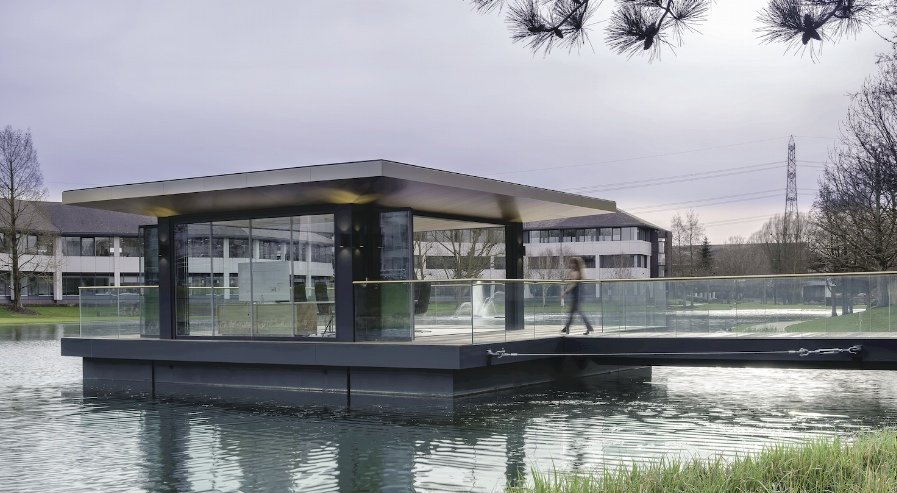
The floating pavilion at Arlington Business Park in Berkshire
Energy is run along this to the pavilion, so it can host PowerPoint presentations and charge as many smartphones as needed out on the lake. The weight of the structure had to be perfectly balanced on top of a custom-made base, so the main timber frame was constructed in three parts off site, then delivered via lorries and craned on top before it was overclad with metal.
“The main design challenge was that the client wanted the structure to be as open as possible,” says Sterling. “Ordinarily on a floating structure you’d expect there to be a degree of solidity on the sides because that’s what you’d see on a boat. On this, we don’t have that, we have four relatively small corner posts, but they have been carefully designed to provide the correct stability to be able to get those 360 degree views.”
Similar to Baca’s amphibious house, the pavilion can rise and fall with the water levels, meaning the lake still serves its intended ecological purpose. “I know lots of people are thinking about having office accommodation on water and they can be very stable given the right engineering,” says Sterling. With land values on the rise and modular construction touted as the answer to unaffordable housing, is our future all at sea?