Three things Star Trek got right about AI

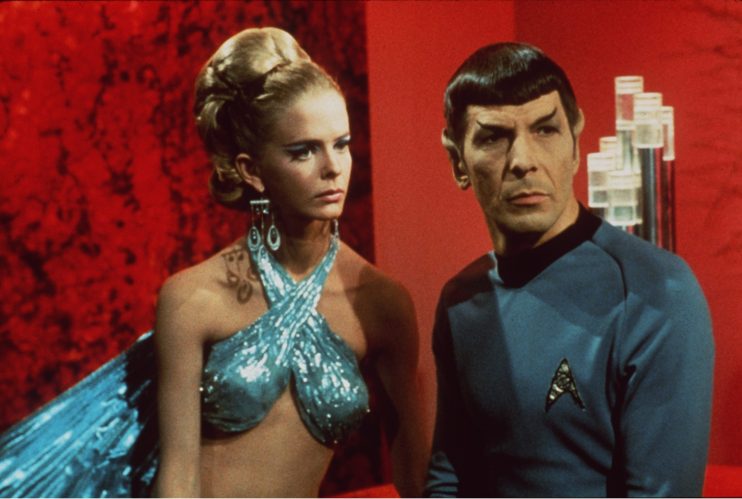
Star Trek either inspired or predicted many of the astonishing developments we live with today, says Lewis Liu
I’m a huge Star Trek nerd, having watched since I was a kid. I’m not alone amongst tech founders – sci-fi remains a core inspiration for us. Elon Musk famously cites the late British sci-fi novelist Iain M Banks as an influence. Apple’s iPad was directly inspired by Star Trek’s PADD.
What’s remarkable is how much Star Trek predicted correctly on tech trends. Technologies the show predicted would take hundreds of years, like touchscreens, video conferencing and mobile communicators, arrived in just 30-50 years. In fact, the mobile revolution was directly inspired by the handheld communicator from the Star Trek: Original Series in the 1960s.
But today’s LLMs are unlocking concepts that seemed even more distant. Here are three related Star Trek ideas that are suddenly becoming real, and the implications are profound.
Ubiquitous voice interfaces
My boys cannot imagine a world without voice interfaces. They talk to Siri, change music with voice commands, ask the car computer trivial questions. Voice is as natural to them as keyboards were for millennials and touchscreens for Gen Z.
In Star Trek, this was standard. The crew gave simple commands by voice, “Computer, tea, Earl Grey, hot” or ran complex data analysis through conversation alone. As a kid watching those episodes, this felt impossibly futuristic.
Today, it’s commonplace. Voice agents are becoming capable enough to handle complex tasks like research and data analysis, not just simple commands.
For technology builders, the implication is clear: voice interfaces aren’t the future anymore. They’re the present. The question is no longer whether to build for voice, but how sophisticated those voice interactions can become.
Digital AI Twins
In the 1989 Star Trek: The Next Generation episode Booby Trap, Chief Engineer Geordi La Forge and the Enterprise face certain destruction unless La Forge can solve an impossible engineering problem. His solution: create a digital AI twin of Dr Leah Brahms, the Enterprise’s original engine designer, by feeding the computer all her public correspondences, logs, writings, and video footage. The simulation helps him save the ship.
What was inconceivable in 1989 is now obvious with LLMs. But what’s most remarkable is how the episode handled both the concept in and of itself (a bizarre sci-fi concept in the 80s) and privacy. When Geordi tries to access Brahms’s private files for a more accurate simulation, the computer blocks him, understanding that context matters for data access. A 1989 TV show was exploring contextual privacy, a concept where privacy is determined by the context of the situation and user permissions to files. This was remarkably prescient given that understanding privacy in context is one of the foundational pieces for getting AI to scale on a personal level.
The implications are profound. Imagine creating digital twins to scale yourself professionally, handling negotiations, answering routine questions, providing your expertise across multiple contexts simultaneously. British sci-fi writer Peter Hamilton envisions exactly this: every human has a digital twin (called an E-Butler in the novels), operating strictly under their control and the contextual privacy constraints of its human principal.
This isn’t just science fiction anymore. Andreessen Horowitz is already creating an investment category around human simulations. As I’ve written previously, knowledge workers face more admin, more context-switching, and less time than ever. Digital twins could revolutionise the workplace by scaling individuals, provided we solve privacy, something Star Trek explored 35 years ago.
IP ownership rights of AIs
In a 2001 episode of Star Trek: Voyager titled “Author, Author,” a sentient AI hologram simply known as “The Doctor” becomes a published author. However, in this fictional universe, AIs lack intellectual property rights, and the publishing company in the episode claimed ownership of The Doctor’s work. In a prescient courtroom drama, The Doctor and his crew argued that he is a sentient being deserving of copyright protection. The judge ultimately ruled that while determining whether The Doctor is truly sentient exceeds the court’s jurisdiction, the legal definition of “artist” should be expanded beyond persons to include AIs.
Remarkably, this scenario is now playing out in real courts a quarter century later. In Thaler v. Perlmutter on behalf of the U.S. Copyright Office (2025), Federal Judge Patricia Millett ruled that copyright law “requires all work to be authored in the first instance by a human being,” meaning works generated solely by AI cannot be copyrighted.
What’s particularly striking is that Judge Millett’s opinion actually references Star Trek, citing another AI character, Data, from The Next Generation, as an example of a hypothetical AI that might qualify as an author, specifically because Data’s intelligence is “comparable to that of a human being.” Judge Millett writes: “There will be time enough for Congress and the Copyright Office to tackle those issues when they arise.”
In other words, current copyright law establishes that only humans can be authors, but the legal system is already contemplating a future where an AI that has achieved human-level intelligence (AGI) could potentially be recognized as capable of authorship. However, this remains a question for Congress to address, not the courts.
Conclusion
Whether it’s something as commonplace as voice interfaces, an emerging category like digital twins, or deep legal questions around AI IP rights (which we haven’t even sorted out for the human creators whose work trained these systems), science fiction like Star Trek remains a testament to genuine human creativity.
One of my close friends was a writer for Star Trek: Deep Space Nine in the late 90s (actually my favorite of the series, and this was before meeting him) as his first job out of Harvard. I often asked him how he thought about the science and technology of the show. The technology, he told me, was often just creative backdrop. The real story was always about how the characters interacted and the societal, ethical or philosophical questions surrounding the technology.
Perhaps that’s what we need to focus on: asking how we humans should interact with our own technological revolution, given we’re on the cusp of the next generation of Star Trek technology.