To defeat our enemies, the West must remember how it won the Cold War

A system that funded defence initiatives while simultaneously delivering prosperity showed up the Soviet Union for what it was. Economic freedom is our most powerful weapon, says Matthew Lesh
How did the West win the Cold War?
This question loomed over European leaders this week as they met at an emergency summit in Paris to devise a response to President Trump’s Ukraine negotiations. The talks between the US and Russia in Saudi Arabia have excluded European leaders and, perhaps even more shockingly, those from Ukraine.
With the US becoming a less reliable ally and shifting its focus elsewhere, Europe is under growing pressure to bolster defence capabilities. But this comes with a big price tag. Supporting Ukraine without the US, perhaps through a peacekeeping force, would be pretty costly. Similarly, bolstering Europe’s readiness to take on Russia, as well as responding to Iran-backed efforts in the Middle East and the global shadow of China’s rise, all come with a hefty price tag.
Domestically, Starmer is under growing pressure to bring forward the undated commitment to boost defence spending to 2.5 per cent of GDP. Trump says that NATO members should spend five per cent on defence, while many struggle to meet the current two per cent target.
Britian is not alone in taking advantage of the post-Cold War ‘peace dividend’. We cut defence spending as there appeared to be fewer threats on the horizon. This money, of course, was not saved. Nor did the size of the state decrease. Instead, successive governments used the dividend to expand the state, with masses of expenditure on welfare and the NHS, which now significantly outstrip defence.
This leaves us in a bind. Various global threats call for defence investment. At the same time, debt is around 100 per cent of GDP, the government has already put up taxes to historic levels, and anything higher can be expected to damage growth aspirations. The pressures on social spending, in an ageing and sicker population are also not going anywhere.
Butter and guns
At this point, it’s important to remember why we were ultimately successful in the Cold War. Of course, our liberal ideas had universal resonance. There was the evil rot at the heart of the Soviet regime and its replicators, resulting in the deaths of tens of millions. But perhaps more than anything else, it was butter and guns. Our economic system won the battle, enabling domestic prosperity and security investment.
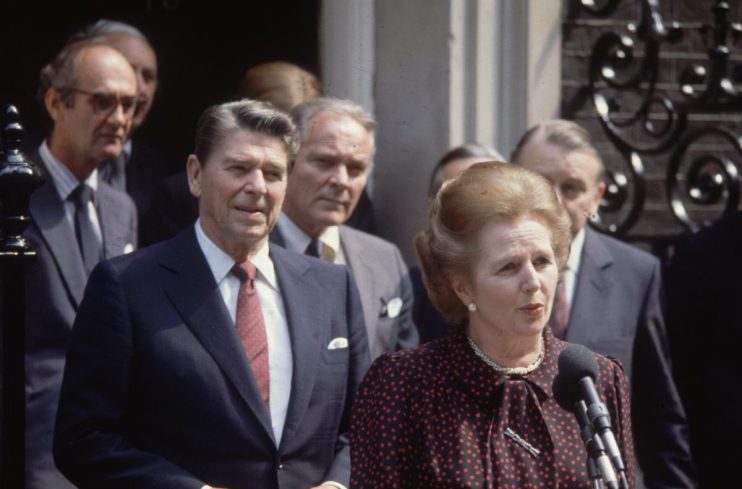
During the 1980s, President Ronald Reagan significantly increased defence spending, particularly on the Strategic Defense Initiative (SDI), often dubbed “Star Wars”. SDI aimed to develop systems capable of intercepting and destroying intercontinental ballistic missiles, to protect the US from a Soviet nuclear attack.
The program faced technical hurdles and failed to materialise (though Trump is talking about bringing it back). Nevertheless, it forced the Soviets to respond by investing disproportionately into defence. In the context of their struggling economy, this was a tall order. It contributed to significant domestic poverty and growing awareness about the failed economic system. So the West’s domestic economies, able to fund defence initiatives while delivering unparalleled prosperity, ultimately outshone the Soviet system.
Whatever comes next, our ability to take on illiberal forces that mean us harm will depend on the strength of our domestic economies
Today’s challenge, from a more difficult fiscal starting point, is the same. Whatever comes next, our ability to take on illiberal forces that mean us harm will depend on the strength of our domestic economies. This matters not only to signal to the world the superiority of democracy for our citizens but also to invest in the defence to keep us secure.
Unfortunately, we are far from that desirable position, particularly in Europe. We have seen years of economic stagnation and relative decline. We have strangled innovative industries in red tape, driving investment elsewhere while blocking housing and infrastructure development and expanding the welfare state into unsustainable territory. Addressing these issues, getting our economic house in order, is key to defeating our enemies.
Matthew Lesh is Country Manager at Freshwater Strategy and a Public Policy Fellow at the Institute of Economic Affairs