Today’s date echoes through history – Starmer should be worried

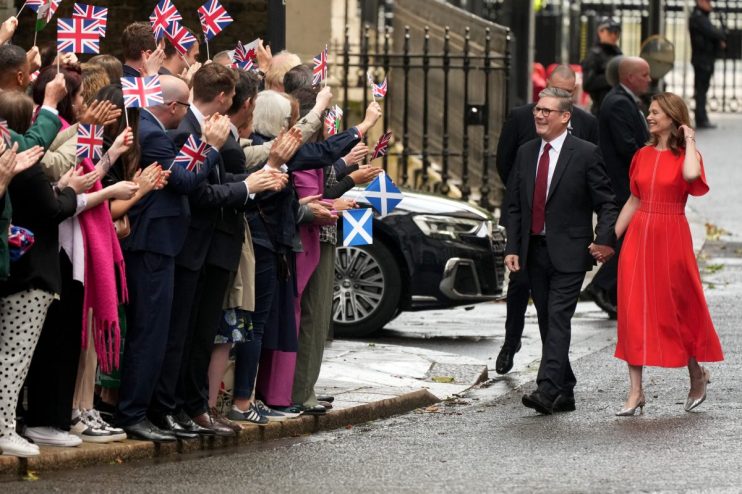
The fourth of July may be synonymous with freedom in the United States, but around the world it has a very different meaning. In Britain it marks the anniversary of Starmer’s election victory, but he’ll probably be hoping to put this disastrous year behind him, says Eliot Wilson
The United States of America was established on 2 July 1776. The Second Continental Congress, meeting in the Pennsylvania State House in Philadelphia, agreed a motion tabled by Richard Lee of Virginia, and resolved:
“That these united colonies are, and of right ought to be, free and independent States, that they are absolved from all allegiance to the British crown, and that all political connection between them and the state of great Britain is, and ought to be, totally dissolved [sic].”
John Adams, the Massachusetts delegate who seconded the motion, wrote to his wife that 2 July “will be celebrated by succeeding generations as the great anniversary festival”. But the Declaration of Independence, the new nation’s 1,331-word manifesto, was only approved and sent to the printers on Thursday 4 July: that date, somehow, became America’s commemoration.
Adams was the first Vice-President of the United States (1789-97) then succeeded George Washington as the second President (1797-1801). He had been part of the Committee of Five which had drafted the Declaration of Independence, but the genius behind its composition had been Virginia lawyer Thomas Jefferson. He became Adams’ vice-president, then succeeded him as 3rd President of the United States in 1801.
On Independence Day, 1826, the 50th anniversary of the birth of the United States, at 6.20 pm, John Adams, by then 90, suffered a heart attack and died. The 2nd President’s last words, either reflective or rueful, were “Thomas Jefferson survives”.
But Adams was wrong. At around 12.50 pm that afternoon, the 83-year-old Jefferson, ailing and having refused laudanum from his physician, had died. His last words that anyone could make out were “Is it the Fourth?”
The sitting president in 1826 was John Quincy Adams, son of John Adams. He referred to the death on the same day of his predecessors as “visible and palpable remarks of Divine Favor”. One wonders what he made of the fact that five years later, again on the Fourth of July, the 5th President, James Monroe, succumbed to tuberculosis and heart failure.
Five deaths on Independence Day
Three of the first five presidents all dead on Independence Day, two the same year: it makes you look again at coincidence, no matter what the hard-headed statisticians say about its likelihood. Perhaps America should have marked 2 July after all. But it has freighted that date ever since with heavy symbolism, as anyone who has indulged in a mawkish but satisfying thrill watching Roland Emmerich’s Independence Day (1996) will attest.
Sometimes the day has carried that whiff of progress and emancipation. In 1832, William IV granted Royal Assent to the Durham University Act which formally recognised England’s third university after Oxford and Cambridge (though UCL and King’s make their own claims).
It was also on 4 July, in 1947, though minds may not have been on the United States, that the Prime Minister, Clement Attlee, presented a bill in the House of Commons “to make provision for the setting up in India of two independent Dominions”. The Indian Independence Act 1947 gained Royal Assent only a fortnight later: the clock had long been ticking for the Raj.
The fourth of July is freighted with heavy symbolism, as anyone who has indulged in a mawkish but satisfying thrill watching Roland Emmerich’s Independence Day (1996) will attest.
Freedom comes in many forms. At midnight on Sunday 4 July 1954, nine years after the Second World War had ended, food rationing was finally ended in Britain. First introduced at the beginning of 1940, it had slowly dwindled to only a few restrictions, but it was only in 1954 that meat and bacon were finally freely available. Butter, margarine, cooking fat and cheese had come off the ration in May.
Sometimes, of course, it is difficult to discern the significance of events at the time. On 4 July 1918, as the First World War was grinding to its conclusion, Crown Prince Mehmed Vahideddin resolved the decision over which he had agonised all night, and confirmed he would accept his deceased half-brother’s crown. As Mehmed VI, he became the 36th Sultan of the Ottoman Empire and 115th Caliph of Islam. (Some flickering footage of his enthronement ceremony at the Topkapı Palace survives.)
Seeing monarchies collapse in Germany, Austria-Hungary and Russia, Mehmed desperately tried to shore up the Ottoman sultanate, but he had met his match in the nationalist leader Mustafa Kemal Pasha. The sultan was deposed in 1922 and Mustafa, now remembered as Atatürk, soon became President of the Republic of Turkey.
In Britain, a year ago voters went to the polls in the general election; or rather, 59.7 per cent of us did. With the exception of 2001 (59.4 per cent), it was the worst turnout since 1918. But Sir Keir Starmer’s Labour Party won a majority of 174, its second-biggest ever. That Fourth of July has not obviously brought unbridled freedom – the Prime Minister must be hoping to put his first year behind him.
Eliot Wilson is a writer