Trump, tariffs and GDP: How do you forecast uncertainty?

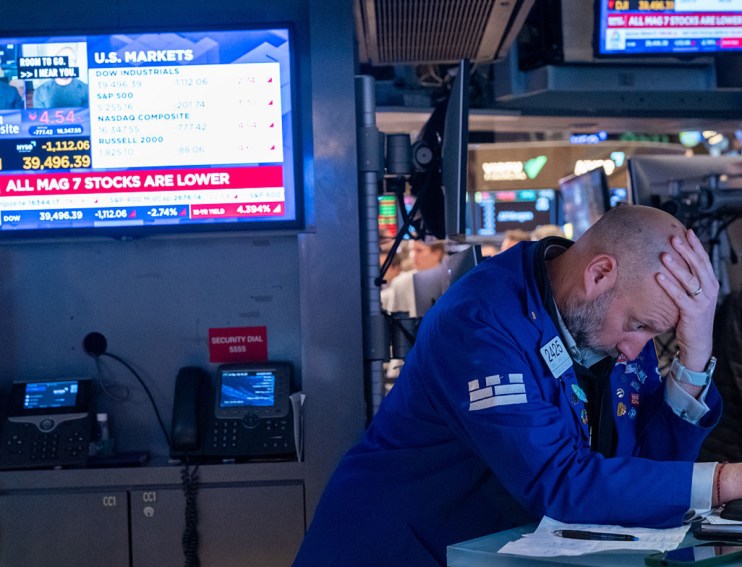
The Office for Budget Responsibility (OBR), one of the UK’s central forecasters, prepared itself for President Trump’s tariff war – or at least partially.
At a presentation after Chancellor Reeves’ Spring Statement, OBR chair Richard Hughes admitted the fiscal watchdog’s central forecast risked being completely undermined by global events.
Hughes came up with three possible scenarios for what Trump could announce and how much pain the UK economy would suffer. In one scenario, where the UK was slapped with 20 per cent tariffs on all of its exports to the US, output would take a hit of over 0.5 per cent.
Just two weeks later, Hughes could not be more wrong – and more correct.
Nothing even close to what Hughes set out in his scenarios has materialised over the last week and a half. And indeed, the central forecast is now of no bearing whatsoever to policymakers and businesses.
“That forecast is irrelevant after what we’ve seen over the last two weeks,” Kallum Pickering told Morning Wire.
“The world has changed its way. It’s not even worth paying attention to economic data that is telling you about the economy before the US dramatically escalated tariffs. It’s just redundant.”
Economists must now make do with what they’ve got: targeted tariffs on China, Mexico and Canada; a 90-day pause on “universal” tariffs of ten per cent tariffs on major economies including the UK; and a Truth Social account that can come out with anything at any second.
The key challenge for forecasters is to model uncertainty. On the face of it, the task seems to be impossible.
Some economists have confronted the challenge head-on, long before Trump was even elected in November. Dario Caldara’s trade policy uncertainty index, for one, has found fresh relevance among economics wonks as it has provided an indication of how far business investment is likely to be affected.
But policymakers, particularly rate-setters at the Bank of England, have little time to play around with numbers.
Former Monetary Policy Committee member Michael Saunders suggests forecasts will still lie on shaky territory come May, when current members will meet and come to a new interest rate decision.
“Whatever forecast you end up with is going to be pretty conditional on tariffs that follow a certain path and whether you know what the effects on economies of the changes in tariffs are going to be. Both of those are pretty uncertain,” he told Morning Wire.
Head scratching over tariffs
President Trump’s tariffs have supercharged the current fog of uncertainty dogging forecasters.
Last Friday, economists polled by Reuters and Bloomberg were wide off the mark in estimating GDP figures for February – growth of 0.5 per cent smashed the forecasted growth of 0.1 per cent.
These kinds of errors can be consequential. Over a longer period of time, City analysts’ data estimates weigh heavily on the likes of the OBR, whose advisers come from many of these firms. And Reeves’ entire Autumn Budget rests on what the OBR decides to pencil in for the UK’s economic outlook over next few years. Her fiscal rules, as well as the introduction of a new law last July that mandates the OBR to judge any major spending announcement, could hardly give the government’s fiscal watchdog more power.
The Bank of England and the OBR are also working with slightly dodgy data. The Bank’s chief economist slammed the Office for National Statistics (ONS) for how it has handled its Labour Force Survey (LFS) crisis, while the government, recognising the problems posed by delays to data, have opened a probe into the ONS’ operations.The Resolution Foundation is now proudly using alternative data based on HMRC’s payroll figures to calculate productivity levels.
In a profession where evidence is king, economists are working through one of the toughest environments seen in a long time. Meanwhile, policymakers will now have to decide whether they will take a brave step and plunge into the unknown, or wait for convincing data to emerge.
There may be a dividing line being drawn within the MPC.
Clare Lombardelli and Sarah Breeden have suggested that the effects of tariffs on inflation remained unclear while their colleagues Swati Dhingra and Megan Greene have said that they will be deflationary. The latter is the most common view of economists who are not rate-setters and thus able to speak more freely.
There is an underlying – and growing – frustration with the work of forecasters. Prime Minister Keir Starmer this week suggested the OBR was wrong to ignore the possible benefits of welfare cuts to the labour market.
“The OBR has scored nothing against any change here [to welfare]. The assumption is that not a single person changes their behaviour,” said Starmer said,
“I personally struggle with that way of looking at it, because I do think these measures will make a material difference.”
While Starmer and Reeves may not have quite matched standards set by former prime minister Liz Truss’ standards for bashing the OBR, it is worth stating that former Chancellor Jeremy Hunt has also clashed with the fiscal watchdogs on multiple occasions. At some point, one wonder whether the OBR will begin to face existential questions if clashes persist.
Similar challenges may lie ahead for the MPC. A column in The Times by Patrick Maguire suggested that some within the Labour Party were questioning its purpose.
There are things forecasters simply cannot predict – the clue is in the definition of the word. But amid such unpredictability, forecasters now face the challenge of looking ahead to situations where nothing can be ruled out.