Trump’s protectionism is a threat to freedom

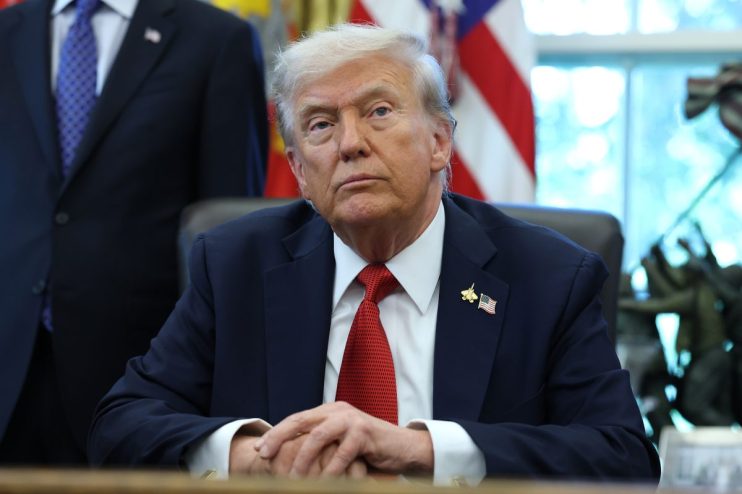
Donald Trumps approach to Vietnam reveals the conflict of interest between his trade policy and his private business interests, says Rainer Zitelmann
Donald Trump has said it time and time again: “To me, the most beautiful word in the dictionary is tariff. It’s my favorite word.” Over the years, Trump has expressed opposing opinions on just about everything. He has called for a massive one-time tax on the rich and universal health insurance provided by employers with subsidies for those in need – only to later advocate exactly the opposite. Between 1999 and 2012, Trump switched political parties seven times. Only in one respect has Trump remained true to himself: on the issue of tariffs. He used to blame the Japanese and the trade deficit with Japan for America’s economic problems. He has successfully garnered voter support by alternately blaming the Japanese, Germans, or Chinese, highlighting the negative US trade balance and calling for higher tariffs.
Why do politicians like Trump promote protectionist rhetoric when all historical evidence shows that no country has ever become more prosperous through protectionism? There are many possible reasons: economic ignorance (a phenomenon among representatives of all parties); the experience that protectionist promises can win votes; and the influence of lobbyists representing companies looking to shield themselves from foreign competitors.
But there is another significant motive, particularly for Donald Trump: tariff policy is a tool that can be used by politicians to their own personal advantage. Like many government regulations, arbitrary tariff policies make politicians very powerful, allowing them to raise tariffs at will or, in return for appropriate concessions, lower them again. In their paper, “Hayek versus Trump. The Radical Right’s Road to Serfdom,” British economists Aris Trantidis and Nick Cowen issue an urgent warning about the danger of tariff policy leading to the erosion of political freedom and market capitalism: “If partial-discriminatory allocations become typical, economic actors may find it impossible to operate outside the reach of the politicized economy and to avoid the exercise of coercion that it entails. At that point, partial-discriminatory interventions generate not simply a state-controlled economy, but a politically controlled society where economic actors can be identified, targeted, rewarded, or discriminated against on political grounds. If the allocation of opportunities is systematically controlled by a single political force that determines how the government distributes resources, social groups find themselves tied into a relationship of dependency which, instead of violence, uses partial-discriminatory allocations as socioeconomic sanctions that force citizens to show political loyalty and to abstain from strong demonstrations of dissent.”
Suspicious links?
The suspicion of a link between Trump’s tariff policy and personal business interests is conspicuous in the case of his approach towards Vietnam. In early April 2025, Donald Trump issued a threat to impose punitive tariffs of up to 46 per cent on Vietnam’s exports to the United States as part of his new trade policy. Renowned economist Mark Skousen commented: “When Vietnam was hit with a bizarre 46 per cent tariff on its exports to the United States, the government there countered by offering a zero per cent rate between both countries – and Trump turned it down. This failure to accept a true free-trade agreement by Trump is especially galling, to punish a former enemy that has adopted market capitalism and finally escaped the evils of communism”. This example also shows that the argument put forward by Trump’s defenders, that his threat of high tariffs actually serves only to reduce tariffs as much as possible on both sides, is nonsensical.
At the same time, Vietnamese authorities were negotiating with the Trump Organisation about a large-scale golf and real estate project. Approval for the project, worth around $1.5bn, was granted by the Vietnamese government in May 2025, and came remarkably quickly during a period of intense trade tensions with the US. Just a few weeks later, Trump publicly changed his stance toward Vietnam. In early July 2025, he revealed that Vietnam would not have to pay the threatened 46 per cent tariffs after all. Instead, a deal was announced for flat tariffs of approximately 20 per cent. This reduction was portrayed as the outcome of successful negotiations. Critics point out that the timing of the tariff threat, the approval of the resort project, and the subsequent tariff reduction at the very least create the impression of a conflict of interest. The Trump camp refutes any connection, but the case serves as an example of the potentially blurry lines between government trade policy and private business interests.
The impacts of protectionism therefore extend beyond economic damage and also involve significant political dangers – including, potentially, the erosion of the rule of law.
Rainer Zitelmann is author of the books THE POWER OF CAPITALISM https://the-power-of-capitalism.com/ and HOW NATIONS ESCAPE POVERTY https://nations-escape-poverty.com/