Trump’s tariff madness is based on anti-capitalist zero-sum thinking

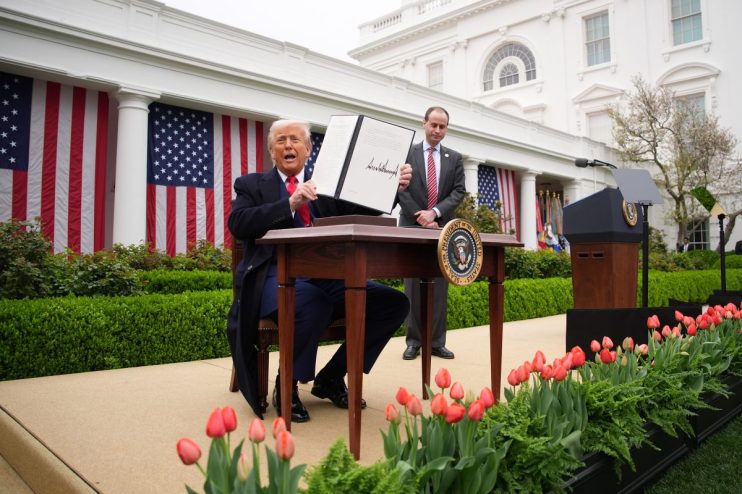
What is the real reason behind Trump’s punitive tariffs? Two beliefs that have frequently wreaked havoc in the past, writes Rainer Zitelmann
Throughout history, absurd economic theories have repeatedly caused immense damage. From Marxism to other forms of anti-capitalism, these ideologies have plunged numerous countries into poverty. But rarely have economic zero-sum beliefs and scapegoating caused such economic carnage in such a short space of time as in the few days since Trump’s “Liberation Day”.
For zero-sum thinking and scapegoating are the basis for Trump’s tariff policy.
What is zero-sum thinking?
Zero-sum thinking refers to the fallacy that in the economy, one person’s gain is always another person’s loss. It is a belief anti-capitalists are profoundly convinced of, and Trump is too. He cannot imagine that free trade benefits both sides; for him, one party’s gain is another party’s loss.
Zero-sum thinking is often linked to scapegoating, whereby politicians in one county blame their own internal problems on other countries. This is a popular narrative in countries such as Russia, Venezuela, Cuba, North Korea, and Iran, where rulers attribute their countries’ problems to sanctions imposed by the West. Similarly, many African nations blame historical colonialism for the fact that they are poor today.
Donald Trump has exhibited a pattern of shifting political beliefs throughout his life. In the early 1990s, for example, he supported reversing Ronald Reagan’s tax cuts and raising the top tax rate to between 50 and 60 per cent. During his time as a candidate for the “Reform Party”, he endorsed policies typically associated with the political left, including a one-off tax on the wealthy and employer-funded universal health insurance.
However, despite all the changes in Trump’s political convictions, one of the few constants in Trump’s beliefs is that other countries are to blame for problems faced by the United States. In the 1980s, he criticised Japan for the US trade deficit, accusing them of unfair trade practices and flooding the United States with automobiles. Later, he aligned himself with the views of the economist Peter Navarro, who, in his book Death by China, blamed the Chinese for problems in the US. Navarro became Trump’s trade advisor but, after the disaster caused by the tariffs Navarro recommended, he has since been forced to take a backseat role.
A case study: Vietnam vs Nepal
Whether a country looks for the root cause of its economic problems in itself or in others can have a decisive impact on its economic success. A comparison can be made between two Asian nations I have studied extensively: Vietnam and Nepal.
In the 1980s, Vietnam was the poorest country in the world, surpassing all African nations in terms of poverty. If the Vietnamese had succumbed to scapegoating, they could have blamed their poverty on Americans or even the French, Japanese or Chinese, all of whom had waged war on their country. But they did not. They understood that their centrally planned economic system was to blame. So, at the end of the 1980s, they introduced private property rights and opened up their country. Today, Vietnam boasts one of the most open economies in the world and the poverty rate has fallen from 80 percent to just three percent.
In stark contrast, Nepal has an average annual income of 330 US dollars and is the second poorest country in Asia after Afghanistan and one of the 10 poorest nations worldwide. Trump should love Nepal, because it is hard to find such high and so many tariffs anywhere else on the planet, some of which exceed 300 per cent. A BMW X5, for instance, costs the equivalent of around 450,000 US dollars in Nepal due to high import duties and taxes. There are long lists of goods that no one is allowed to import in order to protect Nepal’s economy. The country’s leaders espouse Maoist ideologies and subscribe to zero-sum beliefs and scapegoating. Supposedly, other countries are to blame for Nepal’s problems.
Trump’s finger-pointing is absurd
The American economist Mark Skousen dismissed Trump’s claims that the United States is being exploited by other countries as absurd: in response to the criticism that the US has “suffered from abuse” of unfair trade over the years, Skousen points out that eight of the 10 richest companies in the world are American. Trump has repeatedly complained that there are far more German cars in the US than American cars in Germany: “When you walk down Fifth Avenue, everyone has a Mercedes-Benz in front of their house. How many Chevrolets do you see in Germany? Not too many, maybe none at all, you do not see anything over there, it’s a one-way street.” Trump fails to consider the possibility that customers simply think Mercedes makes better cars than Chevrolet. Instead, he sees it as unfair that Americans buy more German cars than vice versa.
Trump has repeatedly said that the word “tariffs” is the most beautiful word in the dictionary, which is just as absurd as someone declaring that “taxes” is the most beautiful word in the dictionary. One can only hope that the logic of the markets and economic realities will, step by step, continue to force Trump to act against his convictions – as has already happened in recent weeks with him announcing more and more exceptions to the measures he unveiled on “Liberation Day.”
Rainer Zitelmann is a historian and sociologist and the author of the book The Power of Capitalism