Tube strikes start today: Bosses warned they must stand up to unions

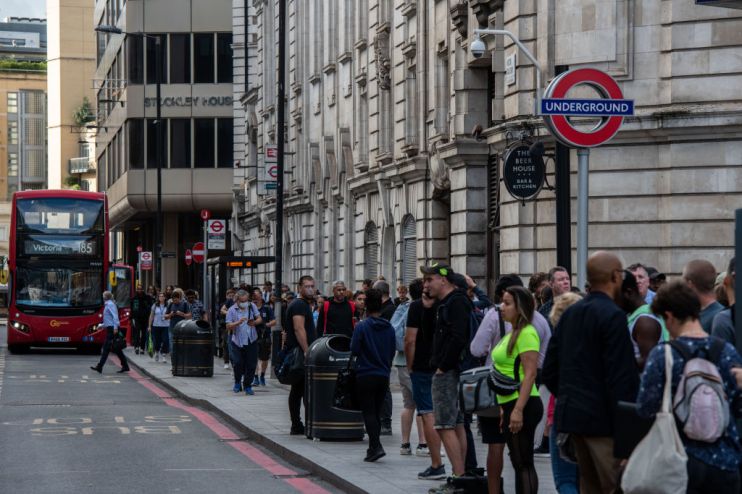
Tube strikes will start today as workers begin seven days of industrial action, which is expected to cause significant disruption across the London Underground and the wider Transport for London (TfL) network.
Members of the Rail, Maritime and Transport (RMT) union, representing around 10,000 TfL staff, are set to walk out between January 5 and 12 as part of an ongoing feud with the operator, which began in March last year.
The Unite union are looking for a pay rise of 6.1 per cent, while the Transport Salaried Staffs’ Association (TSSA) reportedly rejected a five per cent increase for the current financial year.
The train drivers’ union Aslef has, however, accepted a five per cent pay offer for its Tube drivers in the capital, the first union to reach an acceptable deal with TfL.
The RMT is infuriated at TfL bosses for freezing pay bands, warning it will create a “two-tier workforce.” It is also calling for improved travel facilities for Tube workers.
“Our members have made it clear that they are prepared to take action and we urge TfL to improve their offer to avert disruption in the capital,” General Secretary Mick Lynch said in December.
When do the tube strikes start?
Different RMT workers, which include engineers and signalling staff, will leave their posts on separate days throughout the seven-day period.
The most significant disruption will occur when all RMT staff strike on the 8th and 10th.
TfL warned yesterday there will be little or no service between the evening of Sunday 7 and the morning of Friday 12. It said passengers using the London Underground should “only travel if their journey is essential” on those days.
The DLR, bus services and the Overground are also likely to be busier than usual throughout the week and TfL have encouraged commuters to check their website ahead of travel.
- Friday 5 and Saturday 6 January: 24 hours of industrial action from engineers and maintenance workers, beginning at 6pm on Friday evening.
- Sunday 7 and Monday 8 January: Strikes from RMT members in London Underground Limited (LUL)’s network control functions on Sunday, joined by walk outs from all RMT union employees on Monday.
- Tuesday 9 January: Strikes from RMT workers in the Tube’s signalling and service control functions.
- Wednesday 10 January: All RMT union employees will walk out.
- Thursday 11 January: Strikes from RMT workers in the Tube’s signalling and service control functions.
The industrial action will not affect services on the Elizabeth Line, whose workers are represented by the TSSA.
TfL bosses have reassured passengers that Tube lines in North London serving the Emirates Stadium for Arsenal and Liverpool’s Sunday FA cup tie will “try to remain open longer.”
Campaigners urge bosses to stand up to the unions
With tube strikes starting this evening, campaigners have urged bosses to stand up to trade union leaders, citing the economic impact strikes will have in the new year restart.
This comes after fresh research commissioned by London HQ, the collective of four central London Business Improvement Districts (BIDs), showed one in five workers are choosing to stay at home over travelling into the office because of the strikes.
A census of 2,000 London-wide workers showed a fifth were not going to brave alternative transport, with the cost of travel, childcare and going out after work.
This comes after businesses have urged, and in some cases mandated their staff to return to the office after the pandemic, while some workers have looked for more flexible options, even if it means a pay cut.
Ruth Duston, chief executive of London Heritage Quarter said: “Despite there being a clear appetite for a more regular return to the office from both employers and employees, the impact of these strikes are clearly preventing workers from commuting in.”
Darwin Friend, research director of the TaxPayers’ Alliance, said: “Londoners will be seething at a week of severe commuter disruption.
“With TfL overseeing an already bloated pay-bill, hard-pressed taxpayers are bound to wonder how unions can justify this strike.
Transport bosses must stand up to unions and deliver a transit system that works, not one that constantly walks out.”
Will the tube strikes be called off?
The New Year strikes are the latest in an ongoing feud, which began in March 2022. The RMT first voted to walk out amid fears of over 600 job losses across the network’s station posts, following up with six separate strikes over the first year.
But more recent planned industrial action has so far been averted. Last-minute deals in both July and October managed to save key jobs and prevent planned changes to work rosters, key elements of the dispute.
A late deal is not off the cards this time. The RMT yesterday called on Sadiq Khan and TfL to enter unconditional talks hosted by the conciliation service ACAS to avert the industrial action.
“Our members have made it clear that they are prepared to take action and we urge TfL to enter into meaningful conciliatory talks to avert disruption in the capital,” Mick Lynch said in a statement.
Khan is under pressure to keep the Tube network running after pledging in his leadership campaign that there would be zero strikes during his tenure. Some 135 have been staged across the TfL network since he took the role.
London businesses, particularly hospitality, have faced multi-million-pound writedowns as a result of industrial action across Britain’s rail network. Before the last planned week of walk-outs were averted, the Centre for Economics and Business Research (CEBR) forecast a £62.5m hit to the capital’s economy.
Significant progress has been made in the separate national dispute over recent months. A pay deal between the government and the RMT has ensured there will be no industrial action until spring next year, although ASLEF has yet to reach such an agreement.