Skip to content
Saturday 12 September 2026London --:--Frankfurt --:--Zurich --:--
NewslettersSearchEN · DE · FR
MorningWire

European business, markets and politics

FTSE 100
10,650.44
+0.39%
DAX
25,568.56
+0.82%
CAC 40
8,179.77
+0.78%
STOXX 50
6,325.13
+0.90%
  • Europe
  • Markets
  • Business
  • Economy
  • Regulation
  • Politics
  • Opinion
More
GermanyFranceEU InstitutionsCompetitionPublic AffairsBankingTechnologyEnergy
  • Germany
  • France
  • Europe
  • Markets
  • Business
  • Economy
  • Regulation
  • Politics
  • Opinion
  • DE
Tuesday 22 October 2019 11:32 am  |  Updated:  Tuesday 22 October 2019 11:33 am

UK manufacturing firms planning lowest investment since financial crisis

By: Harry Robertson

Add as a preferred source on Google
UK manufacturing firms planning lowest investment since financial crisis
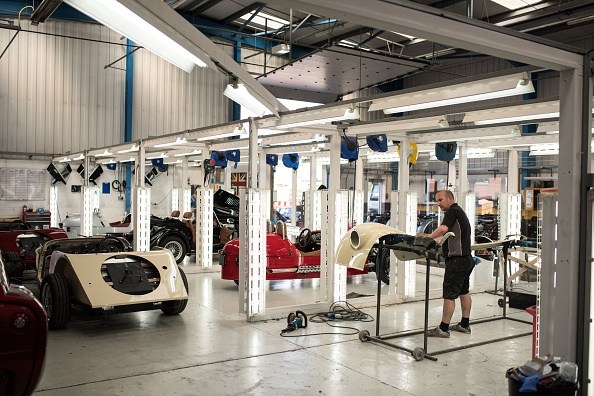
An employee of The Morgan Motor Company checks and polishes a car wing section in an inspection bay at the car firm's factory in Malvern, southwest of Birmingham, central England on August 13, 2019. - The Morgan Motor Company was established in 1909 by H.F.S Morgan and have been manufacturing quintessentially British vehicles at their Pickersleigh Road factory in Malvern, UK, for over 105 years. Each Morgan is hand-built using traditional craftsmanship skills from three core elements: ash wood, aluminium and leather. The Morgan family retain a shareholding of the company, alongside majority shareholders Investindustrial, an investment company that also has Aston Martin in its portfolio. Morgan produce just 800 cars per year from three ranges: the 3 Wheeler, Classic and Plus Six, with prices ranging from around 40,000 GBP to over 78,000 GBP. (Photo by OLI SCARFF / AFP) (Photo credit should read OLI SCARFF/AFP/Getty Images)

British manufacturing companies are planning to invest at the lowest rate since the financial crisis next year, a survey showed today, as Brexit uncertainty batters the sector.

Read more: What’s in the WAB? Government’s Brexit bill explained

The sector’s slowdown worsened in the three months to October, with orders for products falling at the fastest pace in almost a decade and output falling after stagnation in the quarter to September.

The CBI’s industrial trends survey of over 250 firms showed that prospects for the following quarter remain downbeat, with firms expecting output to fall at a faster rate in the coming three months.

“Each day of Brexit uncertainty sees firms forced to withhold key investment and recruitment decisions that make a huge difference to communities across the country,” said Tom Crotty, group director of chemicals firm Ineos and chair of the CBI manufacturing council.

Investment by UK companies has slumped in 2019 as firms await some political certainty before opening their wallets. Business investment is around 20 per cent lower since the Brexit referendum than if it had continued on its pre-2016 path.

Prime Minister Boris Johnson will this week attempt to push through his new Brexit deal parliament. Chancellor Sajid Javid has said will let business “get on with taking decisions” on investment.

Britain’s manufacturing sector has also been hit by the US-China trade war and a general global economic slowdown, both of which have dampened demand for products.

The proportion of firms citing political and economic conditions abroad as a factor limiting exports over the next quarter hit a survey record high, the CBI said.

Read more: UK economy close to recession after stagnant services sector data

A lack of confidence led to firms firing workers at the fastest rate since April 2010 in the quarter to October. Businesses said they expect employment to drop at an even faster rate in three months to January.

(Image credit: Getty)

Read more

Manufacturers overcome gloomy economy as output surge continues

Manufacturing sector faces mounting tribunal pressures amid economic uncertainty

Share this article

  • Facebook
  • X
  • LinkedIn
  • WhatsApp
  • Email

Similarly tagged content:

Sections

  • Markets & Economics
  • News

Categories

  • Business
  • Economics

Trending Articles

  • Serie A won’t catch the Premier League by selling its rights better

  • Last Night, a Star-studded Evening Celebrating Moncler’s Fifth Avenue Flagship Ushered in a New Chapter in the Brand’s Enduring Love Story With New York

  • Crystal Palace agree deal with HSBC that paves way for new training ground

  • Lotus, Porsche and Corvette: the best sports cars to buy in 2026

  • Claridge’s swings to £10m loss as luxury hotel warns on ‘adverse impact’ of tax hikes

More from Morning Wire

  • Manufacturers overcome gloomy economy as output surge continues

    Industrials
    Manufacturing sector faces mounting tribunal pressures amid economic uncertainty
  • Jobs market ‘stops moving’ as employment costs weigh on hirers

    Economics
    The recruitment industry is grappling with a slowdown in hiring among UK employers and wider macro-economic uncertainty.
  • 22 months of cuts: Jobs crisis deepens despite growth boost 

    Economics
    London has defied national trends as job postings in the capital rose.
  • Manufacturing growth loses momentum as economic risks loom 

    Industrials
    Manufacturing has suffered yet another downturn in activity over September.
  • UK economy to ‘reverse gains’ as construction drags growth

    Economics
    Retail sales slowed in September
  • Inflation expectations softer than predicted ahead of interest rate decision

    Economics
    The Bank of England is expected to hold interest rates at four per cent due to stubbornly high inflation.
  • European private credit booms as private equity firms are forced to refinance

    Investing
    Investment platform Webull is offering access to UK shares
  • UK economy’s rebound fails to stem two years of mass job losses 

    Economics
    LONDON, UNITED KINGDOM - JANUARY 31: The Shard is seen on the horizon as commuters cross London Bridge during the morning rush hour on January 31, 2023 in London, United Kingdom. The IMF reports that the UK economy will contract by 0.6% in 2023, as opposed to the previous prediction it might grow, and will perform worse than many other advanced economies, including Russia.The cost of living continues to hit households with grocery inflation for the first four weeks of 2023 rising to 16.7% which would add a further £788 per year to family food bills. (Photo by Leon Neal/Getty Images)
MorningWire

Independent European business, markets and political news for decision-makers.

Morning Briefing

Europe

  • Germany
  • France
  • EU Institutions
  • Europe

Business

  • Markets
  • Business
  • Economy
  • Regulation
  • Competition
  • Public Affairs

Editorial

  • Opinion
  • Editorial Policy
  • Corrections
  • Contact

Company

  • About Morning Wire
  • Privacy Policy
  • Terms of Use
  • Cookie Policy
© 2026 Morning Wire Ltd · Published by Morning Wire Media, Bahnhofstrasse 65, 8001 Zürich, Switzerland
Privacy · Terms · Cookies · Facebook