US-UK deal is free trade in name only

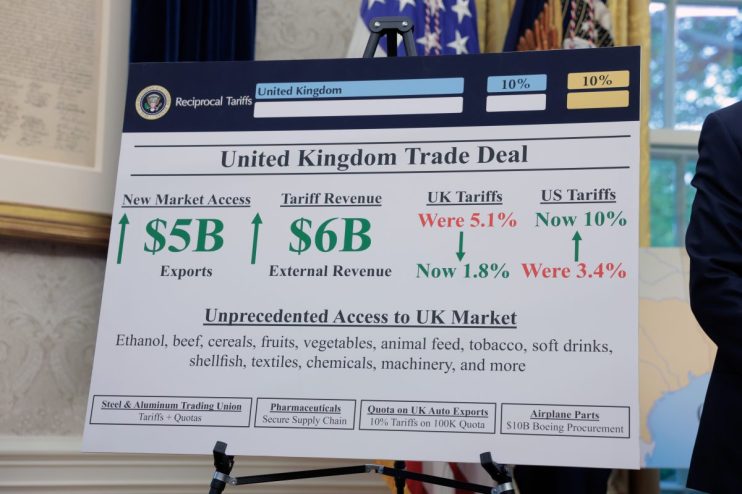
The newly announced UK-US trade agreement under Trump is a modest, tactical rollback of recent protectionist measures rather than a true free trade deal, aimed more at political optics than economic transformation, says Eliot Wilson
Donald Trump advertised last week’s trade agreement between the United States and the United Kingdom as “full and comprehensive”, a “MAJOR TRADE DEAL” (the president’s inevitable capitalisation on his Truth Social platform) which would be “THE FIRST OF MANY!!!”. That imprimatur was enough to alert us to what the agreement was not: it is neither full nor comprehensive, and is certainly not a “free trade agreement”.
The deal announced today is not the end, but it may be, to go one step further than Churchill, the beginning of the end. What the transatlantic negotiating teams achieved was an agreement to reduce penalties and barriers in key sectors of the two countries’ economies. It undoubtedly represents trade liberalisation, but only from the protectionist heights that the president created in April with his “Liberation Day” tariff régime.
What Sir Keir Starmer, his business and trade secretary Jonathan Reynolds and others have achieved is a welcome step. It is said, plausibly, that a key figure in this has been the wily, razor-sharp but emollient Lord Mandelson, three months into his tour as British ambassador in Washington.
If there is a lot of work still to be done, Starmer’s government has at least pushed the process forward. Until the agreement was announced, goods imported from the UK into the US were subject to a 10 per cent universal tariff, with a higher rate of 25 per cent applied to steel, aluminium and cars.
The agreement walks some of that back. The UK can export 100,000 cars to America under a 10 per cent tariff rather than 25 per cent, and a limited range of products, like Rolls Royce aero engines, will be admitted tariff-free. In return, the UK will allow greater access to its markets for American food and agriculture products. But this is an exercise in mitigation. The universal tariff of 10 per cent remains in place and the terms of trade between Britain and America remain worse than when President Trump came to office in January.
Trump’s protectionist instincts
It is clear that this is not a free trade agreement in any conventional sense, not least President Trump does not really believe in free trade. His Manichaean view of the world, dividing into friends and enemies, loyal followers and traitors, winning and losing, simply cannot accommodate the concept of mutual advantage, which was central to the economic system in Adam Smith’s The Wealth of Nations (1776). Prosperity and innovation depend on “those mutual good offices which we stand in need of”, but the President sees someone else winning and assumes that by definition he himself, and by extension the United States, must be losing.
Let us not pretend, though, that Trump and his most protectionist advisers like trade counsellor Peter Navarro and commerce secretary Howard Lutnick, are the only dissenters. The EU presents a free-trade face to the world but means free trade among its member states, with tariffs to protect against the rest of the world. The Labour Party, dirigiste to its marrow, cannot quite talk about free trade without the comfort of phrases like “so that it works for Britain” and “global minimum rates of taxation”.
For President Trump, maximal and frictionless trade with the UK is not the chief objective, because he does not think in conventional economic terms
The Prime Minister and his government deserve recognition for dragging this framework document across the line with the Trump administration, and in the same week to have unveiled the UK-India Free Trade Agreement. The last part of this trade triptych will be finalised at the UK-EU summit in London next week, and it remains to be seen how successfully Britain can face both Europe and America, with their radically different political and commercial cultures, at the same time.
We have to remember the wider context. For President Trump, maximal and frictionless trade with the UK is not the chief objective, because he does not think in conventional economic terms. He wants to show that his tariff regime has forced other countries to the negotiating table as supplicants and that he has therefore “won”. We also know that the president could simply disown the agreement at any time, the way he turned on the US-Mexico-Canada Agreement that he himself signed in his first term.
For the UK, it is damage limitation. The political fallout from concessions on agricultural products could be challenging, and the government has had to make the best accommodation it can with the topsy-turvy, funhouse-mirror Trumpian interpretation of commerce and economics. It is an improvement on the status quo of six weeks ago, but we are not where anyone on this side of the Atlantic wants to be. As the hoary old joke goes, I wouldn’t start from here.
Eliot Wilson is a writer and strategic advisor