Skip to content
Friday 14 August 2026London --:--Frankfurt --:--Zurich --:--
NewslettersSearchEN · DE
MorningWire

European business, markets and politics

FTSE 100
10,772.67
-0.56%
DAX
26,299.74
0.00%
CAC 40
8,650.56
0.00%
STOXX 50
6,545.47
0.00%
  • Europe
  • Markets
  • Business
  • Economy
  • Technology
  • Politics
  • Opinion
More
GermanyFranceBankingAIEnergyFintechPropertyCapital Markets
  • Germany
  • France
  • Europe
  • Markets
  • Business
  • Economy
  • Technology
  • Politics
  • Opinion
  • DE
Tuesday 12 March 2024 7:04 am  |  Updated:  Tuesday 12 March 2024 7:35 am

Wage growth slows faster than expected and unemployment picks up slightly


By: Chris Dorrell

Add as a preferred source on Google
Adding more trams, trains and buses to the UK's major cities will not only make our morning commutes quicker, it will also help improve the economy, Chris Dorrell writes
Birmingham and Munich are roughly the same size. Yet during rush hour, nearly three quarters (74 per cent) of Munich's population can reach the city centre within 30 minutes through public transport while only 34 per cent of Birmingham's can.

Wage growth came in slightly below expectations, new figures show, as evidence builds that the Bank of England’s interest rate hikes are creeping through into the wider economy.

Annual pay growth including bonuses averaged 5.6 per cent between November and January, according to figures from the Office for National Statistics (ONS). Economists had expected it to remain more or less stable at 5.8 per cent.

Excluding bonuses, the figure was 6.1 per cent compared to 6.2 per cent previously.

Although wages are now growing more slowly than before, lower inflation means households are actually still seeing a boost to their real pay. Real total pay rose 1.4 per cent between November and January.

“Recent trends in the jobs market are continuing with earnings, in cash terms, growing more slowly than recently but, thanks to lower inflation, real terms pay continues to increase.,” ONS director of economic statistics Liz McKeown said.
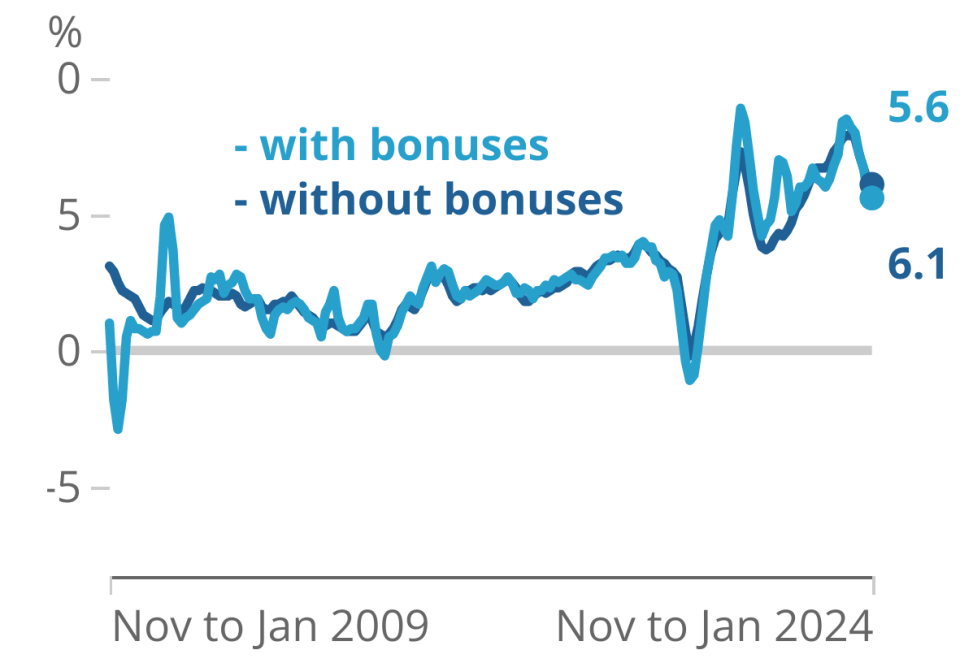
Source: ONS

There were other signs that the labour market, which has so far been remarkably resilient to the Bank’s rate hikes, might be loosening.

Unemployment crept up to 3.9 per cent from 3.8 per cent, above market expectations. The number of vacancies, a measure of labour demand, fell by 43,000.

This means that vacancies have been falling for 20 consecutive quarters, although there are still around 100,000 more vacancies than pre-pandemic.

“Today’s ONS figures paint a familiar picture of further gradual softening in the labour market and easing pay pressures, but it remains an incremental process,” Jack Kennedy, senior economist at Indeed commented.

Read more

Hold interest rates but ‘sound hawkish’, Morning Wire Shadow MPC tells Bank of England

Andrew Bailey, Governor of the Bank of England, with the Bank of England building and Union Jack flag in the background

The figures come as the Bank of England deliberates on when to start lowering interest rates, which currently stand at a post-financial crisis high of 5.25 per cent.

Rate-setters are paying careful attention to developments in the labour market for signs that higher interest rates are working to slow the economy, thereby bringing down inflation.

The Bank’s most recent Monetary Policy Report suggested that there needed to be a “moderation in pay pressures” to bring down services inflation, a key gauge of domestic inflationary pressures.

But economists argued that Tuesday’s figures would do little to change the Bank’s current thinking.

Yael Selfin, chief economist at KPMG UK said the data was “unlikely to warrant a major policy shift” from the Bank as pay growth remains “robust”.

Paul Dales, chief UK economist at Capital Economics, agreed. “The easing in wage growth in January is probably still a bit too slow for the Bank of England’s liking,” he said.

While the figures show that the labour market remains tight, survey data suggests cracks are starting to show.

Starting salary inflation dropped to its lowest level in nearly three years, according to the KPMG-REC jobs survey. The survey also showed that there had been an “accelerated reduction” in demand for workers alongside a “marked upturn” in candidate supply.

Selfin thought that pressure would continue building on the labour market, allowing the Bank to pivot to rate cuts. “We expect the labour market to weaken in the coming months, which should reduce momentum in wage growth and raise the prospect of interest rate cuts from the summer onwards,” she said.

Read more

Bank of England holds interest rates but warns of rises to come

Bank of England headquarters in 2025, showcasing modern architecture and iconic London skyline in the background.

Share this article

  • Facebook
  • X
  • LinkedIn
  • WhatsApp
  • Email

Similarly tagged content:

Sections

  • Markets & Economics
  • News

Categories

  • Economics

People & Organisations

  • Bank of England

Related Topics

  • Bank of England
  • employment and wages
  • UK inflation
  • UK jobs, employment and wages

Trending Articles

  • Five-star Mayfair hotel hit with HMRC winding-up petition

  • Revolut takes flight with launch of new airport lounges

  • It’s not just Jason Arday, most of sociology is a scam

  • IT consultant ordered to pay £50,000 after being accused of stealing Soho House members’ personal details

  • As it happened: FTSE 100 falls as Iran and US clash over Strait of Hormuz; Oil stockpiles ‘rapidly depleting’

More from Morning Wire

  • Hold interest rates but ‘sound hawkish’, Morning Wire Shadow MPC tells Bank of England

    Economics
    Andrew Bailey, Governor of the Bank of England, with the Bank of England building and Union Jack flag in the background
  • Bank of England holds interest rates but warns of rises to come

    Economics
    Bank of England headquarters in 2025, showcasing modern architecture and iconic London skyline in the background.
  • Healey faces £24bn spending squeeze as inflation puts tax rises in play

    Economics
    Bank of England headquarters in 2025, showcasing modern architecture and iconic London skyline in the background.
  • How patient can the Bank of England be?

    AD
    Historic Royal Exchange building in London with modern skyscrapers behind, clear blue sky.
  • Bank of England to hold interest rates as oil price surge threatens UK economy

    Economics
    Bank of England building on Threadneedle Street, London, showcasing its historic architecture and financial significance
  • Burnham premiership begins with decline in job postings

    Economics
    Andy Burnham, Mayor of Greater Manchester, in a professional setting.
  • ‘Door is open’ to interest rate hike as inflation fears return

    Economics
    Bank of England headquarters in 2025, showcasing modern architecture and iconic London skyline in the background.
  • ‘False dawn’: June inflation falls to 2.6 per cent but analysts say rises ahead

    Economics
    Till sales growth slowed to 2.7 per cent in the last four weeks
MorningWire

Independent European business, markets and political news for decision-makers.

Morning Briefing

Europe

  • Germany
  • France
  • Europe
  • UK & Ireland

Business

  • Markets
  • Banking
  • Technology
  • Energy
  • Property
  • Fintech

Editorial

  • Opinion
  • Editorial Policy
  • Corrections
  • Contact

Company

  • About Morning Wire
  • Privacy Policy
  • Terms of Use
  • Cookie Policy
© 2026 Morning Wire Ltd · Published by Morning Wire Media, Bahnhofstrasse 65, 8001 Zürich, Switzerland
Privacy · Terms · Cookies · Facebook