Waspi women deserve compensation, but could there be a sting in the tail?

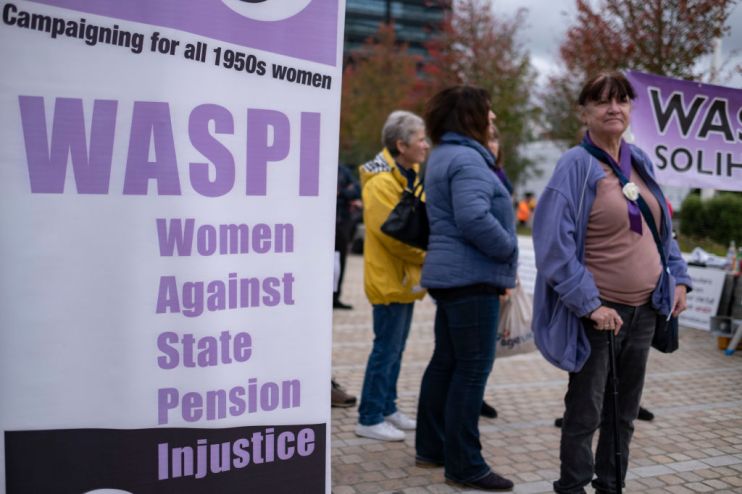
Waspi women have a legitimate grievance over waiting longer than they expected for their pensions, but any reimbursement scheme must take into account that working people are struggling too, says Eliot Wilson
From 2004 to 2009, the Department for Work and Pensions was guilty of maladministration, it breached the Civil Service Code and it failed to inform the public about wide-ranging changes to pension entitlement. The equalisation of the state pension age for men and women has meant that women born in the 1950s are waiting longer for their pensions, affecting their legitimate retirement plans. This litany of failure entitles those women to compensation.
Those were the conclusions last week of the Parliamentary and Health Service Ombudsman, which reported on the issue championed for nearly a decade by campaign group Waspi (Women Against State Pension Inequality). One Conservative MP called it “grim reading” and underlined that the ombudsman expressed little confidence in the DWP to do the right thing and issue adequate compensation.
This is unquestionably a major issue for those women affected, who number between 2.6m and 3.7m, depending on the calculation used. People may rely on several different systems for their financial security in retirement, but the state pension is an important part of that, and it has been regarded, quite reasonably, as something to which we are entitled. The state pension isn’t just a reimbursement of contributions made over a working life (not least because it’s paid for out of general taxation), it’s a fundamental part of the welfare system.
On the face of it, this appalling situation should be put behind us, lessons learned and recompense paid out to those who have been affected. As Angela Madden, chair of Waspi, told the BBC, “We are asking for fair compensation for the injustices we suffered”. But Whitehall already had a long and unacceptable track record of failing to address the pensions issue, treating claimants poorly and without urgency.
The ombudsman’s report notes that “maladministration in DWP’s complaint handling caused complainants unnecessary stress and anxiety and meant an opportunity to lessen their distress was lost”. The fact that part of the department’s response was to point out that it is not bound by the ombudsman’s findings is worrying.
This is factored into the report. Rebecca Hilsenrath, the ombudsman’s chief executive, said “we have proactively asked Parliament to intervene and hold the department to account. Parliament now needs to act swiftly, and make sure a compensation scheme is established. We think this will provide women with the quickest route to remedy.”
Of course we need to consider money. According to the BBC, compensating all women affected in line with the ombudsman’s report would cost the government between £3.5bn and £10.5bn. That may be relatively small beer: before the last general election, the Labour Party pledged to pay individual compensation of more than £30,000 as part of a commitment which topped £58bn.
Not everyone is as open-handed as Comrade Corbyn. Sir Keir Starmer and his shadow chancellor, Rachel Reeves, have yet to make any firm commitment on the issue – there is no reason they should so long as the government has not responded to the ombudsman – but their dogged commitment to fiscal responsibility suggests the spending taps will not be opened very far.
We need texture too. If resources are finite – to put it mildly – we have to prioritise competing claims, and the truth is that some pensioners are comfortably off, with a security net in the form of the triple lock which neither party will touch. The Waspi issue has been badly handled but, as the Court of Appeal ruled in 2020, the women were not subject to unlawful discrimination. At the same time, other demographic groups, like those in low-paid work, are struggling financially too.
Angela Madden has ventured a reasonable approach. “It doesn’t need to bankrupt the country… but it is urgent to get on with it. There are people dying before they can be fairly compensated.”
Parliament should act swiftly to lay down some kind of marker. A resolution of the House of Commons would not be binding but would send an important signal. We need to balance the undoubted grievance against a defensible policy objective and straitened public finances.
Finding a just solution will require reasoned and realistic debate and a mutual sense of good will. It is a shame that those are the very qualities in short supply at Westminster at the moment.
Eliot Wilson is co-founder of Pivot Point