Skip to content
Friday 28 August 2026London --:--Frankfurt --:--Zurich --:--
NewslettersSearchEN · DE · FR
MorningWire

European business, markets and politics

FTSE 100
10,811.33
+0.17%
DAX
26,512.68
+0.55%
CAC 40
8,398.41
+0.94%
STOXX 50
6,471.24
+0.72%
  • Europe
  • Markets
  • Business
  • Economy
  • Regulation
  • Politics
  • Opinion
More
GermanyFranceEU InstitutionsCompetitionPublic AffairsBankingTechnologyEnergy
  • Germany
  • France
  • Europe
  • Markets
  • Business
  • Economy
  • Regulation
  • Politics
  • Opinion
  • DE
Monday 15 June 2020 4:14 pm  |  Updated:  Monday 15 June 2020 6:49 pm

Watch out for too much money — and the return of boom and bust cycles

By: Juan Castaneda

Add as a preferred source on Google
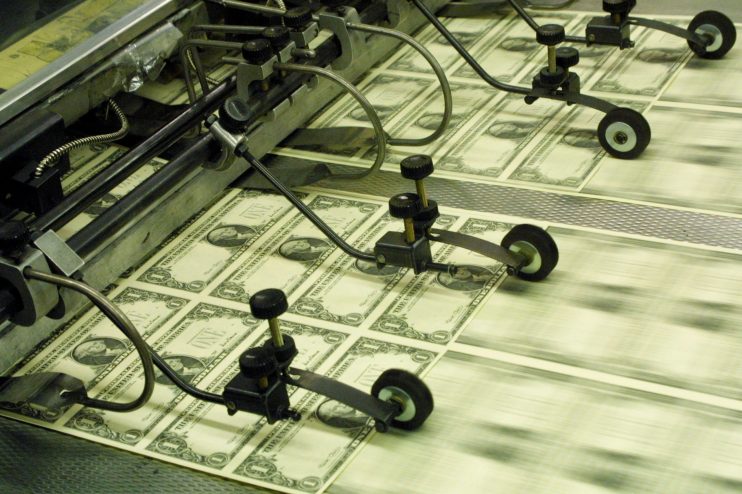
New Series 2001 One Dollar Bill Notes
We are observing a surge in the amount of money unseen in decades

Money is growing at record rates in peace time the US, at least by modern standards. 

The quantity of money in the US (as measured by M3) rose by 7.5 per cent in April 2020. With further strong money growth in May, the annual rate of growth of money has shot up to a shocking 25.5 per cent. 

America is not unique. Similar trends can be observed in other leading economies, although on nothing like the same scale. 

And yet, despite these disturbing figures, US Federal Reserve chair Jerome Powell stated last week that the asset purchases programmes (i.e. quantitative easing) will continue “at least” at the current rate for the time being, and that the Fed Funds rate would remain at the current historically low level until 2022. 

On top of this, the Fed has previously stated its willingness to support the federal government and buy its debt. Indeed, it has already started to do it in recent weeks. With the US federal government deficit expected to reach a record level in peace time (estimated around 15 per cent of GDP by the end of 2020), this means that the monetisation of the deficit by the Fed will create yet more money in the economy in the next few months. 

It is very worrying that the Fed is paying no attention to the effects of such monetary financing of the deficit on inflation in the medium term, and seems to be totally disregarding the powerful message which the current extraordinary rate of growth of money in the US is sending out .

The rest of the world should be very concerned about the effects of the Fed’s policies over the next two to three years. In sharp contrast to the response during the global financial crisis of 2008, not only have both treasuries and central banks coordinated unprecedented economic stimulus policies to address the current crisis, but bank regulators have also significantly eased bank capital requirements. 

All in all, this is already producing a surge in the amount of money unseen in decades. 

Read more

‘Good growth in every postcode’ is a woeful catchphrase

Andy Burnham adjusting his tie, overlooking white cliffs and the sea on a sunny day

It is important to underline that at the moment, unlike during the financial crisis, not only are central bank balance sheets growing, but so are bank deposits (i.e. money available to spend). Once the economy starts to reopen in the next few months, the excess in money holdings by companies and financial institutions will likely lead to much higher spending and to a significant rebound. This is something we are already observing in financial markets, with equity prices already at pre-crisis levels. 

If the increase in the amount of money continues as expected, we will experience an inflationary boom in the US by the end of 2021 or 2022, with possible and even likely double-digit inflation rates.

By then, the Fed will have to change its policies drastically to tackle inflation. Sadly, it will be too late. 

We can but hope that other central banks are taking note of these concerns, including the Bank of England. With a massive government deficit here being financed by Threadneedle Street and the high street banks, there is no need to continue with quantitative easing as well. Broad money in the UK grew at an annual rate of 21.8 per cent in the three months to April. Though not as worrying a figure as that for the US, it is still far too high. 

The Bank of England needs to take action as soon as possible if the UK is to keep inflation under control over the medium term, when the pandemic is hopefully over and the economy starts to recover.

Juan Castaneda will be presenting a report on this subject on 18 June. More details are available here.

Main image credit: Getty

Read more

Give London power to level up the rest of the country

Business professionals in formal attire engaged in a lively discussion at a corporate meeting in a modern office setting.

Share this article

  • Facebook
  • X
  • LinkedIn
  • WhatsApp
  • Email

Similarly tagged content:

Sections

  • Jobs and Money
  • Markets & Economics
  • Opinion

Categories

  • Economics
  • Money
  • Opinion

Trending Articles

  • Pensioners to hand over bank statements in government benefits crackdown

  • Jamie Carragher: HMRC petitions for Sky Sports star to be declared bankrupt

  • Brewdog founder James Watt hits out at ‘total silence’ over new venture

  • Lloyds Bank and Halifax users unable to use app in latest outage

  • Economists urge Bank of England to halt bond sales as borrowing costs climb

More from Morning Wire

  • ‘Good growth in every postcode’ is a woeful catchphrase

    Opinion
    Andy Burnham adjusting his tie, overlooking white cliffs and the sea on a sunny day
  • Give London power to level up the rest of the country

    Opinion
    Business professionals in formal attire engaged in a lively discussion at a corporate meeting in a modern office setting.
  • Hammersmith Bridge is a test for Burnham’s place-based growth

    Opinion
    Hammersmith Bridge closed in 2021 with fencing, banners, and traffic cones blocking access to the walkway.
  • Ask the expert: How do I avoid double tax on my pension?

    Personal Finance
    Marianna Hunt discussing financial strategies at a business conference, wearing a professional suit, engaging with the aud...
  • ‘War on wealth creation’: capital gains tax raid would lose government money, Tories argue

    Politics
    Mel Stride speaking at a press conference, addressing key issues, in a formal setting with a backdrop of the events logo.
  • Liverpool and LA Lakers deals set new bar for sport investment

    Sport Business
    Rows of yellow Lakers jerseys with 77 on seats in a dark basketball arena.
  • Dolly Parton: The rhinestone capitalist

    Opinion
    Dollywood gift shop with Dolly Parton t-shirt, books, mugs, and colorful floral display. A person browses merchandise.
  • IPOs aren’t the new meme stocks

    Opinion
    Elon Musk discussing SpaceX investment as Scottish Mortgages largest holding on a business news platform
MorningWire

Independent European business, markets and political news for decision-makers.

Morning Briefing

Europe

  • Germany
  • France
  • EU Institutions
  • Europe

Business

  • Markets
  • Business
  • Economy
  • Regulation
  • Competition
  • Public Affairs

Editorial

  • Opinion
  • Editorial Policy
  • Corrections
  • Contact

Company

  • About Morning Wire
  • Privacy Policy
  • Terms of Use
  • Cookie Policy
© 2026 Morning Wire Ltd · Published by Morning Wire Media, Bahnhofstrasse 65, 8001 Zürich, Switzerland
Privacy · Terms · Cookies · Facebook