We already know how to end rough sleeping, so why haven’t we?

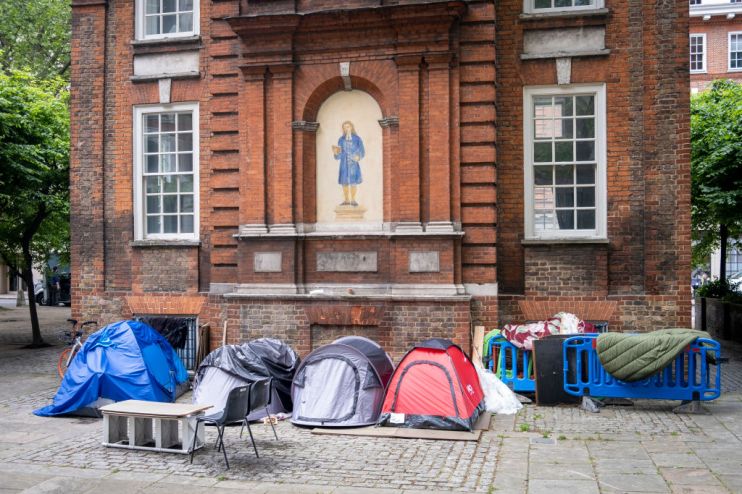
Instead of criminalising rough sleeping, the government should expand a policy that’s proven to work: giving people homes, argues Lucy Kenningham
Buried inside the government’s Criminal Justice Bill are measures that would make rough sleeping an offence worthy of a £2,500 fine or imprisonment.
The bill has gone through the first and second readings of parliament, and is now at the committee stage. It has received heavy criticism, unsurprisingly from groups like Crisis. The charity’s campaigns manager Rosie Perkins says the legislation “amounts to the criminalisation of rough sleeping”.
“The police and local authorities already have measures to cover genuine instances of antisocial behaviour. Threatening people facing homelessness with prison and unaffordable fines does nothing to support them and will push people living on the streets into less safe areas,” she says.
Ironically, this is the same government whose 2019 manifesto included a pledge to end rough sleeping by 2024. Yet at the end of January, . In total, 4,389 people are now spending their nights on the capital’s streets – a 23 per cent increase on the same period in 2022.
What is frustrating about this situation is that it is both unnecessary and relatively simple to solve. International and national evidence shows that the best way to solve rough sleeping in the long term is to give people homes.
Finland is the shining example of this policy, and due to its success has become the only country in the EU to have reversed its numbers of rough sleepers. Its previous prime minister pledged to end rough sleeping by 2027 – 2025 in the capital Helsinki – and the country is well on its way to achieving this goal.
Back in 2007, the Finnish government introduced a Housing First scheme – an approach that pledged to give all rough sleepers an apartment of their own without obligations. Finland’s progressive policy has made it the only country in the European Union to achieve a decline in homelessness in recent years. A significant one at that – in the past four years Helsinki has seen a 40 per cent drop in people sleeping rough.
On top of that, the country’s Housing First scheme provides wraparound support including access to social services helping with emotional issues and access to healthcare and benefits. Crucially, the service provides users with a legitimate tenancy agreement. People are not kicked out if their alcohol or drug addiction doesn’t magically disappear upon their being given a home (though, sensibly, these substances are banned from communal spaces).
This scheme might sound prohibitively expensive but, surprisingly, it’s quite the opposite: Finland’s evidence shows that the scheme is so cost effective it actually saves governments money. To be precise, €32m annually since 2012, mostly in healthcare.
Is Finland a Scandinavian outlier, a setter of impossible standards? After all, it’s a rich country with a small population. But – though few people know about it – England has actually adopted a similar scheme, in pilot form to date.
It, too, has been proven to save the state money. Crisis found that for every £1 invested in England’s Housing First scheme, £1.24 is saved. The scheme was praised in a report by the All-Party Parliamentary Group for Ending Homelessness and from mayors of the city regions it represented.
In 2022, England’s national Housing First pilot ended but was then renewed with £13.9m of funding for two years. But its future beyond 2025 is uncertain, as the charity Homeless Link points out. Being labelled a pilot is scuppering the scheme’s potential. Crisis guesses an expansion of Housing First could help over 16,000 people out of homelessness. “England should be looking to do the same as Finland,” Perkins suggests.
The numbers are also relatively small: just 4,400 or so rentals would need to be found in London, for instance. Expanding the scheme seems like a no-brainer to anyone who wants to help rough sleepers off the streets – or indeed save the NHS some money.