We risk losing our minds over this unhealthy data obsession

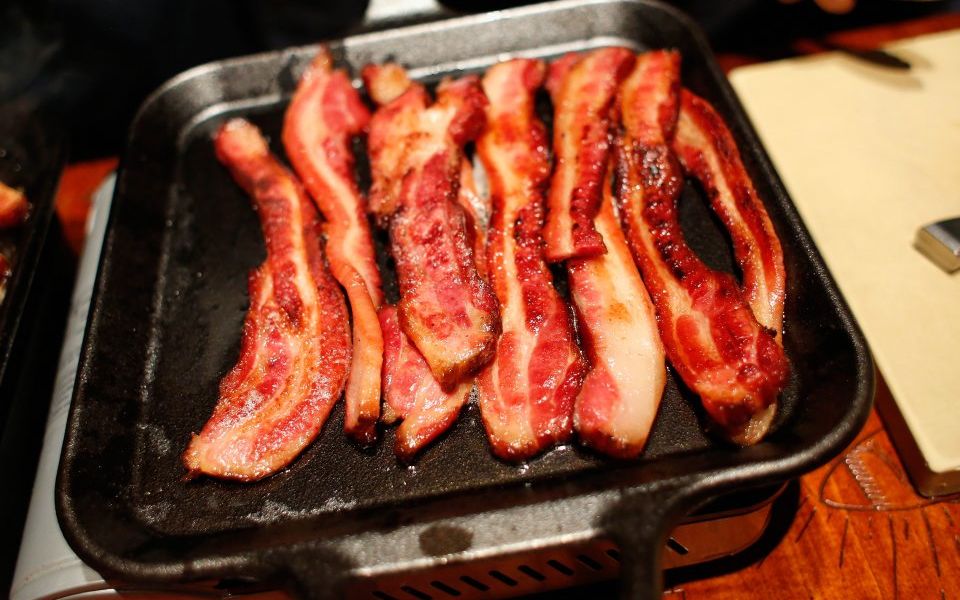
After two listeners complained about a radio advert that compared avocados unfavourably to bacon butties as a breakfast choice, Costa coffee was forced to withdraw the ad.
The Advertising Standards Authority upheld the complaint that the advert “discouraged the selection of avocados” and therefore broke the UK Code of Broadcast Advertising by discriminating against vegetables.
Let’s leave aside for a moment the fact that a bacon buttie clearly is, objectively, a better breakfast choice than an avocado.
Read more: Costa barred from telling consumers not to eat avocados for breakfast
Is it justified for the regulator to treat fruit and vegetables as a protected category, which must always be portrayed in a positive light, given that we wilfully persist in eating less healthy foods on the flimsy grounds that we like them?
A recent study points to processed meat (bacon, for example) as a risk factor in breast cancer. A daily bacon buttie could push me into the “high” consumption category, increasing my lifetime risk by nine per cent.
Take 100 random women, and you’d expect 14 of them to develop breast cancer over a lifetime. If all of them ate a lot of processed meat, you’d expect one extra woman out of that 100 to get breast cancer.
But will that extra woman be me?
The problem is that it really doesn’t work like that. For any individual, that “nine per cent of 14 per cent” increase in risk (roughly one per cent) tells you very little about your own future.
Data is good at zooming out to look at the big picture, which has led to great strides in public health, from sanitation to vaccination. But zoom back in to individual behaviour, and the noise obscures the signal worse than trying to phone home from a Friday night pub.
This may be disappointing, as we like data to quantify the risks we face in some way that helps us control and reduce them.
In an uncertain and unpredictable world, the appeal of statistical evidence and high-tech data analysis is certainty. We can’t know the future, but we can at least gather some data, build mathematical models, and look at some numbers.
Much as I love numbers, there are two things wrong with this approach.
The first is that data can never give you certainty, least of all about the future. It’s inevitably data from the past, and it’s a partial view of the world that omits swathes of reality in order to pull out the patterns more clearly.
Comparing enough bacon-eaters and avocado-eaters could suggest that the latter are more likely to die later, or of something different, than the former – on average.
But as an individual, I’m not defined solely by my choice of breakfast (thankfully). I am a bundle of competing risk factors, driven by obstinate free will, and swimming in a sea of random chance.
Extrapolating from population-scale data to any one person is of limited use. This is not to say that it’s pointless to stop smoking, for example, or to avoid drink-driving. But living a pure and healthy life only improves your odds. It doesn’t take you out of life’s poker game, which sooner or later we will all lose.
The second problem is that risk is nearly always framed as danger, and seldom as opportunity.
Aviation today is an industry that employs millions of people worldwide, and has opened up the globe to billions whose grandparents never left the country of their birth.
We owe our ability to complain about limited legroom and lost baggage to generations of “tower-jumpers” who risked, and frequently broke, their necks in pursuit of human flight.
Little more than a century ago, nobody knew whether aeroplane flight was even possible, but enough people took a risk to make it the reality we take for granted today.
I’m not comparing my brave breakfast choice to the heroes of early aviation. That risky rasher is nothing like as dangerous as flinging myself from a building in a glider of my own devising. But I am saying that we have an unhealthy aversion to risk.
A risk is usually portrayed as something to be avoided, with those who take them seen at best as fools, at worst as morally deficient. But if you never take a risk, you will never ask for a date, or apply for a job you can’t already do, or put your money into an experimental technology that just might change the world.
We think that data gives us more knowledge, and thus more control, or at least more informed choices about the future. But data will only answer the question we ask. Too often today that question is: “how likely is this to kill me?”
When did you last see a headline saying “Delicious bacon safer than social isolation”, for example? Because that’s statistically true. No, it’s always “Processed meat linked to breast cancer”. And though in real life we may continue to reach for the bacon buttie, we’re no longer allowed to hear adverts telling us where to buy one.
Everything around us is measured according to how dangerous it is. And that can’t be healthy.
Timandra Harkness is speaking at the Battle of Ideas over the weekend 13-14 October.
Read more: When it comes to our social care crisis, prevention is the only cure