We should welcome ex-PMs back to cabinet, but Cameron won’t win votes

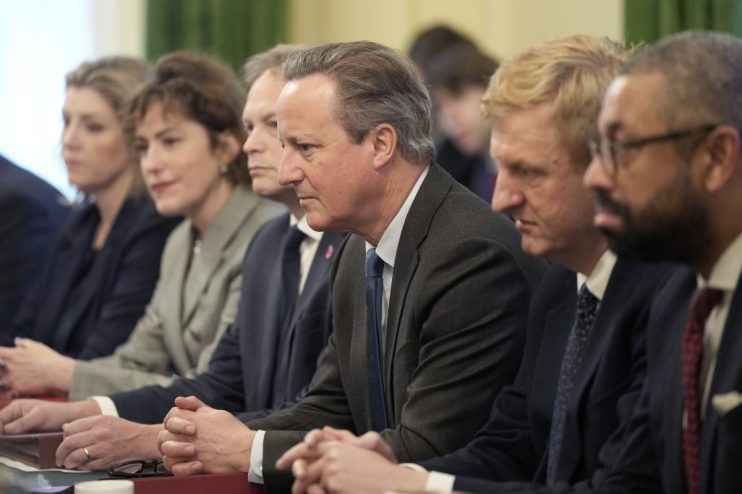
David Cameron is back in government to save Rishi Sunak’s premiership, but the former prime minister is wildly unpopular, writes Josh Williams
Fire up the Delorean, Doc. We’re going back to the future. Stepping out of an unmarked car outside 10 Downing Street, a familiar figure emerged. A little heavier than before, now looking even more like the overstuffed sausage we’d all remembered, “Call Me Dave” Cameron walked into 10 Downing Street. Just audible on Sky’s coverage, one reporter at the scene exclaimed: “what the hell?” Speaking for us all, the BBC’s Henry Zeffman began his piece to camera with the now viral line: “I don’t think I’ve had a funny turn.” Characteristically, Zeffman spied the story immediately: our old Prime Minister was about to become our new foreign secretary.
So, what the hell indeed? Why would one Prime Minister bring back a predecessor, not least one whose record he rubbished just weeks ago in his conference speech?
There are reasons to think there is method to the madness. Our political life is losing its best politicians too early. There was a time when former premiers and cabinet ministers aged, usually helpfully and only occasionally disgracefully, on the backbenches. Blair and Brown are gone, and so too are pretty much all of their former ministers, although many of them – think of Ed Balls, James Purnell or Alan Milburn – are still of serviceable fighting age. Aided by the Johnson era exodus, some of the most promising ministers of the Cameron years are now gone, like Amber Rudd, Rory Stewart, David Gauke. British politics, on both sides of the house, would be better for retaining more of its stars.
It should also be noted that while politics involves a lot of politics, it is really supposed to be about public service. I do believe that Cameron has returned to the frontline because he is committed to that ideal. I also happen to think he will make a decent foreign secretary. While he was never the negotiator he believed he was (consider his failed renegotiation of the EU relationship before the Brexit Referendum), few have deeper experience of foreign affairs than former prime ministers.
Perhaps most importantly, the arrival of Cameron marks a strategic shift by Rishi Sunak. Until as recently as days ago, Sunak was trying to fight the upcoming election on the idea that his is the party of change, and change in a largely rightwardly direction. The arrival of Cameron dispels both. It is an attempt to woo the middle ground, which the Conservatives must win if they are to hold onto their affluent Blue Wall. And it is a clear signal that the government will fight the next election on their record, and on the idea that they are the more experienced and trustworthy offer versus an untried Labour Party.
If this all sounds reasonable thus far, consider that I have mostly talked about returning prime ministers in the abstract, rather than about David Cameron the specific political figure. Here, for Rishi Sunak, is the rub.
Cameron is one of the few unifying politicians in British public life. In an era in which almost everything split down the lines of who voted Remain and who voted Leave, Cameron manages to be loathed by everyone. Brexiteers dislike Cameron because he campaigned for Remain. Remainers dislike Cameron because he, and he alone, called for a referendum that they did not want, and then managed to lose it. As my Labour Together colleague, the pollster Christabel Cooper, recently noted: David Cameron really is remarkably unpopular.
Meanwhile, Sunak’s shift from a campaign built around change to one focused on continuity might be the best argument that he can make, but it is unlikely to be the one the country wants to hear. There is clearly a clamour for change in Britain. Sunak has correctly realised that he cannot provide it, he is now placing an almighty gamble on the idea that he can convince Britons that they really want more of the same.
David Cameron was once a formidable, election-winning figure. But then came Brexit. I have no doubt that a pre-Brexit Cameron would have been a considerable coup had he been announced as Rishi Sunak’s new foreign secretary. But a pre-Brexit David Cameron would have only finished serving his second term in 2020, and only just embarking on his corporate career pre-disgrace. The past is a foreign country. They do things differently there. Outside of science fiction, it’s impossible to go back to the future.