What does the new year hold for the BBC?

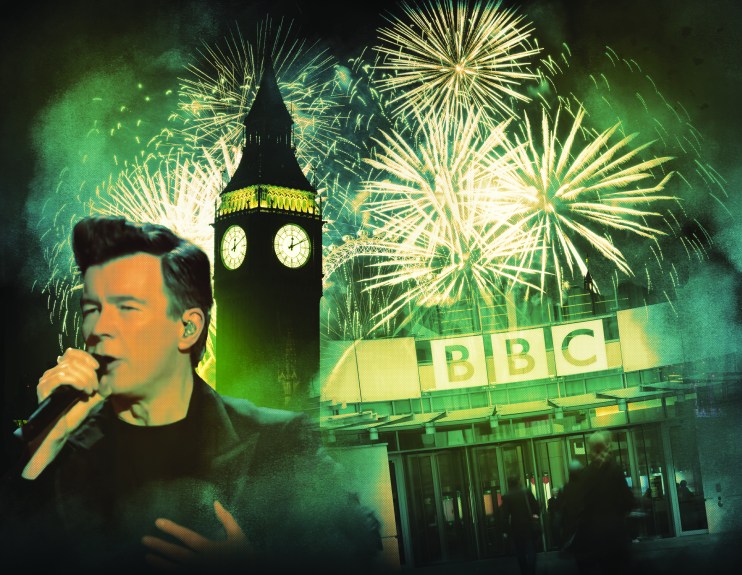
For millions of Brits, the BBC is New Year’s eve: fireworks and Rick Astley are a classic combination for the ‘bed just after midnight crowd.’ But as the singer crooned to the masses, he rang in a very uncertain year for the public broadcaster.
The BBC is in a funding quagmire as the renewal of its governing charter looms in three years’ time.
Currently, the cogs are kept turning by the licence fee, paid by the public to watch live programmes and iPlayer shows.
And it could be scrapped completely in 2027 due to “challenges around the sustainability” of the model, according to a government review teased at the end of last year.
Two ideas often mooted are an opt-in subscription system and advertising, although analysts have said both these options are flawed.
According to Enders Analysis, even with a high subscription rate comparable to Netflix, revenue generated would fall short by over £1bn compared to the current licence fee.
An advertising model would lead to a similar loss of income and could favour commercially viable content at the expense of core BBC genres like news, arts, and regional programming, as well as posing a threat to the BBC’s independence.
What next?
The government review says it aims to report to the secretary of state for the Department of Culture, Media and Sport (DCMS) by autumn this year.
Gill Hind, chief operating officer and TV director at Enders Analysis, told Morning Wire that DCMS will most likely be looking at tweaking the licence fee or exploring a tax-based solution, drawing inspiration from systems evolving in countries like Germany and Finland.
“Whatever change is made,” she said, “it is going to take a huge amount of time to implement because obviously you need to get the buy-in of everyone including politicians in all parties.
“So, I think the first and foremost thing they’ll be looking at is actually what can be done with the current mechanism and how could that potentially be altered in some shape or form,” Hind explained.
Although it would fail to offset the licence fee issue entirely, Hind added that the BBC needs to generate additional revenues from BBC Studios – its in-house production arm, which licences content overseas.
Any changes could however be delayed by the upcoming general election set to take place before January 2025.
Media policy expert at the London School of Economics, Damian Tambini, said he thinks it is “likely” that some kind of public funding mechanism will be found for the stalwart broadcaster after the next election.
Money, money, money
In 2022/23, the BBC made £3.47bn in fees, down from £3.8bn the previous year.
Due to the financial strain, the BBC has already curtailed content spending in a bid to save £500m. It announced cutbacks to programming late last year, which drew anger especially from staff and viewers of Newsnight, the flagship evening news programme, which will be cut back in time and substance.
And Auntie may have bigger problems – namely, competing in a more competitive media environment than ever.
The BBC is now prioritising content that resonates with audiences who are increasingly accessing its services across digital platforms – and the youngsters who are no longer engaging with the public broadcaster as previous generations once did.
Hind said that “perhaps the biggest issue for the BBC is how it appeals to those younger audiences using social media such as Tiktok. That’s not unique to the BBC; it’s for all of the broadcasters to figure out.”
The impending Media Bill, currently in passage through the Commons, could be a game-changer.
For the best part of the past decade, the BBC has been lobbying hard for ‘prominence’: regulations to ensure that public service broadcasters like the BBC and Channel 4 are displayed more prominently on smart TVs and streaming sticks.
Tambini said that governments are “thinking very hard” about how to update the UK’s approach to media policy, with the Online Safety Bill and the Media Bill being the first stage.
“I think the next BBC charter will be a historic charter, which strengthens the BBC, undoes some of the damage which has been done in the last decade and puts it on a much more secure footing for the long term,” he added.
With strong cross-party support, the Media Bill is expected to breeze through parliament.