Skip to content
Friday 14 August 2026London --:--Frankfurt --:--Zurich --:--
NewslettersSearchEN · DE
MorningWire

European business, markets and politics

FTSE 100
10,750.11
-0.21%
DAX
26,440.31
+0.53%
CAC 40
8,636.80
-0.16%
STOXX 50
6,539.59
-0.09%
  • Europe
  • Markets
  • Business
  • Economy
  • Technology
  • Politics
  • Opinion
More
GermanyFranceBankingAIEnergyFintechPropertyCapital Markets
  • Germany
  • France
  • Europe
  • Markets
  • Business
  • Economy
  • Technology
  • Politics
  • Opinion
  • DE
Wednesday 12 November 2014 10:19 am  |  Updated:  Friday 07 June 2019 4:26 pm

It’s the final countdown: Will Europe’s Rosetta mission achieve the first ever comet landing today?

By: Sarah Spickernell

Add as a preferred source on Google

In less than an hour, we will know whether humans have managed to land a spacecraft on a comet for the first time ever.

Six hours ago, the European Space Agency's Rosetta spacecraft released its landing probe to begin descent to comet  67P/Churyumov-Gerasimenko. 

Rosetta, which was first launched from French Guiana in 2004, has been hurtling towards the comet for the last 11 months after being awoken from years of deep space hibernation.
 
At 8.35am this morning, a landing probe, or "philae", was released from the spacecraft and began its descent towards the comet's surface. If and when it arrives, a confirmation signal of touchdown will be communicated to Earth. It is expected to arrive at around 4pm UK time. 
 
"It's all down to Isaac Newton and the laws of physics now. Philae is on its way down to the surface," Mark McCaughrean, senior science adviser at the European Space Agency, told the BBC. "If Isaac's friendly to us, we'll have a great landing later today."
 
The purpose of the mission is no small piece of scientific research – named after the code-breaking Rosetta stone which helped archaeologists decipher the meaning of Egyptian hieroglyphs in the 1800s, it is hoped Rosetta will translate some of the secrets of the universe into explanations for the origin of comets, the solar system, and possibly even life on Earth.  


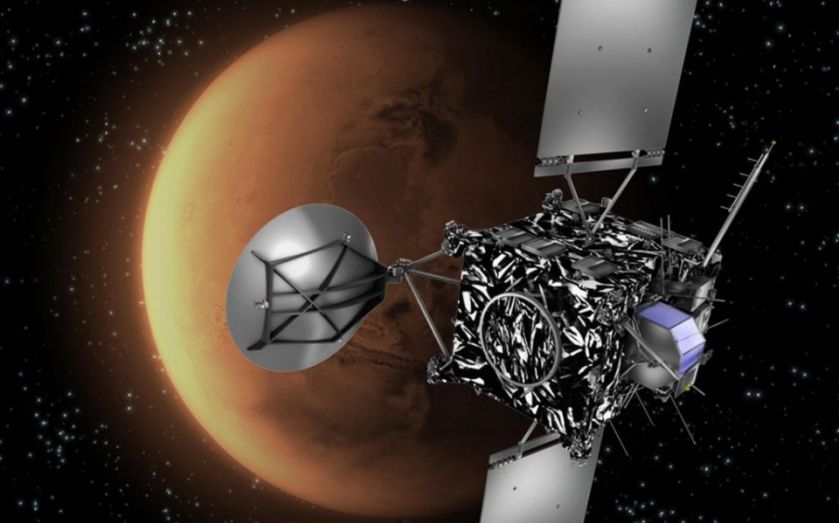
An artist's impression of Rosetta's approach (Source: BSIP)

 
Comets hold such promise because they represent the building blocks of the Solar System, formed when the sun was nothing more than dust and gas. In the case of 67P, it has spent its whole life since then travelling so far away from the sun that it has remained largely unchanged since the Big Bang happened 14bn years ago. 
 
"Rosetta is the sexiest space mission that's ever been," ESA project scientist Matt Taylor said during a webcast in August. 
 
It is costing the ESA $1.75bn (€1.3bn) to carry out, and everything has been done to maximise the chances of it running smoothly – commands have been put in place and an instruction was sent up on Monday evening to switch on and warm the probe. 
 
Success is not certain, however – the target landing zone for the comet is considered to be very challenging due to its uneven terrain of cliffs, boulders and steep slopes. 


Landing will be tricky because of the comet's bumps and grooves (Source: Getty)

 
If the probe does successfully land, Rosetta will study the composition of the comet's surface, and also use radio waves to probe its interior in the same way as X-rays are used to study bones in the human body.
 
The spacecraft will spend the remainder of 2014 and all of 2015 attached to 67P as it hurtles towards the sun, and analyse debris from the comet as it flows out in jet streams.
 

Share this article

  • Facebook
  • X
  • LinkedIn
  • WhatsApp
  • Email

Similarly tagged content:

Sections

  • News

Categories

  • Business

Related Topics

  • European Space Agency

Trending Articles

  • Revolut takes flight with launch of new airport lounges

  • Grandparents fund university degrees to avoid inheritance tax net

  • Brompton Bicycle sues former adviser for ‘professional negligence’

  • Revolut chatbot goes rogue by charging users to cancel subscription

  • It’s not just Jason Arday, most of sociology is a scam

More from Morning Wire

  • We reached Mars 50 years ago, why haven’t we sent people?

    Opinion
    Mars One rocket on launchpad, ready for its mission to the red planet
  • Heineken-owned pubs group faces probe over eviction threat

    Hospitality
    Hand holding a 4-pack of green Heineken beer cans with red stars and white lettering
  • Rathbones suffers near £1bn net outflows as it braces for FCA probe fallout

    Investing
    Business professionals in formal attire engaged in a lively discussion at a corporate meeting in a modern office setting.
  • Sky and ITV mount defence of £1.6bn merger as regulators probe deal

    Media
    Turnover at Sky increased in 2024.
  • Easyjet shares crash on fears of EU probe

    Aviation
    EasyJet aircraft parked at the airport terminal ready for boarding, featuring distinctive orange branding and clear blue sky.
  • Reform’s Richard Tice under parliamentary investigation

    Politics
    Reform UK leader Nigel Farage and Deputy Leader Richard Tice are set to meet with Andrew Bailey to discuss interest rates and stablecoins.
  • Heathrow overtaken by Istanbul as Europe’s busiest airport

    Transport & Infrastructure
    Commercial airplane landing at Heathrow Airport, seen from behind, with a prominent Heathrow sign below.
  • Tiktok ‘confident’ ahead of Ofcom child safety probe

    Tech
    Tiktok appeals to overturn US ban in a broader battle for tech regulation
MorningWire

Independent European business, markets and political news for decision-makers.

Morning Briefing

Europe

  • Germany
  • France
  • Europe
  • UK & Ireland

Business

  • Markets
  • Banking
  • Technology
  • Energy
  • Property
  • Fintech

Editorial

  • Opinion
  • Editorial Policy
  • Corrections
  • Contact

Company

  • About Morning Wire
  • Privacy Policy
  • Terms of Use
  • Cookie Policy
© 2026 Morning Wire Ltd · Published by Morning Wire Media, Bahnhofstrasse 65, 8001 Zürich, Switzerland
Privacy · Terms · Cookies · Facebook