Skip to content
Saturday 8 August 2026London --:--Frankfurt --:--Zurich --:--
NewslettersSearchEN · DE
MorningWire

European business, markets and politics

FTSE 100
10,901.09
+0.31%
DAX
26,319.45
+0.69%
CAC 40
8,714.93
+0.17%
STOXX 50
6,523.86
+0.33%
  • Europe
  • Markets
  • Business
  • Economy
  • Technology
  • Politics
  • Opinion
More
GermanyFranceBankingAIEnergyFintechPropertyCapital Markets
  • Germany
  • France
  • Europe
  • Markets
  • Business
  • Economy
  • Technology
  • Politics
  • Opinion
  • DE
Thursday 09 January 2025 12:06 pm  |  Updated:  Friday 10 January 2025 7:51 am

What is a gilt? And why should you care?

By: Chris Dorrell

Add as a preferred source on Google
Tax Trap: Another 74,000 taxpayers were added to the punitive £100,000-£125,000 income bracket during the 2024/25 tax year
More Brits are set to pay income tax.

Rachel Reeves has had a torrid start to the year.

Financial markets appear to have turned on the Chancellor despite the fact there has been no major economic data so far in 2025.

Investors have been drawing comparisons to the bond market meltdown following Liz Truss’s mini-budget and the IMF bailout in 1976.

But what are gilts and why have they received so much attention?

What is a gilt?

Governments issue debt, bonds, to help pay for public services and investment programmes. A UK government bond is known as a gilt.

Bonds pay out a yield to attract investors – which are usually big financial institutions like investment banks or pension funds. A yield is the annual return that an investor gets on a bond. When the price of a bond falls, the yield rises.

Yields have been rising a lot in recent weeks, which means that the government has to pay out more to attract investors to hold government debt.

The yield on the 10-year gilt hit its highest level since 2008 on Wednesday, while the 30-year gilt climbed to its highest level this century.

The sell-off in gilts has been driven by a number of factors. The bulk of the increase has been driven by changing expectations about the path for interest rates in the US.

However, concerns about the outlook for the UK economy have also added to market jitters, and UK yields have been rising faster than yields elsewhere.
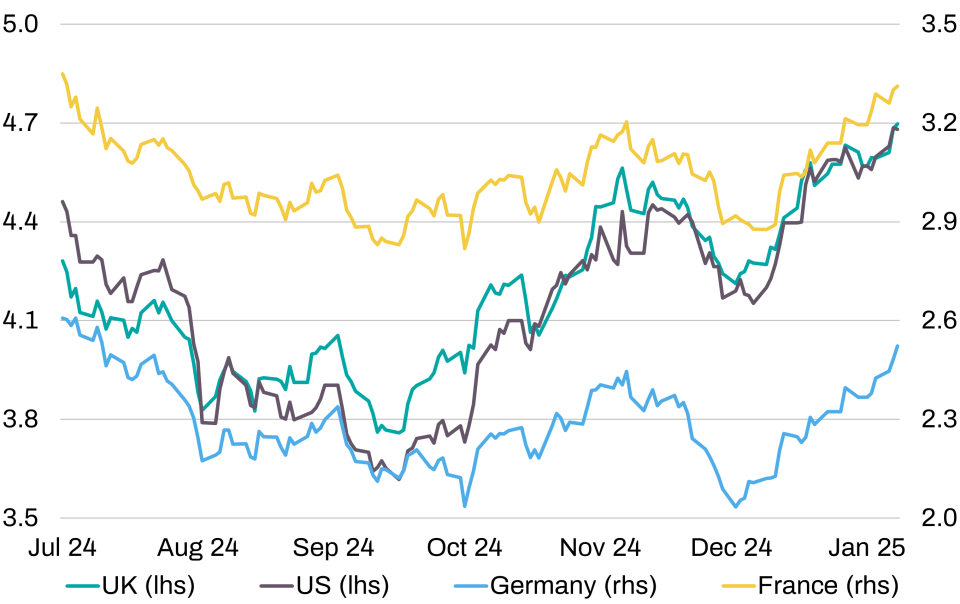
Government bond yields. Source: Peel Hunt.

Whatever the cause, the outcome is the same. The upward movement will likely add billions to the government’s total spending bill.

That’s because spending on debt interest makes up a large portion of total government spending. According to the most recent forecasts from the Office for Budget Responsibility (OBR), made in October, spending on debt interest will be £89bn in 2024/25, 7.3 per cent of total spending.

Why rising gilt yields are bad news for Rachel Reeves

So why should you care?

There are two reasons why you should care about rising gilt yields.

Read more

A beginner’s guide to appeasing the bond market – and why it matters

Chancellor Healey speaking at a podium before a crowd, with the HM Treasury sign visible on the brick building.

First, it could force Rachel Reeves to raise taxes or cut spending again this year.

In October, Reeves left herself a £9.9bn buffer to meet her key fiscal rule of ensuring that tax receipts match day-to-day spending.

The OBR will publish new economic forecasts in March which will include the most recent market movements, as well as slower-than-expected growth since October.

Most economists think this new set of forecasts will show Reeves needs to find some extra cash to stay on the right side of the fiscal rules.

The government has stressed that it will do exactly that should the situation require it.

“No one should be under any doubt that meeting the fiscal rules is non-negotiable and the government will have an iron grip on the public finances,” the Treasury said on Wednesday.

Play Video

Will the government have to cut spending?

Reports suggest the Chancellor will favour spending cuts rather than tax rises if she needs to shore up the public finances.

Some economists worry that further tax hikes would pile pressure on an already weak economy, making the fiscal situation even more perilous.

But gilt yields also act as benchmarks for lending in the rest of the economy. This is because they reflect expectations about the likely path of interest rates.

Higher yields effectively mean that financial conditions are tighter across the economy as a whole, making it more difficult for households to get a mortgage or businesses to take out loans.

Paul Dales, chief UK economist at Capital Economics, said higher gilt yields would contribute to a “further rebound” in mortgage rates in the coming weeks.

Dales expects that typical mortgage rates will rise from around 4.5 per cent during December to just over 5.0 per cent.

Higher borrowing costs across the board will add a further headwind to the UK in early 2025. Matthew Ryan, an analyst at Ebury, said the impact on the economy “is not to be underestimated”.

Read more

‘Moron premium’ – Westminster turmoil has ‘cost taxpayers £35bn’ since 2022

Westminster Houses of Parliament under clear sky, iconic London landmark representing UK government and politics

Share this article

  • Facebook
  • X
  • LinkedIn
  • WhatsApp
  • Email

Similarly tagged content:

Sections

  • News
  • Markets & Economics

Categories

  • Economics

People & Organisations

  • bond markets
  • Gilts
  • governement bonds
  • Keir Starmer
  • Labour
  • Labour Party
  • markets
  • Rachel Reeves
  • Treasury
  • UK economy
  • UK Government
  • UK Interest Rates

Trending Articles

  • WPP slashes jobs as revenue continues to fall

  • Liverpool owners tipped to sell – but not to Amazon boss Bezos – by former CEO

  • Revolut founder’s wealth set to balloon amid talks of share award at $500bn valuation

  • Starling plans to ‘come out swinging’ in diversification bid

  • As it happened: Stocks rise despite new tensions in Strait of Hormuz; Oil price climbs

More from Morning Wire

  • A beginner’s guide to appeasing the bond market – and why it matters

    Markets
    Chancellor Healey speaking at a podium before a crowd, with the HM Treasury sign visible on the brick building.
  • ‘Moron premium’ – Westminster turmoil has ‘cost taxpayers £35bn’ since 2022

    Politics
    Westminster Houses of Parliament under clear sky, iconic London landmark representing UK government and politics
  • Can the City make friends with Healey?

    Politics
    Chancellor John Healey smiling, wearing a navy suit, white shirt, and red tie.
  • Why even gilts are outperforming the once unstoppable Magnificent 7 this year

    Markets
    Depiction of the Magnificent 7 tech companies experiencing financial decline, with stock charts showing negative trends
  • Investors ‘may be less than impressed’ by John Healey’s £9bn borrowing plans 

    Economics
    Man in suit and red tie speaking at a podium to an audience in a modern building.
  • Milestone Alphabet century bond already under pressure

    Markets
    Googles modern Kings Cross headquarters showcasing innovative architecture in Londons dynamic tech district
  • UK borrowing costs soar as Iran ceasefire collapses

    Markets
    Rising borrowing costs depicted amid escalating tensions following the Iran war, illustrating economic impact on global ma...
  • IMF offers UK modest growth upgrade despite fresh Iran war tension

    Economics
    Rachel Reeves delivering Spring Statement 2026 at UK Parliament, addressing economic policies and fiscal strategies.
MorningWire

Independent European business, markets and political news for decision-makers.

Morning Briefing

Europe

  • Germany
  • France
  • Europe
  • UK & Ireland

Business

  • Markets
  • Banking
  • Technology
  • Energy
  • Property
  • Fintech

Editorial

  • Opinion
  • Editorial Policy
  • Corrections
  • Contact

Company

  • About Morning Wire
  • Privacy Policy
  • Terms of Use
  • Cookie Policy
© 2026 Morning Wire Ltd · Published by Morning Wire Media, Bahnhofstrasse 65, 8001 Zürich, Switzerland
Privacy · Terms · Cookies · Facebook