What makes King’s Cross London’s best train station? Competition

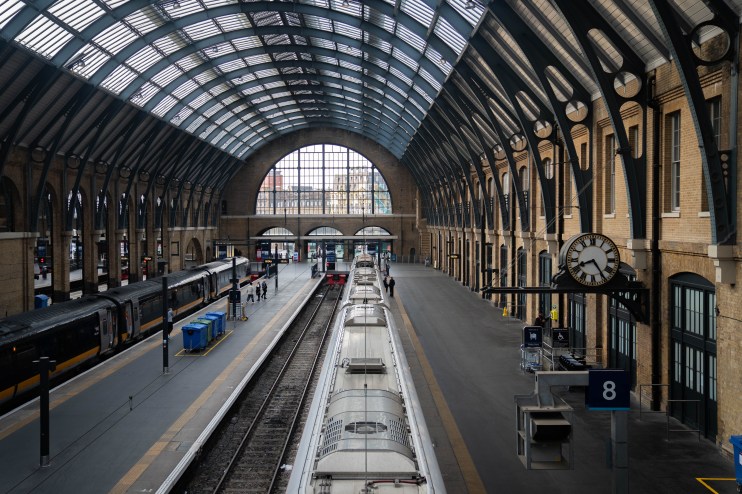
Passengers on the East Coast mainline enjoy fierce fare competition and a choice of routes, so why isn’t this successful model replicated elsewhere on the network? Asks Tony Lodge
What makes King’s Cross unique among London’s train stations? Why do passengers who use the station rate most of its train services the very best in the country and what are the lessons for the rest of the rail network?
The answer is competition and choice. Tonight at King’s Cross, passengers heading north on the East Coast mainline can choose between four high-speed train operators and consequently enjoy fierce fare competition and a wide choice of routes.
So why is this popular and hugely successful model still only a feature at King’s Cross where the main government-run and subsidised operator, LNER, competes with three unsubsidised and privately run ‘open access’ operators.
Trains from this station record the highest passenger satisfaction ratings in the country. Two of the open access operators, Lumo and Hull Trains come top with an eye-catching 96 per cent satisfaction with LNER on 80 per cent. Similarly, these operators also come top in many other key areas.
The evidence is clear; when train operators face competition they raise their game and attract more people to the railway. They deliver better services at competitive fares because they have to fight for passengers. This is crucially important when we look at the latest rail statistics from the Office of Rail and Road (ORR).
In the year to the end of March, revenue from passengers was £10.3bn. That is just 82 per cent of the £12.7bn generated in 2019/20 (before Covid), despite the total number of journeys being made recovering to 93 per cent, yet on the East Coast route competition has led to all the operators fully recovering and growing.
Key opportunities for a new government to seize will be encouraging open access train competition from all of London’s mainline stations as the new ‘Great British Railways’ brand is launched. Such services are already proposed from Paddington and new applications were recently submitted for services from Euston, subject to approval. But what about Liverpool Street, Waterloo, Victoria and St Pancras, where passengers endure monopoly train services?
Earlier this year ministers said they were looking to identify spare capacity on the railways which could be awarded to new open access train services. This was welcome but we will also need to see key changes made to future railway timetables. Underused London commuter services, especially on Fridays, should be removed from the timetable and these ‘ghost train’ slots given to high-demand faster long-distance services.
The long-weekend rail leisure market is booming and this lucrative demand must be met. Similarly, any move by rail planners to restrict existing and new open access services must be opposed, especially as these hugely popular services record some of the highest passenger growth on the network and bring lower fares for passengers. Planners must better prioritise which services satisfy high demand and boost connectivity against those which aren’t popular and consequently lose money.
Why would rail planners allow underused train slots to block out high-demand and high-growth ones, especially when the annual rail subsidy still stands at £4bn, according to ORR data.
In particular the new government should quickly encourage the approval of open access applications to bring high speed train competition between Manchester, Sheffield and the capital. These important cities endure one monopoly long-distance train operator which leads to a disproportionate number of journeys by car and coach and comparatively high rail fares. The First Group proposal to connect Manchester Victoria (and Rochdale) would also give London a direct connection to Salford’s Media City, home to the BBC and a large number of growing tech businesses.
There’s a proven model to get the railways back on track, the next government should use it.
Tony Lodge is a research fellow at the Centre for Policy Studies and author of Rail’s Second Chance – putting competition back on track, published by the CPS