Skip to content
Wednesday 12 August 2026London --:--Frankfurt --:--Zurich --:--
NewslettersSearchEN · DE
MorningWire

European business, markets and politics

FTSE 100
10,836.84
-0.07%
DAX
26,469.63
+0.30%
CAC 40
8,695.89
-0.22%
STOXX 50
6,556.74
+0.08%
  • Europe
  • Markets
  • Business
  • Economy
  • Technology
  • Politics
  • Opinion
More
GermanyFranceBankingAIEnergyFintechPropertyCapital Markets
  • Germany
  • France
  • Europe
  • Markets
  • Business
  • Economy
  • Technology
  • Politics
  • Opinion
  • DE
Tuesday 19 January 2021 6:00 am  |  Updated:  Monday 18 January 2021 4:19 pm

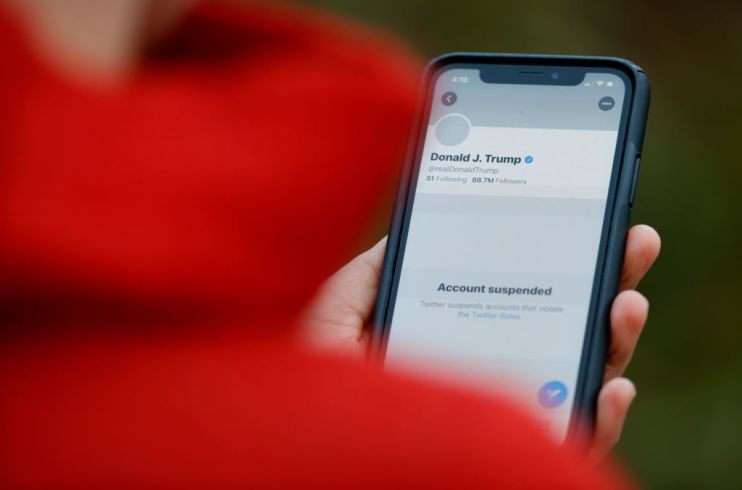
What next for social media regulation in the post-Trump world?

By: Jessica Lovell

Add as a preferred source on Google
Twitter Permanently Suspends President Donald Trump's Twitter Account
Citing the risk of further incitement of violence following an attempted insurrection on Wednesday, Twitter permanently suspended President Donald Trump’s account. (Photo Illustration by Justin Sullivan/Getty Images)

Two weeks on from the storming of the US Capitol the social media excision of the 45th US President is so extensive, the holder of the most powerful office in the world is presently unable to log in to Pinterest to create a mood board for his impending house move.

His exclusion has drawn condemnation from advocates as unlikely as Angela Merkel and French finance minister Bruno Le Maire, hardly MAGA cap wearers.

These critics hit on the difficult truth that political content on social media is almost impossible to regulate.

Read more: China’s money is coloured – it’s about the regime, not profit

On one hand, as Merkel and others point out, having the limits of political speech decided by policies and judgements of private companies and whoever happens to own them is at least “problematic”.

On the other, the policies the social networks apply cannot be regulated by governments either. If politicians are prepared to say things so outrageous social networks feel they must be deleted, it’s fair to assume those same politicians are likely to be willing to amend regulations in retaliation.

This is the circular lock that will bog down the debate on regulating political speech online for years.

It seems to be no coincidence that the strong actions against Trump and his assault on democracy only came after President Elect Biden was confirmed by the joint session in the US Capitol (you may not need to guess how content has been treated from countries that don’t choose a new leader every four years).

Why? The answer looks to be because the social networks want to avoid that risk of retaliation; most likely change to the beloved 1996 Federal legislation that protects them from liability for any content they host in the US.

Read more

The 24-hour news cycle is ruining politics

Downing Street entrance with iconic black door, relevant to UK government and politics, set in a historic London street scene

The very sentence highlights the nonsense of how poorly the world has legislated for the rise of social media: the US is judging Snapchat against law designed to protect Geocities from copyright claims at the time Bill Clinton started his second term.

The effect of that protection is what dictates the attitude of social media companies throughout the world: if they are immune at home in the US then why not elsewhere?

For starters because other countries have not dealt with responsibility for content in the same way.  you could just as easily highlight that some of the law we still use to govern the internet in the UK originates from 17th century attempts to stop people killing each other duelling for honour, but the application of data protection law to internet companies in Europe has been a significant and valuable change.  

While contemplating regulation around political speech may be hard the priority for governments now must be to avoid it being cited as a get out of jail card for social networks to avoid being regulated at all. The truth is that the argument around other harmful content is easy.

Social networks are rife with bitcoin scams, hate speech and vile content encouraging self-harm. The multi-billion dollar businesses running the social networks know this: it is reported to them, they know it’s there and they know it keeps being posted again. Yet they still act against it lethargically and reluctantly, if at all.

If you ever need to get a teenager off a device at speed you quickly see how effectively tech companies have innovated to encourage one more click and to keep eyes on screen.

If they approached innovation to protect users from harmful content half as enthusiastically many problems could be avoided.

Read more: Those who profit in Hong Kong should speak up for its freedoms

Read more

Government accelerates social media crackdown with midnight curfews

Getty Images logo on a digital screen, symbolizing media and photography industry presence in news and business contexts

Share this article

  • Facebook
  • X
  • LinkedIn
  • WhatsApp
  • Email

Similarly tagged content:

Sections

  • Jobs and Money
  • Opinion

Categories

  • Fintech
  • Opinion

Related Topics

  • Social media

Trending Articles

  • Five-star Mayfair hotel hit with HMRC winding-up petition

  • Nottingham Forest owner Marinakis sues Crystal Palace for defamation

  • Back to basics: Sainsbury’s gradual retreat from the British high street

  • Hargreaves Lansdown orders staff back to office

  • As it happened: Intel, Arm shares slide; Oil climbs higher

More from Morning Wire

  • The 24-hour news cycle is ruining politics

    Opinion
    Downing Street entrance with iconic black door, relevant to UK government and politics, set in a historic London street scene
  • Government accelerates social media crackdown with midnight curfews

    Tech
    Getty Images logo on a digital screen, symbolizing media and photography industry presence in news and business contexts
  • David Brent was supposed to be a satire, now he looks like a model for political leaders

    Opinion
    Ricky Gervais as David Brent performing on stage, wearing sunglasses and a patterned vest.
  • Natwest boss becomes latest City figure caught in AI social media scam

    Banking
    NatWest building exterior with logo, highlighting corporate presence and architecture on a business news website.
  • Sadiq Khan urges tougher Ofcom action as UK prepares social media ban rules

    Tech
    Sadiq Khan addressing media at a press conference in formal attire, discussing recent developments in London policies
  • The Debate: Should political donations be capped at £100,000?

    Opinion
    Nigel Farage delivering a speech in July 2026, wearing a suit, addressing an audience at a political event.
  • The only answers to over-tourism are prices or queues

    Opinion
    Tourists photograph the ornate white marble Trevi Fountain in Rome, Italy.
  • ‘Moron premium’ – Westminster turmoil has ‘cost taxpayers £35bn’ since 2022

    Politics
    Westminster Houses of Parliament under clear sky, iconic London landmark representing UK government and politics
MorningWire

Independent European business, markets and political news for decision-makers.

Morning Briefing

Europe

  • Germany
  • France
  • Europe
  • UK & Ireland

Business

  • Markets
  • Banking
  • Technology
  • Energy
  • Property
  • Fintech

Editorial

  • Opinion
  • Editorial Policy
  • Corrections
  • Contact

Company

  • About Morning Wire
  • Privacy Policy
  • Terms of Use
  • Cookie Policy
© 2026 Morning Wire Ltd · Published by Morning Wire Media, Bahnhofstrasse 65, 8001 Zürich, Switzerland
Privacy · Terms · Cookies · Facebook