What’s causing the current global shortage of semiconductor chips?

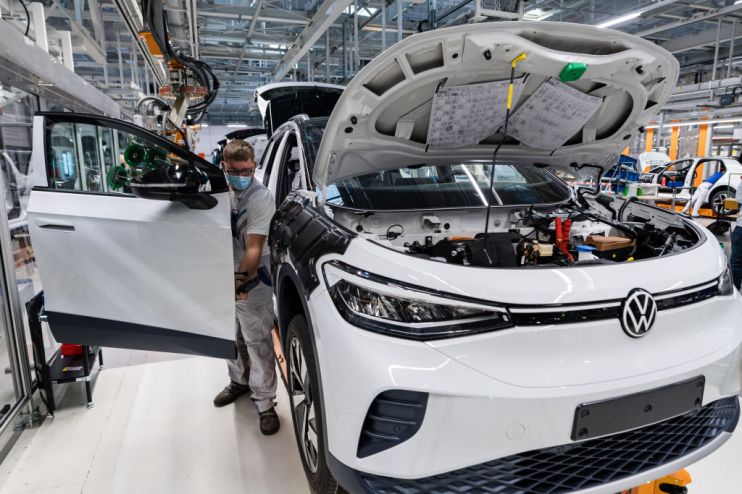
The modern world runs on semiconductors; everything from mobile phones to washing machines depends on these tiny microchips.
But few industries are so totally dependent on these microprocessors as the automotive sector, as has been proved time and again over the last couple of months.
One by one, a roll-call of the world’s biggest carmakers have come out and said that they will be forced to delay or cut production due to a shortage of these chips.
Earlier this month, it was US giant General Motors’ turn; before that, everyone from Audi to Mazda to Subaru issued the same warnings. In the UK, Honda’s Swindon factory has been forced to halt production multiple times over the issue.
So what’s going on?
What are semiconductors?
Put simply, semiconductors are materials like silicon which can conduct electricity – making them essential for our tech-centric world.
Since first being used in radios, these materials are now integral – in the form of microchips – to almost all electronic devices.
In the auto world, power steering, brake sensors, and parking cameras, the standard specs of a modern car, are all dependent on these chips.
According to Deloitte’s head of auto Michael Woodward, there are about 1,300 such chips in a petrol or diesel car, but over 3,500 in a electric vehicle.
Around 50 to a 100 of these chips have “significant” processing power, says Woodward – meaning they are used for advanced solutions such as engine management and radar.
So why is there a shortage?
In a word: coronavirus. Faced with months confined inside our homes, we’ve turned to our electronic devices like never before to keep boredom at bay.
At the same time, car factories were shuttered for months, and even when they were reopened, new car sales stayed low.
As a result, demand for tech like laptops, tablets, and games consoles has soared, meaning that there are fewer chips available for global auto players.
But with car sales now beginning to pick up again – especially in China, the world’s largest car market – auto firms are unable to increase production due to the shortfall.
According to Falan Yinug, director of industry statistics and economic policy at the Semiconductor Industry Association, demand for the chips recovered just as quickly in the autumn as it had collapsed in the spring, leading to an imbalance.
Writing in a blog post, he said: “The clear decrease in monthly year-over-year sales growth for application-specific chips used in the automotive market was sudden and precipitous in March and April, when the pandemic was shuttering auto plants globally.
:Equally as pronounced was the rapid recovery in sales during the third and fourth quarters. In fact, monthly fourth quarter sales had recovered to be positive again.”
The issue is complicated further by the fact that most car factories operate “just-in-time” supply chains – meaning instead of keeping large stockpiles of key elements, parts arrive as and when they are required.
But with few chips making their way to factories, and few in stores, manufacturers have little choice but to shut down production lines into volumes return.
Woodward says that there was no doubt carmakers would have to change their production plans as a result.
There could also be a shortage of other semiconductor dependent tech if demand continues on its current trajectory.
So when will the shortage be resolved?
Carmakers, look away now – the problem is not going away soon. Woodward says that production will likely slow for a couple of months at least.
Semiconductor factories – which are largely based in Asia – are in the process of ramping up production, but have warned that any increase will not be instant.
The chips are themselves incredibly complex examples of manufacturing, and can take up to 26 weeks to produce.
Even the elements have now got involved. The brutal winter storm currently engulfing Texas, the centre for US chip manufacturing, has forced Samsung and NXP to cease production.
Politics is also likely to slow things down. Last week China’s top chipmaker Semiconductor Manufacturing International said that sanctions imposed by the Trump administration had disrupted its own supply chains, which would have a knock-on effect on its own on production.
For the car industry, Woodward warns that this current shortage could be just the first of a number of production issues that emerge as electric vehicles become more and more popular.
“This could be the first of a number of supply constraints that could start impacting EV production. We saw in 2019 what happened when there was a shortage of lithium – because the speed of uptake was quicker than expected, manufacturers got caught on the hop”, he told Morning Wire.
“We could see something similar this year with cobalt, which all comes from one small region in the DRC. It’ll get sorted out when a new source of supply is identified, but in the short term it could well cause a production slowdown.”