Where will Ethereum PoW miners go post-merge?


by Tim Bullman, CEO of Caduceus Foundation
With Ethereum’s merge to proof-of-stake (PoS) around the corner, a global array of proof-of-work (PoW) miners, along with their collective resources and capital (that accounted for $19 billion in revenue in 2021), are actively migrating to other platforms.
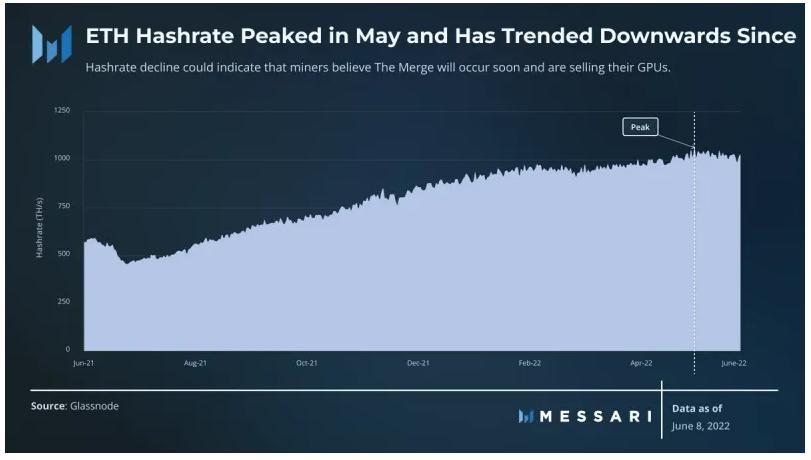
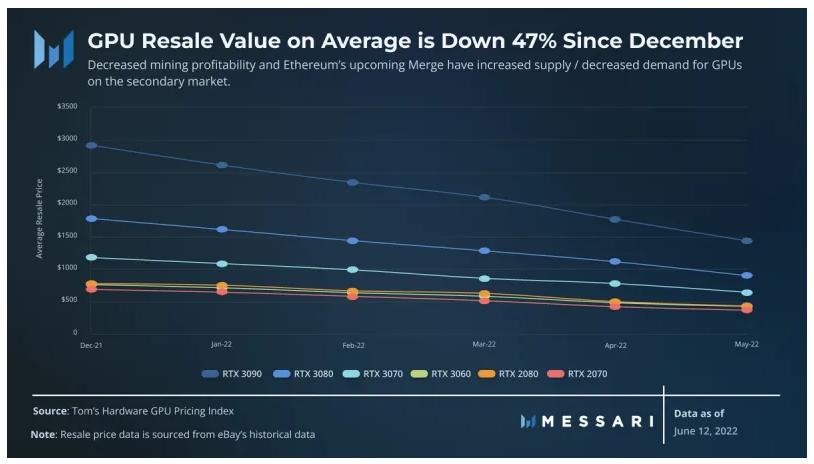
Such activity is further evidenced by Messari data which reveals a steady decline in Ethereum’s hash rate since May 2022 and a 47% drop in GPU resale value since December 2021.
(image: https://messari.io/report/what-will-ethereum-miners-do-after-the-merge?referrer=grid-view)
(image: https://messari.io/report/what-will-ethereum-miners-do-after-the-merge?referrer=grid-view)
What about alternative PoW chains?
But contrary to popular thought, relocating resources and capital to alternative PoW blockchains is not always sustainable. This is largely because increased hash rate (mining activity) on lesser-known PoW chains (while correlated) does not directly cause a price rise of the associated token.
See also: https://minerdaily.com/2021/btc-price-follows-hash-rate-no-not-necessarily/
If said token has relatively low levels of liquidity or user engagement, it could create an inverse effect, whereby mining difficulty increases (due to more participants) and the rewards, (or chances of earning them), fall. As a result, a majority of profits invariably flow to entities (like institutions) that can leverage the cheapest energy and most extensive facilities.
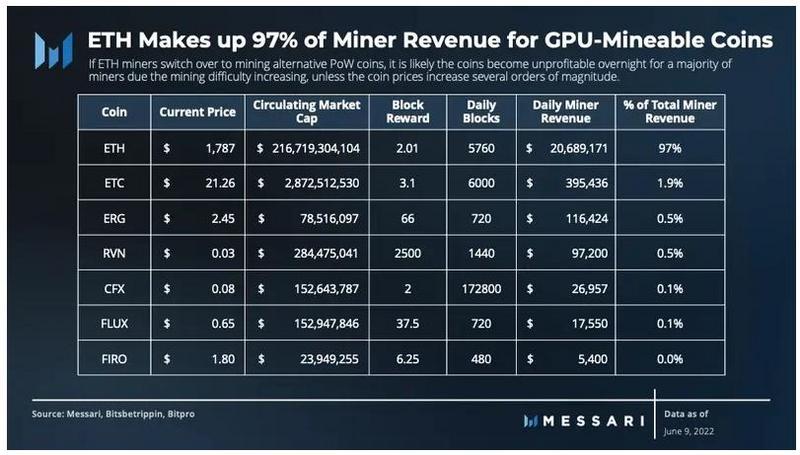
Considering PoW chains like Ethereum Classic (ETC) don’t have nearly the same liquidity, market cap, or user engagement as Ethereum (which accounts for 97% of the GPU miner revenue), the 90% of Ethereum miners with GPU-based hardware need to look for more viable solutions.
(image: https://messari.io/report/what-will-ethereum-miners-do-after-the-merge?referrer=grid-view)
The Caduceus solution
With this in mind, alongside becoming a validator on PoS or supporting the growing Zero-Knowledge Proofs (ZKPs) ecosystem, a more pragmatic approach is for miners to contribute their GPU power towards data centres and data-intensive Web3 protocols, like the collective tapestry of Metaverses that require high-performance computing. One shining example amongst these burgeoning options is the metaverse-centric blockchain, Caduceus. Recently listed on Bybit and securing partnerships with prominent NFT brands like HAPE, the Caduceus protocol functions as an infrastructure layer for future Metaverse development.
Buying and selling GPU processing power with $CMP tokens.
The native $CMP token will help enterprise (institutional) clients purchase and utilize greater degrees of computational power from a global network of Caduceus nodes (miners), ultimately increasing efficiency and reducing rendering cycles – all at a fraction of traditional costs.
Furthermore, with an open C2B business structure, the Caduceus ecosystem will also allow any GPU device (like personal laptops) connected to the network to offer idle processing power in exchange for $CMP tokens. In essence, compared to market volatility that impacts conventional mining revenue and profitability, Caduceus offers stronger, more stable incentives for miners and enterprise clients that can mutually benefit via the $CMP token.
Rendering nodes:
Ethereum PoW miners can become a “rendering node” on Caduceus by locking up a set quantity of CMP tokens. The network will then secure these devices’ processing power through smart contracts. The locked $CMP tokens will also act as collateral (similar to the Filecoin staking mechanism) to mitigate against malicious behaviour.
Similar Web3 protocols
Further examples of similar Web3 protocols that miners can contribute their GPU power to include:
- Render Token: Founded in 2016, the vision of Render Network is to democratize GPU cloud rendering. As alluded to in the name, it achieves this by connecting users looking to perform render jobs with people who have idle GPUs to process the renders. Once users, like miners, register their idle GPUs on the Render Network, these GPU owners become “Node Operators” and are able to earn RNDR Tokens by accepting jobs advertised on the platform.
- Livepeer Network: With over 100 total active nodes, Liverpeer is a decentralized network for video streaming, which relies on miners to provide video transcoding services using GPUs and earn LPT tokens along with ETH in return.
- Computecoin: With over 200,000 nodes, and similar to Caduceus, Computecoin is an infrastructure platform that empowers Web3 and the Metaverse by providing powerful, low-latency, cost-effective and reliable computing resources so that developers can easily and deploy dApps in a decentralized manner across the growing Web3/Metaverse ecosystem.
Conclusion
Overall, despite the substantial revenue that Ethereum will remove from miners post-merge, an even greater opportunity remains for platforms like Caduceus that can fill the void with practical incentives and revenue streams while also allowing associated sectors to benefit from sizable computational power on offer.