Skip to content
Monday 10 August 2026London --:--Frankfurt --:--Zurich --:--
NewslettersSearchEN · DE
MorningWire

European business, markets and politics

FTSE 100
10,881.10
-0.18%
DAX
26,334.89
+0.06%
CAC 40
8,696.43
-0.21%
STOXX 50
6,527.69
+0.06%
  • Europe
  • Markets
  • Business
  • Economy
  • Technology
  • Politics
  • Opinion
More
GermanyFranceBankingAIEnergyFintechPropertyCapital Markets
  • Germany
  • France
  • Europe
  • Markets
  • Business
  • Economy
  • Technology
  • Politics
  • Opinion
  • DE
Tuesday 04 June 2024 3:57 pm  |  Updated:  Tuesday 04 June 2024 4:31 pm

Whisper it, but private equity returns might just be too good to be true


By: Elliot Gulliver-Needham

Add as a preferred source on Google
Forecasters are under intense pressure to predict the unpredictable.

A new paper has suggested private equity houses have been adjusting fund performance figures to smooth returns and increase their appeal to investors.

A research paper written by Maria Borysoff and Gregory Brown has claimed private equity funds regularly shift reported losses and profits in funds to smooth overall returns.

The traditional metric used by private equity houses to measure returns is multiples of invested capital (MOICs), and the paper analysed over 1,000 buyout funds and their MOICs over time.

It found that there was an unusually low frequency of multiples just below one in MOICs, which would suggest a loss, compared to an unusually high frequency of payouts equal to or just above one.

“This behaviour is consistent with funds attempting to minimise loss ratios which are commonly used to assess the riskiness of funds by outside investors and consultants,” explained the paper.
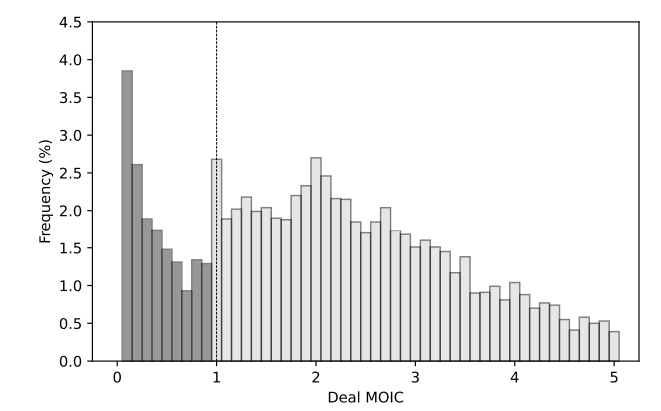
More experienced private equity partners appear more likely to use this ‘loss avoidance’ technique, especially while fundraising for their next fund. If the technique is used, the partners “raise significantly larger subsequent funds relative to their peers,” the paper said.

However, while this may benefit the private equity partners, loss avoidance “is negatively associated with the final fund returns that investors receive,” it warned.

Last week, the Financial Times reported that data compiled by Preqin revealed that private capital firms had taken more money from investors than they had distributed back to them in gains for six years in a row.

Over the last 14 years, private capital funds have bought in $821bn more than they have distributed, or $1.6 trillion over the last six years, as money brought in has remained locked in funds that aren’t distributing any returns.

Read more

Swiss Pension Funds Increase Commitments to Record Infrastructure Equity Fund to EUR 1.23 Billion

Despite this, the seven largest listed North American private capital companies have earned over $100bn in labour and stock-based compensation costs over the last five years.

Private equity bosses have consistently argued they’re better at running businesses, which would explain why the paper found a lower-than-expected level of losses in portfolios.

However, that doesn’t explain why funds have sucked in so much capital over the past 14 years with minimal distributions to investors.

The one-way flow of capital suggests funds have struggled to realise portfolio company uplifts.

Another analysis the paper did involved Benford’s Law, which states that numbers starting with the digit ‘1’ should appear more frequently than numbers starting with ‘2’, which are then more frequent than ‘3’ and so on.

This distribution is often used when analysing data that may have been prone to tampering, such as election fraud, as those editing the underlying figures will not take into account the expected statistical distribution.

When the first two digits of reported MOICs are analysed across all private equity funds, the values do not match Benford’s Law, clearly signally data manipulation.

This effect is especially large when a fund is raising money, but once a fund is closed for investment, the effect vanishes.
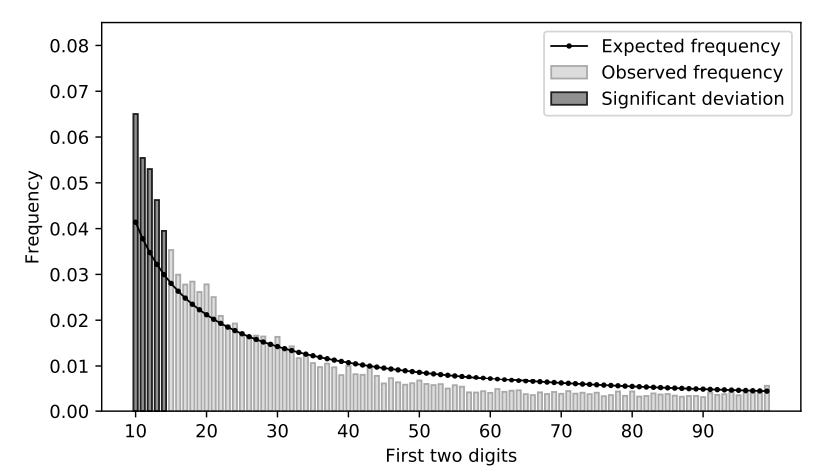
“While our analysis provides no evidence of improper or fraudulent behaviour by funds, it does suggest that funds may potentially reallocate resources to get small losers to the break-even point,” the paper concluded.

Read more

Loomis Sayles Growth Equity Strategies Team Celebrates Twenty-Year Milestones

Share this article

  • Facebook
  • X
  • LinkedIn
  • WhatsApp
  • Email

Similarly tagged content:

Sections

  • News

Categories

  • Business

People & Organisations

  • fraud
  • Investment
  • private equity

Related Topics

  • Private equity

Trending Articles

  • Back to basics: Sainsbury’s gradual retreat from the British high street

  • Thames Water faces fresh threat to survival after pensions regulation breach

  • Hargreaves Lansdown orders staff back to office

  • PwC’s Embankment HQ to get major makeover ahead of Canary Wharf move

  • A tribute to wine legend Matthew Jukes by his friend Libby Brodie

More from Morning Wire

  • Swiss Pension Funds Increase Commitments to Record Infrastructure Equity Fund to EUR 1.23 Billion

    Business Wire
  • Loomis Sayles Growth Equity Strategies Team Celebrates Twenty-Year Milestones

    Business Wire
  • ROYC Selected by Slättö as Structuring and Platform Solution for Luxembourg Feeder Fund

    Business Wire
  • Clifford Chance partners pocket £2.3m as private markets drive growth

    Law
    Silhouetted person walks past a modern building with 10 Upper Bank Street visible on its glass facade at night.
  • Record Launches “Record Amanah” Sharia-Compliant Investment Platform

    Business Wire
  • Pension funds pledged a private investment splurge. Three years on, has anything changed?

    Markets
    Mansion House meeting of pension fund leaders discussing investment strategies and financial accords in a grand boardroom ...
  • ‘You can blame us’: The firm that sparked accountancy private equity gold rush

    Accountancy
    On the hunt for lost savings
  • Grant Thornton partners pocket £35m from private equity deal

    Prof Services
    Grant Thornton building exterior with illuminated logo and name against a dramatic pink and purple sky at dusk.
MorningWire

Independent European business, markets and political news for decision-makers.

Morning Briefing

Europe

  • Germany
  • France
  • Europe
  • UK & Ireland

Business

  • Markets
  • Banking
  • Technology
  • Energy
  • Property
  • Fintech

Editorial

  • Opinion
  • Editorial Policy
  • Corrections
  • Contact

Company

  • About Morning Wire
  • Privacy Policy
  • Terms of Use
  • Cookie Policy
© 2026 Morning Wire Ltd · Published by Morning Wire Media, Bahnhofstrasse 65, 8001 Zürich, Switzerland
Privacy · Terms · Cookies · Facebook