Skip to content
Sunday 16 August 2026London --:--Frankfurt --:--Zurich --:--
NewslettersSearchEN · DE
MorningWire

European business, markets and politics

FTSE 100
10,750.11
-0.21%
DAX
26,440.31
+0.53%
CAC 40
8,636.80
-0.16%
STOXX 50
6,539.59
-0.09%
  • Europe
  • Markets
  • Business
  • Economy
  • Technology
  • Politics
  • Opinion
More
GermanyFranceBankingAIEnergyFintechPropertyCapital Markets
  • Germany
  • France
  • Europe
  • Markets
  • Business
  • Economy
  • Technology
  • Politics
  • Opinion
  • DE
What is City Talk? City Talk allows marketers to connect directly with our audience by publishing content on morningwire.eu
Wednesday 28 October 2020 10:40 am  |  Updated:  Wednesday 28 October 2020 10:43 am

Who’s afraid of Jerome Powell?

By: CFA Institute Contributor

Add as a preferred source on Google

I see charts of central bank balance sheets everywhere.

Maybe it’s because I am so adamant that quantitative easing (QE) isn’t going to create inflation that I notice them so much.

But then again, there is a reason these charts pop up time and again. After all, the US Federal Reserve has increased its balance sheet by $2.8 trillion, or 13.6% of US GDP, between January and July 2020. The Bank of England (BOE) has expanded its balance sheet by $306 billion or 10.7% of UK GDP, and the European Central Bank (ECB) by $2.3 trillion, or 19.9% of eurozone GDP, over the same time period.

All this money has to go somewhere and when it arrives in the economy, it will not only create growth, it will also create inflation.

Exorcising the Ghosts of 2009

But unlike in 2009 and 2010, when we were in truly uncharted waters, we now know how QE works. We have had more than a decade to study its effects on economic growth and inflation.

A group of researchers recently examined all the studies done on the impact of QE on growth and inflation over the years. In the United States, they found that QE to the tune of 1% of US GDP increases the price level by 0.21%. In the United Kingdom, the price level rises by 0.04%, and in the eurozone by 0.11%.

If we apply these findings to the balance sheet expansion of central banks thus far in 2020, we come to an expected increase in the price level of 2.9% in the United States, 0.4% in the United Kingdom, and 2.2% in the eurozone.

Central Bank Balance Sheet Expansion 2020: Cumulative Impact on Price Levels
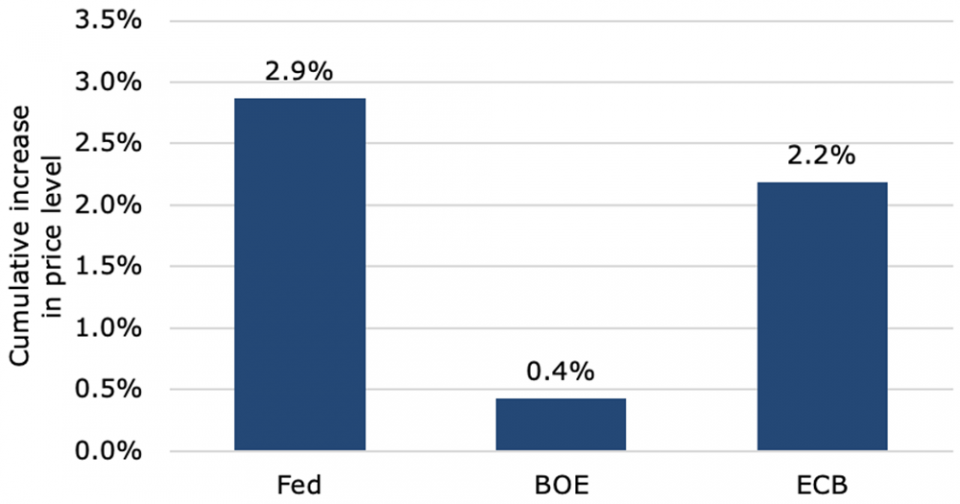
Source: Fabo, Brian, et al. “Fifty Shades of QE: Conflicts of Interest in Economic Research”

Read more

UK debt ‘hits £3 trillion’ milestone

Houses of Parliament in Westminster showcasing historic architecture under a clear sky, central to UK government and politics

Keep in mind that this is an increase in the price level, not an increase in inflation. What these numbers mean is that if the total effect of QE were to be felt over one year, inflation rates in the United States would go up by 2.9 percentage points in that year and then go back to the previous level, assuming there is no additional QE.

If the effect of QE is spread out equally over two years, then inflation rates in Year 1 and Year 2 would be 1.45 percentage points higher and then fall back to pre-QE levels thereafter, and so on.

So what’s the takeaway from all of this?

The overall impact of the balance sheet expansion by central banks in 2020 will be very small at best. For inflation to really get out of hand, we need much more balance sheet expansion than we had in the financial crisis and during the COVID-19 pandemic. And not just once or twice, but every year for the foreseeable future.

So there’s no need to be afraid of central bank balance sheets or those scary charts. Jerome Powell, Andrew Bailey, and Christine Lagarde shouldn’t keep us up at night. They are harmless.


If you liked this post, don’t forget to subscribe to the Enterprising Investor.


By Joachim Klement, CFA, a trustee of the CFA Institute Research Foundation

All posts are the opinion of the author. As such, they should not be construed as investment advice, nor do the opinions expressed necessarily reflect the views of CFA Institute or the author’s employer.

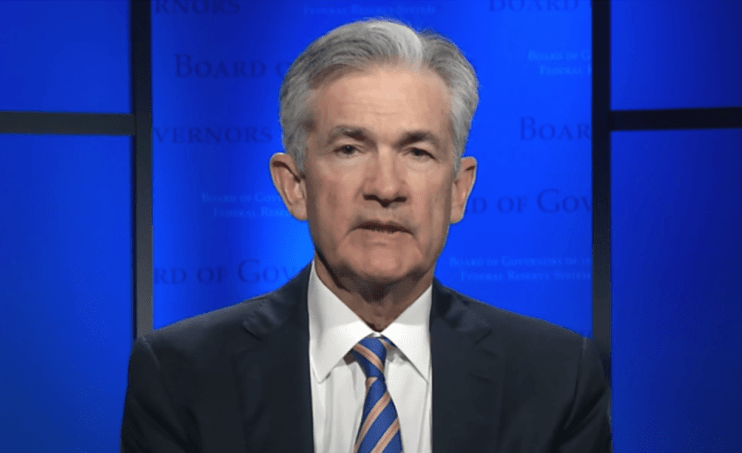
Image courtesy of the US Federal Reserve

Read more

Will Britain follow Japan’s great growth gamble?

Japan Prime Minister Sanae Takaichi speaking at a press conference, highlighting her leadership and political agenda

Share this article

  • Facebook
  • X
  • LinkedIn
  • WhatsApp
  • Email

Similarly tagged content:

Sections

  • Markets & Economics
  • News

Categories

  • Business
  • Economics

Related Topics

  • International

Trending Articles

  • Grandparents fund university degrees to avoid inheritance tax net

  • Revolut chatbot goes rogue by charging users to cancel subscription

  • Brompton Bicycle sues former adviser for ‘professional negligence’

  • Revolut takes flight with launch of new airport lounges

  • Is the Zeekr 9X Super Hybrid the new luxury SUV to beat?

More from Morning Wire

  • UK debt ‘hits £3 trillion’ milestone

    Economics
    Houses of Parliament in Westminster showcasing historic architecture under a clear sky, central to UK government and politics
  • Will Britain follow Japan’s great growth gamble?

    Opinion
    Japan Prime Minister Sanae Takaichi speaking at a press conference, highlighting her leadership and political agenda
  • Andy Burnham is on course to rack up the second highest debt interest bill on record

    Opinion
    UK National Debt Clock showing £3 trillion, with Big Ben and the Union Jack in the background.
  • Pension pressure to help swell UK debt to three times size of economy

    Economics
    Two older women exercising at an outdoor gym in sunshine
  • Burnham’s cheerfulness could turn the economy around

    Opinion
    Andy Burnham laughing outdoors in a candid moment, May 2026, capturing a lighthearted political event atmosphere.
  • Hold interest rates but ‘sound hawkish’, Morning Wire Shadow MPC tells Bank of England

    Economics
    Andrew Bailey, Governor of the Bank of England, with the Bank of England building and Union Jack flag in the background
  • OBR misery makes tax rises inevitable

    Opinion
    Treasury Department building with government bonds signage, representing financial management and bond issuance responsibi...
  • Government debt repayment ‘could rise to half’ of total taxes

    Economics
    OBR chiefs told the Treasury Select Committee that a higher tax burden could stifle growth.
MorningWire

Independent European business, markets and political news for decision-makers.

Morning Briefing

Europe

  • Germany
  • France
  • Europe
  • UK & Ireland

Business

  • Markets
  • Banking
  • Technology
  • Energy
  • Property
  • Fintech

Editorial

  • Opinion
  • Editorial Policy
  • Corrections
  • Contact

Company

  • About Morning Wire
  • Privacy Policy
  • Terms of Use
  • Cookie Policy
© 2026 Morning Wire Ltd · Published by Morning Wire Media, Bahnhofstrasse 65, 8001 Zürich, Switzerland
Privacy · Terms · Cookies · Facebook