Why are we all saving so much?

It’s a question that has been puzzling economists for months.
The worst of the cost-of-living crisis is, for most households, moving further into their rear-view mirror.
The Bank of England’s rate setters have successfully – if belatedly – reined in the worst of the inflation that caused so many households to tighten their belts after the gas price shock of 2022.
The Bank Rate – having shot up over five per between the start of 2022 and half-way through 2023 – has begun to drift downward. Some storied financial institutions like Panmure Liberum and and Goldman Sachs are even pricing in as many as six interest rate cuts over the course of this year.
In other words, monetary conditions are loosening. Disposable incomes are rising, albeit slowly. And with that – and despite the best efforts of our moribund economy – people should be feeling better off, loosening the hatches that they’d firmly battened down over the preceding three years.
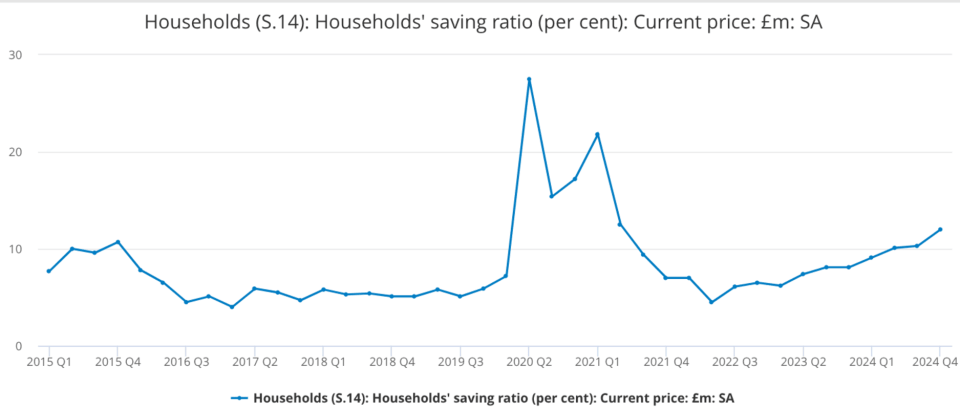
But that hasn’t been the case. In fact, savings rates are the highest they have been since the height of the pandemic.
Figures released by the Office for National Statistics on Friday morning found that the saving ratio – the amount of disposable income that people choose to save – had risen to 12 per cent in the fourth quarter. This is up from 10.3 per cent in the previous three months and 8.3 per cent this time last year.
In other words, despite macroeconomic conditions suggesting people might be minded to loosening the purse strings, excluding the pandemic we – as a nation – are squirrelling more money away than since the aftermath of the financial crash.
Saving for what’s to come…
And households’ collective caution is – economists say – weighing on the economy. More money being siphoned off into bank accounts – while healthy for people’s financial resilience – spells less spending, less economic activity and – by extension – less economic growth.
“Although household incomes are growing strongly, and outpaced inflation in 2024, consumers have proven reluctant to loosen their purse strings,” Jessica Hinds, a director in Fitch Ratings’ economics team, tells Morning Wire.
Hinds believes consumers are worried about a potential downturn in their economic fortunes. Reports of firms cutting jobs in response to bare down on rising costs could be weighing on people’s minds – particularly those in lower- to middle-income households. This combined with the spectre of rising energy bills, water bills and post-national insurance price hike jitters, have all contributed, she says, to consumers’ reticence to let loose.
That notwithstanding, Fitch does anticipate consumer spending only picking up marginally across the year, to 0.9 per cent, from 0.7 per cent in 2024.
Saving for what’s already happened
Others – like ING’s chief UK economist James Smith – believe it’s more to do with what has passed. Smith believes many in the country are currently re-feathering their nests, after many people’s reserves were depleted during the cost of living crisis.
“One theory here is that this [the higher savings ratio] is ‘consumption smoothing’,” he tells Morning Wire. “Households were hit with the gas price shock of 2022, and they’re compensating for it now with higher savings rates now real wage growth has turned positive again.”
The wealthy have had an additional impetus to save. Those in higher-income households, who have the luxury of letting their spending ebb and flow with the economic winds, have made hay from the higher interest payments they accrue from keeping savings in a bank, Smith says.
Wealthier households are “taking advantage” of this more appealing yield, especially those who have mortgages and were still enjoying paying a fixed payment at low, pre-cost-of-living-crisis levels.
Literacy lags
But there is also another, less orthodox theory. One espoused by European Central Bank (ECB) rate setter Isabel Schnabel during a speech on Thursday evening.
Higher-than-expected saving rates is not an issue restricted to the UK, and Schnabel said that Europeans’ reluctance to spend could, in some cases, be down to low financial literacy levels. People with a less sound understanding of their finances still think the macroeconomic environment was the same as during the parsimonious period of 2022-23.
“Over the past three years, real private consumption has increased more slowly than real disposable income,” she said. “This can be partly explained by household misperceptions of their real income developments.”
She added that even though over half of households in the euro area enjoyed income growth in real terms in 2024, “only 11 per cent perceive that their real income had increased”.
While Schnabel’s comments applied specifically to Europe, there is a read across to the UK; specifically with inflation expectations. The Office for Budget Responsibility – and several other economic bodies – believe inflation will come in at about 3.2 per cent in 2025. The average punter, on the other hand, is more pessimistic, They expect inflation of 3.5 per cent this year, according to a recent poll from Citi and YouGov, furthering, in their mind, their incentive to save.
Panmure Liberum’s Simon French event went as far as to call these inflation expectations “concerning” in a recent note.
And he will not be alone. Desperate to free the economy of its zero sum game strait jacket, the Chancellor – not to mention our embattled high street and hospitality sectors – will also be hoping that this nation of savers can find it in them to spend us out of trouble.