Why Britain is no friend of capitalism

Britain has been a home to free marketeers for centuries. Yet the public don’t seem to want them, writes Dr Rainer Zitelmann in this guest essay for Morning Wire
You might have thought that the home of Adam Smith, a raft of prominent economists and indeed Margaret Thatcher would have a rose-tinted view of capitalism – or at least, acknowledge its benefits.
Yet, per my survey on the perceptions of the market economy and capitalism in 34 countries, that doesn’t seem to be the case.
The image of capitalism in the UK is negative – in 13 countries capitalism has a somewhat more negative image than in the UK, in 20 countries perceptions of capitalism are more positive.
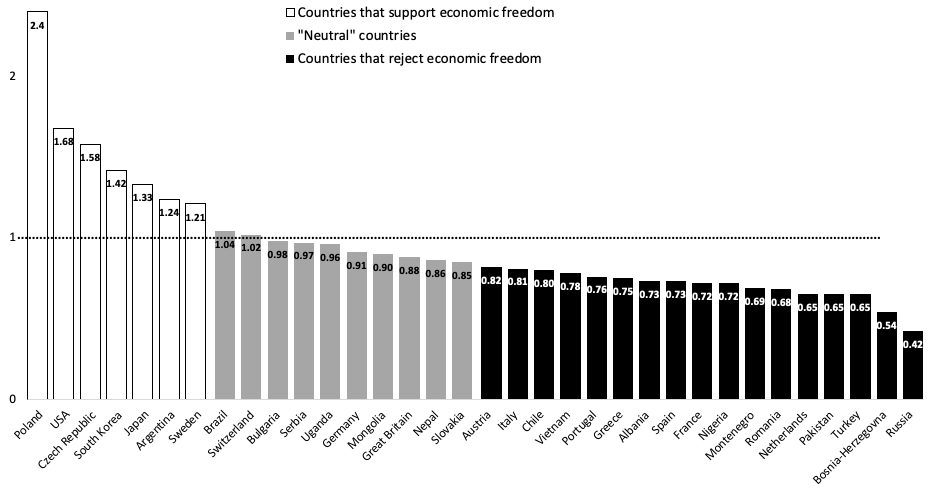
The survey of more than 30,000 people worldwide is the largest and most detailed poll ever conducted on this subject anywhere in the world. As I was preparing the survey, I hypothesized that some people are repelled by the word ‘capitalism’ itself, despite the fact that they essentially hold pro-capitalist opinions. One set of survey questions therefore consistently avoided using the word ‘capitalism’. For example, one statement in the set of questions on “economic freedom” was: “We need a lot more state intervention in the economy, since the market fails time and again”. Another read: “I am for an economic system in which the state sets the rules but ideally does not interfere otherwise”. For each country, the average percentage agreement with the “pro-economic freedom” statements and the average agreement with the “pro-state” statements were calculated to derive the Coefficient of Economic Freedom, which depicts the attitude toward economic freedom in each surveyed country.
While the term ‘capitalism’ was deliberately omitted from the first set of questions, it was explicitly mentioned in the other two sets of questions. In the second set of questions, we wanted to find out what respondents associated with the word ‘capitalism’. This set of questions used a list of 10 terms, namely prosperity, innovation, greed, coldness, progress, corruption, freedom, pressure to perform, a wide range of goods, and environmental degradation. Again, we determined the average percentage of respondents who associate positive characteristics (e.g., freedom and prosperity) and negative characteristics (e.g., environmental degradation and greed) with the word ‘capitalism’.
Figure 1
Attitudes toward economic freedom in 34 countries
Average of statements in favour of a liberal economic system divided by the average of statements in favour of a state-controlled economic system (without using the term ‘capitalism’)
In our third set of questions, respondents were presented with a total of 18 positive and negative statements about capitalism. The negative statements included, for example: “Capitalism is responsible for hunger and poverty” or “Capitalism leads to growing inequality”. The positive statements included, for example, “Capitalism has improved conditions for ordinary people in many countries” or “Capitalism means that consumers determine what is offered, and not the state”.
Combining the results from all three sets of questions allows us to develop an overall picture of what respondents in any given country think of capitalism. Overall, pro-capitalist attitudes dominate in six countries – Poland, the United States, South Korea, Japan, Nigeria, and the Czech Republic. Anti-capitalist attitudes dominate in a majority of surveyed countries.
The fact that people in Nigeria take such a positive view of capitalism may come as a surprise, especially as they also view the market economy negatively. But in Nigeria, capitalism is simply a word of hope: People in this developing country associate it with the kind of prosperity they see in Western countries. Vietnam is only just below the threshold of being classified as a pro-capitalist country. For the sets of questions where the word ‘capitalism’ was used, the Vietnamese were clearly pro-capitalist. The word ‘capitalism’ has positive connotations in Vietnam – even though the country calls itself “socialist” – because the Vietnamese have had very good experiences with the “Doi Moi” market-economy reforms that began in 1986.
Figure 2
Overall coefficient on attitudes toward capitalism in 34 countries
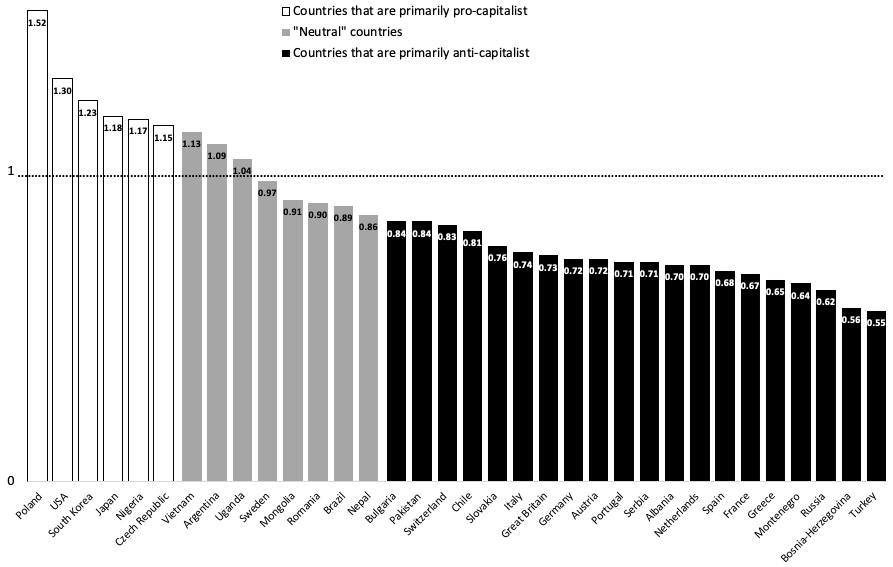
We can see that there are similarities, as well as differences, in the rankings and country groups depicted above. These differences in the “economic freedom” ranking and the “capitalism” ranking can be explained primarily by the fact that, in many countries, the term ‘capitalism’ has a negative connotation.
So, whether the word ‘capitalism’ is used or omitted has an impact – as you would expect. But, contrary to what some pro-capitalists would like, it is unfortunately not just the word ‘capitalism’ that alienates many people, it is what the word actually stands for. When we used the word, people in six countries were pro-capitalist; when we didn’t use it, that total only increased slightly to seven countries.
Rainer Zitelmann is a historian, sociologist and author of the book In Defence of Capitalism https://in-defence-of-capitalism.com/