Skip to content
Monday 10 August 2026London --:--Frankfurt --:--Zurich --:--
NewslettersSearchEN · DE
MorningWire

European business, markets and politics

FTSE 100
10,862.50
-0.35%
DAX
26,323.88
+0.02%
CAC 40
8,726.03
+0.13%
STOXX 50
6,535.62
+0.18%
  • Europe
  • Markets
  • Business
  • Economy
  • Technology
  • Politics
  • Opinion
More
GermanyFranceBankingAIEnergyFintechPropertyCapital Markets
  • Germany
  • France
  • Europe
  • Markets
  • Business
  • Economy
  • Technology
  • Politics
  • Opinion
  • DE
Wednesday 14 February 2024 9:25 am

Why inflation staying stuck at four per cent is actually good news


By: Chris Dorrell

Add as a preferred source on Google
Shoppers have benefited from retailers cutting prices to reignite consumer demand, according to new figures. 

Inflation remained stuck at four per cent in January, according to new figures released on Wednesday morning, but this actually obscures the fact that price pressures are abating.

Economists had expected inflation to rise to 4.2 per cent in January reflecting two factors. The first is that Ofgem increased its energy price cap by five per cent at the start of the year making household bills more expensive.

Reflecting this, the figures showed that gas prices rose by 6.8 per cent in January while electricity prices rose by four per cent.

The second price pressure forecast by economists was in services inflation. Services inflation fell unusually fast this time last year, which distorts the annual comparison since prices in January 2024 are measured against prices a year earlier.

As a result, the annual rate of services inflation rose to 6.5 per cent from 6.4 per cent last month.

Neither of these factors are a cause for concern though. Its likely that Ofgem will reduce its price cap by 14 per cent by April, which will be a significant drag on inflation over the year.

And although the level of services inflation remains far too high to be consistent with the Bank’s two per cent target, this month’s increase should not be the start of a renewed trend of price increases.
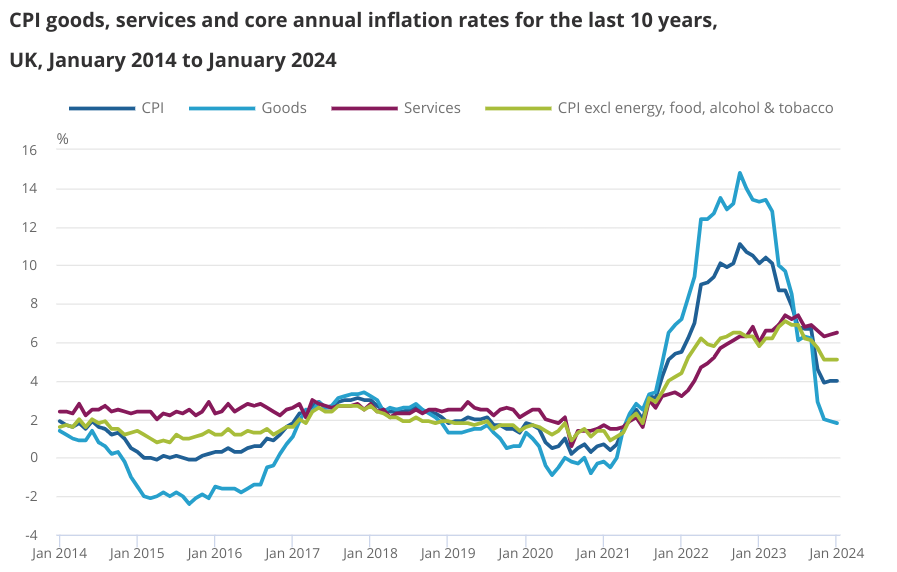
Source: ONS

Wage growth, the most important driver of costs in the services sector, is on its way down – if slightly more slowly than expected.

Samuel Tombs, chief UK economist at Pantheon Macroeconomics, said the increase in services inflation was “entirely due to a base effect…rather than due to a pick-up in near-term momentum.”

Read more

‘False dawn’: June inflation falls to 2.6 per cent but analysts say rises ahead

Till sales growth slowed to 2.7 per cent in the last four weeks

The fact that the headline rate of inflation remained steady in January despite these increases points to stronger than anticipated disinflationary pressures elsewhere.

These can be seen in food prices most clearly, which posted their first drop in over two years. The ONS said that the prices of cream crackers, chocolate biscuits and sponge cakes all dragged food prices lower.

Lalitha Try, economist at the Resolution Foundation, weighed in saying the fall in food prices was particularly “welcome news for low-income households who spend a higher proportion of their income on food”.

Food prices have increased by around 25 per cent over the past two years, the ONS noted.

Household goods were the other key downward contributor to January’s inflation figures. Furniture and household goods prices dropped 3.1 per cent in the month.

A note of caution is due here as January’s data can often be impacted by post-Christmas discounts, and this is likely to have played out in household goods. Simon French, head of research at Panmure Gordon, suggested that January is “always the hardest month to draw insight from.”

Looking over the longer term, however, inflationary pressures are clearly dissipating in those categories. Chris Hare, senior economist at HSBC said they are in “clear decline”.

It therefore seems clear that inflation will resume its descent next month at a healthy clip, paving the way for interest rate cuts in the second quarter of the year.

Read more

Hold interest rates but ‘sound hawkish’, Morning Wire Shadow MPC tells Bank of England

Andrew Bailey, Governor of the Bank of England, with the Bank of England building and Union Jack flag in the background

Share this article

  • Facebook
  • X
  • LinkedIn
  • WhatsApp
  • Email

Similarly tagged content:

Sections

  • Markets & Economics

Categories

  • Economics

People & Organisations

  • Bank of England
  • Office for National Statistics

Related Topics

  • Bank of England
  • UK inflation
  • UK interest rates

Trending Articles

  • Nottingham Forest owner Marinakis sues Crystal Palace for defamation

  • Back to basics: Sainsbury’s gradual retreat from the British high street

  • Thames Water faces fresh threat to survival after pensions regulation breach

  • Hargreaves Lansdown orders staff back to office

  • As it happened: Intel, Arm shares slide; Oil climbs higher

More from Morning Wire

  • ‘False dawn’: June inflation falls to 2.6 per cent but analysts say rises ahead

    Economics
    Till sales growth slowed to 2.7 per cent in the last four weeks
  • Hold interest rates but ‘sound hawkish’, Morning Wire Shadow MPC tells Bank of England

    Economics
    Andrew Bailey, Governor of the Bank of England, with the Bank of England building and Union Jack flag in the background
  • How patient can the Bank of England be?

    AD
    Historic Royal Exchange building in London with modern skyscrapers behind, clear blue sky.
  • Bank of England may set the stage for interest rate hikes this year

    Economics
    Bank of England recession warning
  • Bank of England to hold interest rates as oil price surge threatens UK economy

    Economics
    Bank of England building on Threadneedle Street, London, showcasing its historic architecture and financial significance
  • Interest rate cut is ‘off the table’, says Bank of England governor

    Economics
    Governor Andrew Bailey has launched a defence of the Federal Reserve's independence.
  • House prices slump as Iran war and interest rates hit demand

    Property
    The price paid for first homes has surged 7.1 per cent in a year
  • Bank of England holds interest rates but warns of rises to come

    Economics
    Bank of England headquarters in 2025, showcasing modern architecture and iconic London skyline in the background.
MorningWire

Independent European business, markets and political news for decision-makers.

Morning Briefing

Europe

  • Germany
  • France
  • Europe
  • UK & Ireland

Business

  • Markets
  • Banking
  • Technology
  • Energy
  • Property
  • Fintech

Editorial

  • Opinion
  • Editorial Policy
  • Corrections
  • Contact

Company

  • About Morning Wire
  • Privacy Policy
  • Terms of Use
  • Cookie Policy
© 2026 Morning Wire Ltd · Published by Morning Wire Media, Bahnhofstrasse 65, 8001 Zürich, Switzerland
Privacy · Terms · Cookies · Facebook