Skip to content
Sunday 9 August 2026London --:--Frankfurt --:--Zurich --:--
NewslettersSearchEN · DE
MorningWire

European business, markets and politics

FTSE 100
10,901.09
+0.31%
DAX
26,319.45
+0.69%
CAC 40
8,714.93
+0.17%
STOXX 50
6,523.86
+0.33%
  • Europe
  • Markets
  • Business
  • Economy
  • Technology
  • Politics
  • Opinion
More
GermanyFranceBankingAIEnergyFintechPropertyCapital Markets
  • Germany
  • France
  • Europe
  • Markets
  • Business
  • Economy
  • Technology
  • Politics
  • Opinion
  • DE
Tuesday 14 November 2023 8:00 am  |  Updated:  Monday 13 November 2023 2:49 pm

Why sponsors won’t sweat another desert World Cup – even a dry one

By: Neil Hopkins

Add as a preferred source on Google
Sponsors face challenges at the 2034 World Cup in Saudi Arabia, especially alcohol brands

After Budweiser was blocked in Qatar last year, marketing expert Neil Hopkins on the ramifications for sponsors of the 2034 World Cup heading to Saudi Arabia.

There’s a famous scene at the end of the classic movie ‘Ice Cold In Alex’ when John Mills’s character fondly runs his finger down the side of a chilled glass of Carlsberg.

“Worth waiting for”, he exclaims, after days spent traversing the Western Sahara to reach Alexandria.

Thirty-odd years later, the scene was repurposed as an ad. No CGI in those days. Carlsberg just got lucky that the original film actually featured their lager, branded glasses and all. No product placement fees payable.

The message was simple. What better reward for exertions in the hot desert sun than a glass of cold beer? 

Modern footballers tend not to neck a couple of cold ones after a match these days but fans are somewhat less likely to abstain.

But while beer is integral to football fandom in many countries, a culture clash has arisen as Fifa seeks to broaden the appeal of the sport.

In 2034, the World Cup is once again desert-bound. Saudi Arabia will follow Qatar and become the second Middle Eastern hosts of the world’s biggest football event.

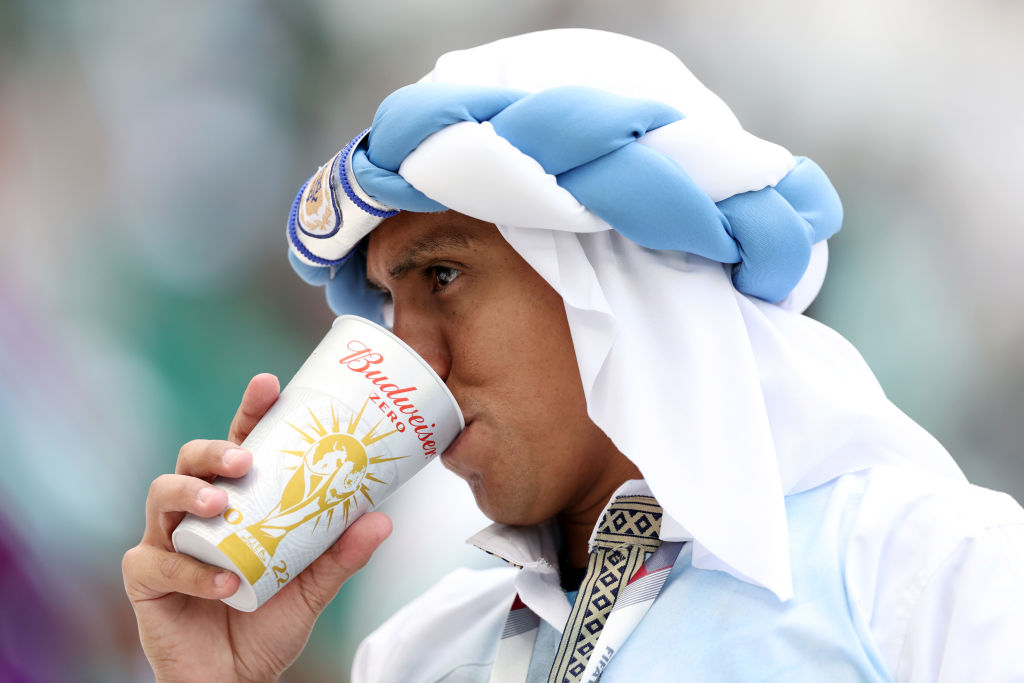
Last year, a spot of last minute flip-flopping by Qatar meant Budweiser, a World Cup sponsor since 1986, was prevented from selling its wares in stadia during the tournament.

Although the brand was happy to extend its relationship with Fifa to encompass the lucrative 2026 World Cup in Canada, Mexico and the United States (and, we may assume, will do the same ahead of the multi-national 2030 tournament) 2034 presents a commercial challenge.

The ability to crack open a Bud at or after a game in Saudi Arabia is clearly a minor issue compared to other restrictions fans might face and, more generally, sponsors across all commercial sectors will have plenty to weigh up in terms of brand perception.

Read more

Exclusive: Wimbledon chiefs ready to defend brand amid Saudi tennis complex similarities

A person cleaning the Wimbledon Championships logo, featuring crossed tennis rackets and a ball.

Ultimately, though, wherever the World Cup is held, the vast majority of consumers do not attend the finals. 

The audience at home presents a huge commercial opportunity and sponsors will be reticent to relinquish an association with the tournament, because for every official partner there are many competitors who would happily step into their shoes.

Play Video

The sports industry has become adept at circumventing restrictions in countries closer to home than Saudi Arabia.

Since the introduction of Loi Evin (Evin’s Law) in 1991, alcohol advertising has been banned in France with consequences for sponsors of major sporting events. 

It prompted the adoption of “alibi marketing” tactics that meant, for French audiences, the Heineken Cup became the H Cup, Guinness’s 6 Nations sponsorship adopted the moniker “Greatness” and, most recently, Japanese beer brand Asahi Super Dry’s Rugby World Cup deal saw it appear on perimeter boards as “Aaah! Super Try!”.

Beyond France, there are so-called dark markets where alcohol is either prohibited or restricted and global sponsors activate their partnerships in a low-key fashion. For instance, Heineken is a global partner of Formula 1, which has races in Bahrain, Abu Dhabi, Qatar and Saudi Arabia. 

Once again, access to the audience at home provides the most significant commercial benefit, with F1 logos emblazoned on bottles and cans on supermarket shelves from Beijing to Buenos Aires.

So, how might the industry tackle a Saudi World Cup? As a wise sage once said, “it depends”. We’re over a decade away from the tournament and that’s more than enough time for sponsors to find a way.

Saudi Arabia meanwhile is embarking on a journey where it will be scrutinised under the same media spotlight that Qatar found itself and the glare may be even more intense.

In the meantime, sponsors will hope the country becomes an oasis if not for cigarettes, then definitely (maybe?) alcohol.

Neil Hopkins is global head of strategy at M&C Saatchi Sport & Entertainment.

Read more

World Cup sponsors could pay price if Infantino’s Fifa sell-off goes ahead

Person holding a red FIFA World Cup branded cup and a smartphone, wearing a white shirt and watch

Share this article

  • Facebook
  • X
  • LinkedIn
  • WhatsApp
  • Email

Similarly tagged content:

Sections

  • Sport

Categories

  • Sport
  • Sport Business

Related Topics

  • Advertising
  • Football
  • Football finance
  • Qatar 2022 World Cup
  • Sports marketing
  • Sports money

Trending Articles

  • Thames Water faces fresh threat to survival after pensions regulation breach

  • PwC’s Embankment HQ to get major makeover ahead of Canary Wharf move

  • Family feud: London estate agent Winkworth sues chair over plot with wife to oust son from board

  • As it happened: Stocks rise despite new tensions in Strait of Hormuz; Oil price climbs

  • A tribute to wine legend Matthew Jukes by his friend Libby Brodie

More from Morning Wire

  • Exclusive: Wimbledon chiefs ready to defend brand amid Saudi tennis complex similarities

    Sport Business
    A person cleaning the Wimbledon Championships logo, featuring crossed tennis rackets and a ball.
  • World Cup sponsors could pay price if Infantino’s Fifa sell-off goes ahead

    Sport Business
    Person holding a red FIFA World Cup branded cup and a smartphone, wearing a white shirt and watch
  • Will Formula 1 need to refund sponsors for cancelled Middle East races?

    Sport Business
    Max Verstappen in a Red Bull Racing cap and team shirt, looking contemplative with hands under his chin.
  • Fifa World Cup 2026: The tournament of IP infringement and touts

    Sport Business
    Breaking news scene with journalists and photographers capturing live event at a bustling city press conference
  • Did this World Cup have too much of Sir David Beckham?

    Sport Business
    Getty Images logo on a digital screen, representing stock photo services and visual media assets in the business industry.
  • Multiply Media Group Expands into Saudi Arabia Through Strategic Partnership with Cenomi Centers and the Launch of BackLite KSA

    Business Wire
  • NBA Europe bosses using World Cup final to hold talks with football club chiefs

    Sport Business
    Getty Images logo on a blue background, representing stock photo agency in a business news context
  • Free-to-air bonanza boon for fans, sport and marketers

    Sport Business
    Getty Images collection number 2284379076 featuring diverse business professionals in a collaborative meeting setting.
MorningWire

Independent European business, markets and political news for decision-makers.

Morning Briefing

Europe

  • Germany
  • France
  • Europe
  • UK & Ireland

Business

  • Markets
  • Banking
  • Technology
  • Energy
  • Property
  • Fintech

Editorial

  • Opinion
  • Editorial Policy
  • Corrections
  • Contact

Company

  • About Morning Wire
  • Privacy Policy
  • Terms of Use
  • Cookie Policy
© 2026 Morning Wire Ltd · Published by Morning Wire Media, Bahnhofstrasse 65, 8001 Zürich, Switzerland
Privacy · Terms · Cookies · Facebook