Why the Bank of England slashed its growth forecasts

The Bank of England delivered Chancellor Rachel Reeves a mixed blessing on Thursday.
Alongside cutting interest rates by 25 basis points, Bank officials halved the UK’s expected growth rate in 2025 to 0.7 per cent from a previous estimate of 1.5 per cent.
This will come as a blow to Reeves, who has staked her reputation on lifting the UK’s shoddy growth rate. It no doubt presages a similar move from the Office for Budget Responsibility (OBR) next month.
Reeves said the interest rate cut was “welcome news” but, perhaps unsurprisingly, she said she was “not satisfied” with the growth rate.
Nor should anyone be. The Bank noted that the economy has been “broadly flat” since March, which is hardly a record to shout about.
“The Bank has been forced to cut because the UK economy is crashing,” Julian Jessop, economics fellow at the Institute for Economics Affairs said.
But why did the Bank of England cut its growth forecasts having been more optimistic just a few months ago?
Growth slowdown
There are broadly two reasons why the economy might be performing weaker than previously thought, reflecting developments on the supply side and the demand side.
Bank officials acknowledged the subdued demand environment, particularly since the Budget.
“Metrics of business and consumer confidence have deteriorated over recent months. Contacts at the bank’s agents report that consumers are more price conscious and holding back on spending. This is consistent with a slowdown in demand,” Andrew Bailey, the Bank’s Governor said.
However, the Bank put more emphasis on supply. “Much of the current weakness in GDP growth is judged to reflect developments in supply,” the latest forecast said.
Supply simply measures how much goods and services the economy can produce. The rate of supply growth is an important consideration for the Bank as it reflects a speed limit on the economy.
If demand is rising faster than supply, then prices will rise. This means that continued weakness in supply growth risks keeping inflation higher for longer.
The Bank slashed its estimates for supply growth from around 1.5 per cent at the start of 2024, to around 0.75 per cent in the first quarter of 2025.
Productivity to blame
So what’s causing the weakness in supply? The Bank gives an answer: “Potential productivity has been much weaker than previously estimated”.
Productivity is effectively a way of measuring how effectively workers are using the resources available to them, which is why it is such an important component of potential supply.
The Bank noted that the latest population estimates from the ONS showed that there were significantly more workers than previously reported, but with no extra boost to GDP.
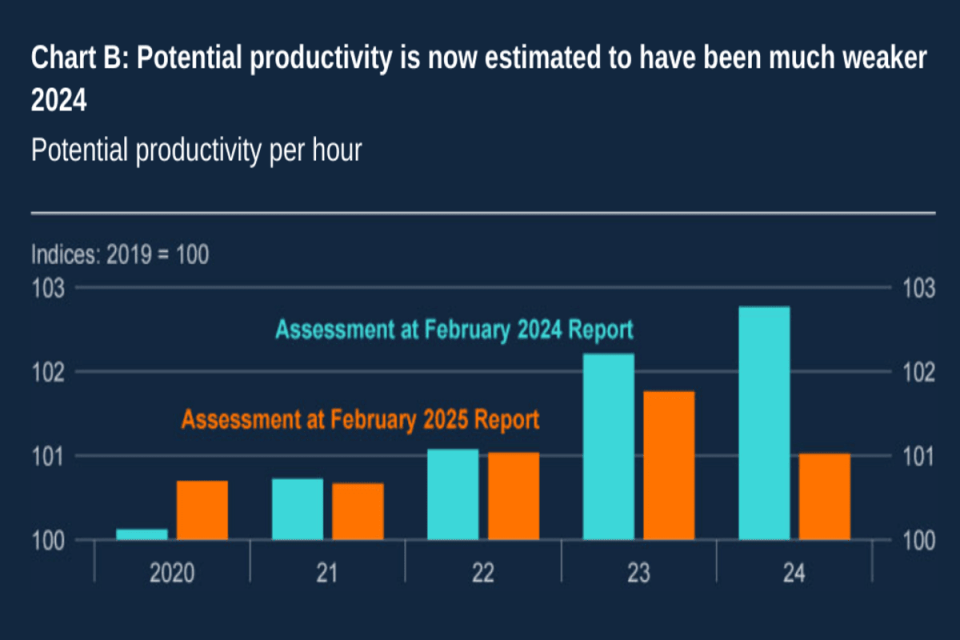
This implies that workers are producing less than the prior estimates suggested. The figures suggest that productivity actually fell 2.4 per cent in the year to third quarter of 2024.
Bailey noted that negative productivity growth was “very unusual” and said it was likely to rebound, but officials still struggled to explain quite why productivity had been so weak.
“A reassessment of the economic factors likely to be affecting potential productivity cannot account fully for the additional weakness implied by the latest revisions,” the forecast said.
Nevertheless, it did have a go. The forecasts noted that specific parts of the public sector – in particular the health sector – have seen many more workers, but productivity has fallen.
If there are more workers in a sector with stagnant or even declining productivity, then overall productivity in the economy will be lower. Hey presto!
As you were?
Bailey suggested that one should not read too much into public sector productivity. “I cannot tell you to what extent that’s a real phenomenon or a measured phenomenon,” he said, pointing to the range of “conventions” for measuring public sector output. .
“I would caution against drawing any strong conclusions,” he added. So back to square one.
Indeed, the Bank expects productivity growth to recover, helping lift aggregate supply growth to 1.7 per cent and 1.5 per cent in the second and third years of the forecast
This recovery helps GDP growth to pick up too. It is worth noting that the growth forecasts for 2026 and 2027, at 1.5 per cent, were actually slightly upgraded compared to November.
But one cannot help but get the feeling that the Bank are not quite sure why growth has been so weak and the MPC left open the possibility of cutting rates more aggressively if demand proved to be “enduringly weak”.