Skip to content
Sunday 9 August 2026London --:--Frankfurt --:--Zurich --:--
NewslettersSearchEN · DE
MorningWire

European business, markets and politics

FTSE 100
10,901.09
+0.31%
DAX
26,319.45
+0.69%
CAC 40
8,714.93
+0.17%
STOXX 50
6,523.86
+0.33%
  • Europe
  • Markets
  • Business
  • Economy
  • Technology
  • Politics
  • Opinion
More
GermanyFranceBankingAIEnergyFintechPropertyCapital Markets
  • Germany
  • France
  • Europe
  • Markets
  • Business
  • Economy
  • Technology
  • Politics
  • Opinion
  • DE
Thursday 11 April 2024 6:01 am  |  Updated:  Wednesday 10 April 2024 5:18 pm

Why UK services exports have continued to grow post-Brexit

By: Chris Dorrell

Add as a preferred source on Google
According to a new report from UK in a Changing Europe (UKICE), UK services trade has been more resilient than almost all other advanced economies.
Labour's Brexit reset will not deliver growth, economists have warned.

The resilience of exports from the UK’s service sector has been a success story despite the feared impact of Brexit.

Services exports reached a record £470bn in 2023, up seven per cent compared to the previous year adjusting for inflation.

Figures out yesterday showed that the UK was the world’s fourth largest exporter in 2022, up from seventh position in 2021, with the improvement attributable to the strength of the country’s services sector.

So what’s behind the surge in service exports? And why hasn’t Brexit damaged the sector more?

In March, the Office for Budget Responsibility (OBR) noted that around two thirds of the growth in services trade volumes since 2019 has been driven by ‘other business sectors’.

This catchy title includes some of the UK’s fastest growing sectors, such as consulting, accountancy and R&D. By contrast, exports of financial services and transport have lagged other sectors, declining 5.9 per cent and 2.0 per cent respectively.

“The UK has real emerging strengths in travel and professional services – alongside other business services such as law, auditing and accounting,” William Bain, head of trade policy at the British Chambers of Commerce told City A.M.
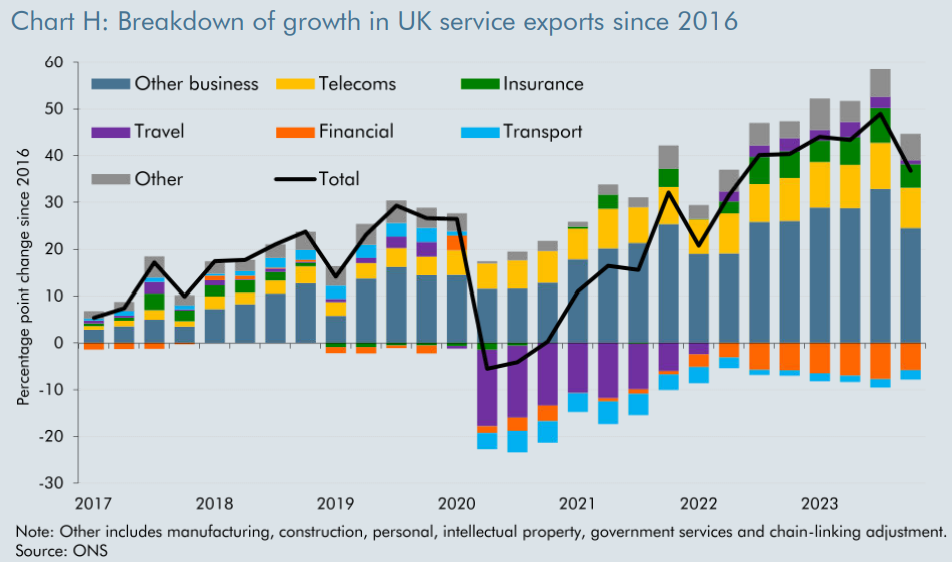
Source: OBR

The OBR suggested a few points that could be behind the relative growth of business services. First, barriers to exporting to the EU in these sectors are likely to be lower than in more highly regulated services, such as banking.

It also noted that there had been particularly strong growth in service exports to the US, which could reflect US firms “outsourcing work to the UK”.

Global demand for business services is also growing, and growing fast. According to the Resolution Foundation, global trade in the services Britain specialises in has tripled since 2005.

Read more

Singapore on Thames or the Sick Man of Europe?: The Economics of Brexit Ten Years from the Referendum 

UK-EU Brexit negotiations meeting with officials discussing trade agreements and policy impacts in a formal conference room

London specifically has been a key driver of this trend, with its exports growing by nearly half between 2016 and 2021.

“The proximity of world-leading firms is a key draw, enabling international companies to access the best financial, professional and legal support in one place,” a BusinessLDN spokesperson said.

The UK should continue to capitalise on the rising tide of services trade. Services exports as a share of global trade set to rise from 25 per cent in 2020 to 28 per cent in 2035, according to the Resolution Foundation.

“Securing more opportunities in global services trade for UK companies should be at the heart of a refreshed trade strategy which government and business can work in partnership together upon,” Bain said.

So has Brexit been a boon for British trade? Well, its more complicated than that.

The UK’s goods exporters have not performed anywhere near as well as the service sector. Although global goods trade has come under pressure in recent years, the UK goods exports have fallen much faster than the G7 average.

Goods exports have under-performed the G7 average by 15 per cent since 2020

Barriers to trade between the UK and EU have certainly contributed to this fall. The Office for National Statistics said that around half of exporting firms had faced extra costs due to Brexit.

The BCC has previously called for primary regulations on traded goods should mirror the EU’s in order to keep business costs low.

Read more

Vehicle production drops in first half of year

Car bodies on an assembly line in a UK car plant, showcasing EV manufacturing process

Share this article

  • Facebook
  • X
  • LinkedIn
  • WhatsApp
  • Email

Similarly tagged content:

Sections

  • News
  • Markets & Economics

Categories

  • Economics

People & Organisations

  • Brexit
  • economics

Related Topics

  • Brexit
  • UK trade

Trending Articles

  • Why the Loire Valley is about so much more than fairytale castles

  • Why HMRC is huge Premier League transfer window tax headache

  • Thames Water faces fresh threat to survival after pensions regulation breach

  • Back to basics: Sainsbury’s gradual retreat from the British high street

  • Thunder Call set to Strike in Shergar Cup Sprint

More from Morning Wire

  • Singapore on Thames or the Sick Man of Europe?: The Economics of Brexit Ten Years from the Referendum 

    Opinion
    UK-EU Brexit negotiations meeting with officials discussing trade agreements and policy impacts in a formal conference room
  • Vehicle production drops in first half of year

    Transport & Infrastructure
    Car bodies on an assembly line in a UK car plant, showcasing EV manufacturing process
  • Making free trade a reality: The UK-GCC strategic dialogue

    Partner
    Alexey Fedorenko credited image showing a relevant scene or subject matter related to the General news article content
  • Exclusive: Jobs lost across Labour’s ‘growth potential’ sectors in blow to Burnham

    Politics
    Jonathan Reynolds, Labour MP, in a suit and tie, holding a notebook, looking right, with a building behind him
  • AI powerhouses are betting on London’s future

    Opinion
    Aerial view of Kings Cross St. Pancras station and square, London, with people, buses, and surrounding buildings.
  • As it happened: Stocks rise as oil lower; Iran threatens ‘forceful response’ over Strait of Hormuz

    Markets
    North Sea oil terminal with storage tanks and docking facilities under a clear sky, highlighting energy infrastructure.
  • UK economy grows despite Iran war hit

    Economics
    Detailed view of a breaking news event related to general topics, showcasing key elements of the story in a business context.
  • Iran war woes cause jump in London-listed profit warnings

    Economics
    GettyImages 2211256637 showing a significant event or figure relevant to recent news updates in the business sector
MorningWire

Independent European business, markets and political news for decision-makers.

Morning Briefing

Europe

  • Germany
  • France
  • Europe
  • UK & Ireland

Business

  • Markets
  • Banking
  • Technology
  • Energy
  • Property
  • Fintech

Editorial

  • Opinion
  • Editorial Policy
  • Corrections
  • Contact

Company

  • About Morning Wire
  • Privacy Policy
  • Terms of Use
  • Cookie Policy
© 2026 Morning Wire Ltd · Published by Morning Wire Media, Bahnhofstrasse 65, 8001 Zürich, Switzerland
Privacy · Terms · Cookies · Facebook