Why Virgin Atlantic’s cooking oil flight ad was banned for being ‘misleading’ on green claims

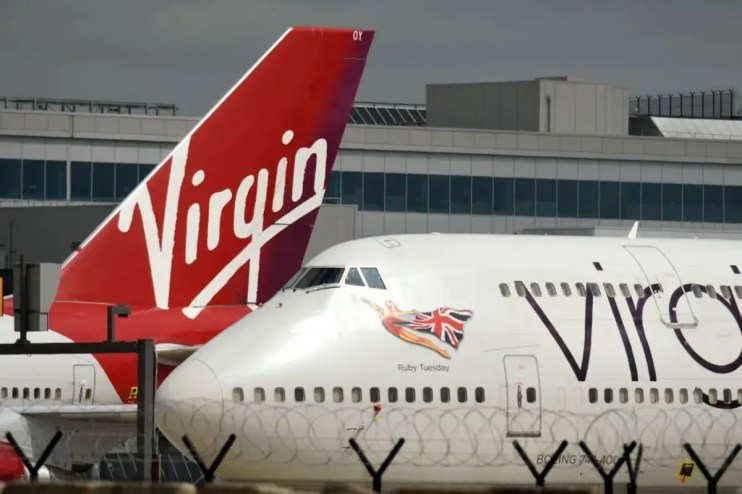
When a Virgin Atlantic flight powered solely by cooking oil successfully jetted from London to New York last year, the airline’s billionaire co-founder Richard Branson was showered with praise.
Politicians, aviation executives and journalists, many of whom were invited on board, hailed the achievement as a milestone in the sector’s battle to decarbonise, while the flight itself was watched worldwide.
“I was just thinking of my history of firsts across the Atlantic and all my previous ones I’ve ended up being pulled out of the sea, whether it is ballooning or boating,” Branson joked as the plane made its descent to the JFK airport runway.
It was undoubtedly an achievement, but you couldn’t help but leave feeling like it was all a bit blown out of proportion.
Now, the UK’s advertising regulator has given the sceptics a reason to feel a bit more justified.
In a ruling on Wednesday, the Advertising Standards Authority (ASA) banned a pre-takeoff Virgin Atlantic radio ad, claiming the flight would be “100 per cent sustainable aviation fuel” following complaints from five viewers.
The radio transcript goes as follows:
“On the 28th of November, Virgin Atlantic’s Flight 100 will take to the skies on our unique flight mission from London Heathrow to JFK to become the world’s first commercial airline to fly transatlantic on 100 per cent sustainable aviation fuel.
“When they said it was too difficult, we said: challenge accepted. Virgin Atlantic Flight 100. See the world differently.”
Virgin Atlantic isn’t happy with the verdict, which is understandable given it appears to undermine the project and raises questions over whether it was more of a PR job than anything else.
The flight was powered by so-called Sustainable Aviation Fuel (SAF), a biofuel made up of things like ethanol and cooking oil.
This is important as the dispute centres around the wording.
The airline says the term “sustainable aviation fuel” is used across the world, by airlines, governments and others, and thus would not mislead consumers into believing the flight was 100 per cent green.
The ASA agreed the term is widely used, however it argues it would still give the impression to the standard consumer that the fuel itself had “no negative environmental impacts at all.”
This gets to the crux of the issue.
Virgin Atlantic’s SAF flight was ultimately a victory for the airline, but not for the battle to reach net-zero.
It was rarely brought up in coverage of the trip but the flight still produced significant emissions, including CO2, nitrous oxide and others.
The production of SAF can involve extensive land use changes, both indirect and direct, and relying on methane-belching animals.
Prior to the event, a consultancy firm calculated the carbon emissions across the full life-cycle of a Virgin Atlantic flight using traditional jet fuel.
The carrier has now confirmed that sustainable aviation fuel produced the same level of CO2 during the flight as its traditional counterpart would have, a staggering omission from most press reports at the time.
SAF emits the same amount of CO2 as conventional kerosene-based jet fuels.
However, the difference is that it utilises carbon that has recently been captured from the atmosphere by the plants and livestock it is produced from.
Its jet fuel counterparts absorbed carbon millions of years ago.
SAF also comes at a huge cost, and will require a Herculean global production ramp-up if the industry wants to come close to any of its targets.
How far does aviation have to go?
In an interview on the flight, Virgin Atlantic’s chief executive Shai Weiss was quick to play down how quickly he thinks it could be rolled out across the entire fleet.
The ad debacle proves many people simply don’t understand how far there is to go for aviation.
A consumer opinion survey commissioned by Virgin, presented to the ad watchdog, confirmed the poor knowledge consumers had of the limitations of SAF after tuning in.
Just 15 per cent understood that it had the same impact as jet fuel and a whopping 30 per cent believed it had “zero impact on the environment.”
It’s hard to believe that Virgin Atlantic had no idea what it was doing when publicising that advert to the general public, many of whom will not have heard of SAF to begin with.
“Virgin Atlantic’s Flight 100… [will] become the world’s first commercial airline to fly transatlantic on 100 per cent sustainable aviation fuel.”
Miles Lockwood, director of complaints and investigations at the ASA, said: “Claiming that a product or service is sustainable creates an impression that it is not causing harm to the environment and for that reason we expect to see robust evidence that this is the case. “
“In this case, while sustainable aviation fuel does emit less carbon emissions than regular aviation fuel, it nevertheless still generates significant carbon and non-carbon emissions in-flight and its production at scale can have wider environmental costs and trade-offs.”
Honesty and transparency over the obvious limitations in the battle to decarbonise is surely a must if there is any hope the sector will reach its emissions targets.
“While we are disappointed that the ASA has ruled in favour of a small number of complaints, we remain committed to open, accurate and transparent engagement on the challenge of decarbonisation,” a Virgin Atlantic spokesperson said.