Skip to content
Thursday 13 August 2026London --:--Frankfurt --:--Zurich --:--
NewslettersSearchEN · DE
MorningWire

European business, markets and politics

FTSE 100
10,833.15
-0.10%
DAX
26,331.07
0.00%
CAC 40
8,674.94
0.00%
STOXX 50
6,533.99
0.00%
  • Europe
  • Markets
  • Business
  • Economy
  • Technology
  • Politics
  • Opinion
More
GermanyFranceBankingAIEnergyFintechPropertyCapital Markets
  • Germany
  • France
  • Europe
  • Markets
  • Business
  • Economy
  • Technology
  • Politics
  • Opinion
  • DE
Thursday 07 August 2014 11:23 am  |  Updated:  Friday 07 June 2019 2:13 am

Rosetta arrives at its destination in “sexiest, most fantastic mission ever”

By: Sarah Spickernell

Add as a preferred source on Google

The thought of travelling four billion miles in ten years might make you feel dizzy, but it's exactly what the European Space Agency (ESA) Rosetta space probe has managed to do in what has been described as the “sexiest, most fantastic mission ever”.
 
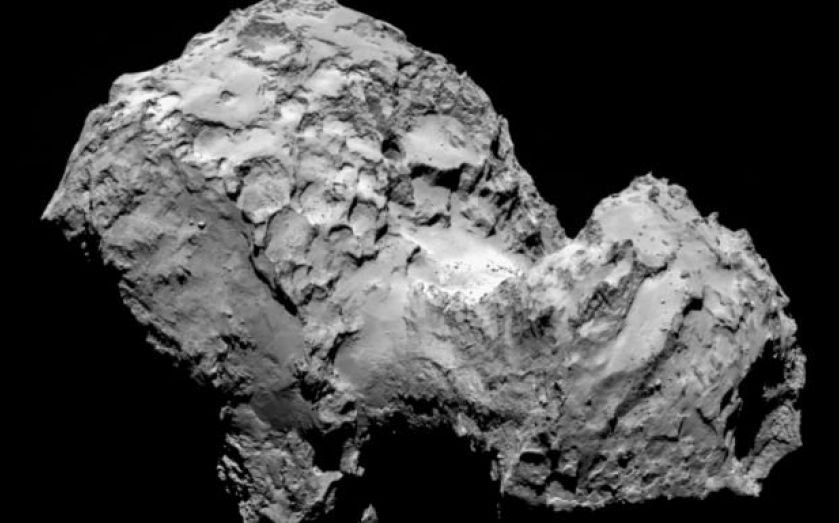
Rosetta, which was first launched in 2005, has been hurtling towards comet 67P/Churyumov-Gerasimenko for the last eight months after being awoken from two-and-a-half years of deep space hibernation in January. 
 
Because the comet has spent its life travelling so far away from the sun, its composition has remained largely unchanged since the birth of our solar system 4.6bn years ago. 
 
This is about to change, however, as the comet starts to travel towards the Sun for the first time. As it does so, it's composition will change and material will be released from its surface via high speed jet streams. By analysing the contents of these streams, Rosetta will be able to determine what the comet was made of when it was first formed.
 
Rosetta's name comes from the code-breaking Rosetta stone, which helped archaeologists decipher the meaning of Egyptian hieroglyphs in the 1800s. Just as that Rosetta shed light on the history of human civilisations, it is hoped that this one will help scientists to understand the origin of comets, the solar system, and possibly even life on Earth.
 
In order to make these exciting discoveries, however, Rosetta had to first connect with the comet in a rendezvous. Whether this would be successful was far from certain. 
 
Yesterday, Rosetta brought smiles to a lot of faces at the ESA's Mission Control in Darmstadt, Germany, when it sent down a signal informing scientists that it had indeed managed to begin its rendezvous with the comet.
 
The scientists were waiting for a tense 22 minutes before the signal arrived, at which point they tweeted “Hello, comet!” in 23 different European languages. 
 
With the mission costing the ESA $1.75bn (€1.3bn) to carry out, a lot has rested on the success of this rendezvous which Rosetta has been building up to since it was first launched. In the interim it has executed a number of complex manoeuvres, all for the purpose of positioning itself to come into contact with the comet at exactly the right moment. 
 
Now, if all goes according to plan, Rosetta will land a “philae” on the comet's surface in November and will then follow the comet for a year as it travels through the solar system, gathering information as it goes.
 
The philae will study the comet's surface composition and also use radio waves to probe its interior, in the same way that X-rays are used to study bones in the human body.
 
"Rosetta is the sexiest space mission that's ever been," said project scientist Matt Taylor during a webcast on Wednesday.
 

Share this article

  • Facebook
  • X
  • LinkedIn
  • WhatsApp
  • Email

Similarly tagged content:

Sections

  • News

Categories

  • Business

Related Topics

  • European Space Agency

Trending Articles

  • Five-star Mayfair hotel hit with HMRC winding-up petition

  • It’s not just Jason Arday, most of sociology is a scam

  • IT consultant ordered to pay £50,000 after being accused of stealing Soho House members’ personal details

  • As it happened: FTSE 100 falls as Iran and US clash over Strait of Hormuz; Oil stockpiles ‘rapidly depleting’

  • As it happened: Stocks jittery as oil nears $90; Trump ‘semi-negotiating’ with Iran

More from Morning Wire

  • We reached Mars 50 years ago, why haven’t we sent people?

    Opinion
    Mars One rocket on launchpad, ready for its mission to the red planet
  • Planet Opens London Office, Expanding European Footprint

    Business Wire
  • O’Brien can complete July Cup Mission

    Sport
    Mission Central headquarters bustling with diverse team members collaborating on innovative projects in a modern office se...
  • Qatar Racing takes over sponsorship of £4.4m British Champions Day

    Sport Business
    Jockey in orange and blue silks on a brown racehorse galloping on a green track, another horse slightly behind.
  • Everything’s going to sh*t. Here are 25 of the best dystopian novels

    Life&Style
    Stack of popular dystopian novels including 1984 and Brave New World on a wooden table, perfect for book enthusiasts.
  • Scottish Government Selects Planet for AI-Enabled Monitoring to Support Sustainable Agricultural Reform

    Business Wire
  • People read less: Do we still need the Booker Prize?

    Life&Style
    Collection of eight Booker Prize-nominated book covers, featuring various authors and titles.
  • LA28 Olympic Hospitality Launches New Once-in-a-Lifetime Packages for Equestrian, Golf, Beach Volleyball and More

    Business Wire
MorningWire

Independent European business, markets and political news for decision-makers.

Morning Briefing

Europe

  • Germany
  • France
  • Europe
  • UK & Ireland

Business

  • Markets
  • Banking
  • Technology
  • Energy
  • Property
  • Fintech

Editorial

  • Opinion
  • Editorial Policy
  • Corrections
  • Contact

Company

  • About Morning Wire
  • Privacy Policy
  • Terms of Use
  • Cookie Policy
© 2026 Morning Wire Ltd · Published by Morning Wire Media, Bahnhofstrasse 65, 8001 Zürich, Switzerland
Privacy · Terms · Cookies · Facebook