Everything’s going to sh*t. Here are 25 of the best dystopian novels

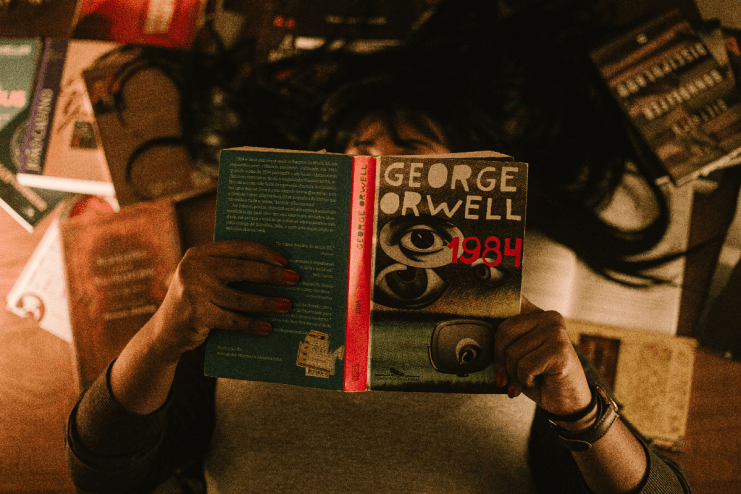
The genre has roared back onto bookshelves and best-seller lists. Harry Owen asks why we keep returning to this bleakest of genres – and recommends some top dystopian fiction
Dystopian fiction is once again lining the bookshelves of Waterstones. And is it any wonder? All good dystopia really hinges on its ‘plausibility’, the writer concocting a scenario just far enough removed from reality that we can comfortably place ourselves in that setting and identify with those characters. Perhaps the resurgence is in part down to the barrier between ‘fact’ and ‘fiction’ becoming more porous.
A decade ago, writing about a global pandemic, AI-driven social and economic collapse, and a tech-enabled trillionaire class attempting to establish off-world colonies would have required an emphatic suspension of disbelief. Now it’s front page news.
London workers are more exposed to AI-induced job cuts than employees in any other major city, according to the world’s leading economics think tank. Once-speculative fiction no longer seems all that speculative.
The genre has, however, witnessed a sharp shift in themes. Writers often focus on concerns around catastrophic climate change, reproductive control, predatory mega-corporations and technological isolation (or even replacement). Bunker-building is on trend, peaking in the novel The Future (2023) by Naomi Alderman, which came off the back of the popularity of Wool (2011) by Hugh Howey.
Dystopian fiction: sub genres include ‘gamified oppression’
Even better, it led to the rediscovery of I Who Have Never Known Men (1995) by Jaqueline Harpman – stripped of the typical action-heavy tropes of the genre, this book focuses on the profound psychological weight of isolation. Another noteworthy mention, albeit set above ground, is The Other Valley (2024) by Scott Alexander Howard, a twisty book consisting of multiple variations of the same town, repeating themselves across a chain of wild valleys.
Two titans of dystopia, Margaret Atwood and Kazuo Ishiguro, continue delivering unnerving worlds for us to escape into… and perhaps from. Atwood’s last book, The Testaments (2019), explores the themes of religious totalitarianism, patriarchy and female agency, building on her great work The Handmaid’s Tale (1985). Meanwhile in Klara and the Sun (2021), Kazuo Ishiguro tackles tech-induced isolation, automation and eventual replacement – ideas he began in his classic Never Let Me Go (2005).
Sub-genres are also back in vogue, not least the idea of “gamified oppression”. I remember being enthralled as a child by Stephen King’s The Running Man (1982) and later Koushun Takami’s Battle Royale (1999). My own children will no doubt point to the YA fiction of Suzanne Collins’s The Hunger Games (2008), The Maze Runner (2009) by James Dashner and, more recently, the popular Red Rising saga (2014) by Pierce Brown.
I realise I’ve now moved fully into sci-fi territory, so while I’m here I may as well throw in Ready Player One (2011) by Ernest Cline, Scythe (2016) by Neal Shusterman and, my absolute favourite, The Will of the Many (2023) by James Islington.
AI and robotics tackled in Cyberpunk novels
Cyberpunk has always been a bit of an outlier, a genre within a genre. Published in every decade since it was conceived in the 1980s, these novels have taken up their own space on the believability spectrum, with the implications of AI and robotics giving the genre’s seminal works a welcome reboot.
I’d recommend books such as Neuromancer (1984) by William Gibson, Snow Crash (1992) by Neal Stephenson and the unhinged world of Paolo Bacigalupi’s The Windup Girl (2009).
My favourite sub-genre, though, has always been Japanese dystopia, with its uncomfortable explorations of extreme state surveillance, social isolation (‘hikikomori’) and corporate-driven existential dread. Look no further than The Memory Police (1994) by Yoko Ogawan, 1Q84 (2009) by Haruki Murakami and The Last Children of Tokyo (2014) by Yoko Tawada.
In the latter, a near-future Japan has completely shut its borders to the rest of the world following an unnamed global environmental disaster, the side-effects of which means older generations cannot die, while the young live in a state of constant suffering as a result of their terminally weak bodies.
A breakthrough, quiet type of dystopian fiction
Finally, there is the inimitable Station Eleven (2014) by Emily St John Mandel, a breakthrough, quieter type of dystopian fiction, far removed from genomics, robots and corporate powers. In this atmospheric read, St John Mandel weaves together elements of noir mystery and literary character studies.
Set 20 years after a devastating swine flu pandemic wipes out 99.9 per cent of the global population, it follows a nomadic troupe of actors and musicians called The Travelling Symphony as they roam the Canadian Great Lakes, fighting to keep art, culture and themselves alive. I have already pre-ordered her seventh novel, Exit Party, due to be published in September this year.
But if you’re going to pick up just one piece of dystopian fiction this weekend, I’d suggest starting at the beginning with The Death of Grass (1956) by John Christopher – because when the shit hits the fan, at least this novel has some useful tips for survival.
Harry is CEO at Morning Wire