On this day: Animal Farm is published

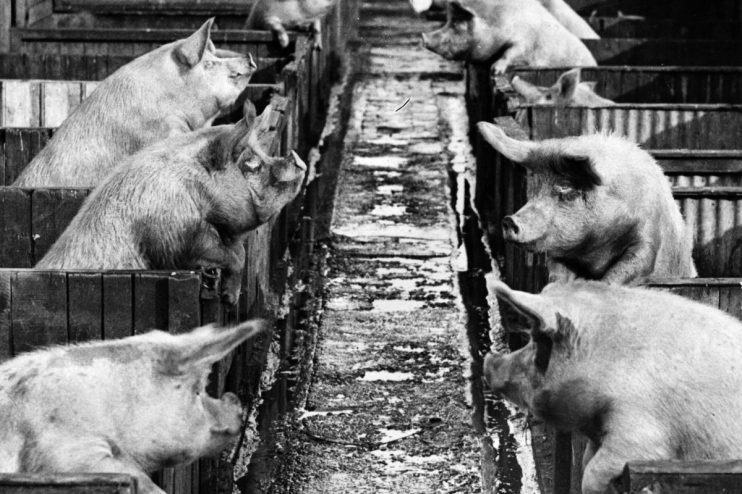
On this day, 17 August, in 1945, with pro-Soviet sentiment rapidly fading in the UK, George Orwell’s dystopian classic Animal Farm is finally published, writes Eliot Wilson
Friday 17 August 1945. The Second World War was finally over. Two days beforehand, the Emperor of Japan, speaking to his people, admitted that “the war situation has developed not necessarily to Japan’s advantage”. The previous week, Hiroshima and Nagasaki had been obliterated by atomic bombs.
The elaborate and oblique Imperial Rescript on the Termination of the War, in classical Japanese, did not say “surrender”, but that is what it meant. Nazi Germany having accepted defeat on 8 May, the deadliest conflict in human history was over.
George Orwell was 42 years old. He had spent the war as a writer, declared medically unfit for military service; he had endured several periods of ill health and had been shot through the throat during the Spanish Civil War. As an author he already had some standing. Down and Out in Paris and London (1933) had been well received, though Orwell himself thought it far from his best work; The Road to Wigan Pier (1937) had proved an satisfyingly horrific depiction of poverty in northern England; the muted response to Homage to Catalonia (1938) perhaps reflected widespread British ambivalence to the Spanish Civil War.
In March 1940, Orwell began writing for the left-wing journal Tribune. Other contributors included Aneurin Bevan, Ellen Wilkinson, Barbara Betts (later Castle), Harold Laski and Winifred Horrabin. But he also wrote for the literary magazine Horizon, edited by his prep school friend Cyril Connolly, the BBC’s weekly The Listener and The Observer.
He had also been a producer and broadcaster for the Eastern Service of the BBC, particularly its Indian Section. Orwell had been born in Motihari in Bengal Presidency, and had served from 1922 to 1927 in the Indian Imperial Police, latterly as an assistant district superintendent. There was a great deal of activity in Orwell’s life but it was somehow unfocused. What was he? A journalist, a critic, an essayist, a novelist, a polemicist?
Orwell’s politics
Orwell was certainly a socialist: his near-fatal injury serving alongside the Workers’ Party of Marxist Unification (POUM) in Spain was testimony to that. But he saw its murderous feuding with the Communist Party of Spain and it hardened his abhorrence of Joseph Stalin and the Soviet Union. He saw Stalinism as brutal and totalitarian and its propaganda as corruptive of the ideals of socialism.
But by the middle of the Second World War, the Soviet Union was Britain’s ally and many left-wing intellectuals would brook no criticism of it. Sir Stafford Cripps, one of Tribune’s founders, had been Ambassador to Moscow 1940-42 and enjoyed a great rapport with Stalin and his foreign minister, Vyacheslav Molotov. Orwell despised this looking-the-other-way friendship, but by 1943 an idea was germinating to articulate his frustration and contempt.
Orwell wrote the manuscript for Animal Farm between November 1943 and February 1944. It was a beast fable in the tradition of Aesop and the medieval Roman de Reynart cycle, a simple tale of the rebellion of the animals of Manor Farm against their human masters and their attempt to create a utopia of freedom and equality. But the revolution is hijacked by the pigs, and a power struggle between Napoleon and Snowball. The latter is defeated and exiled, and his name forever slandered.
Finally, the pigs, having consolidated their control over Manor Farm, form an alliance with their human neighbours, and invite them to a grand dinner. The other animals, peering in at their past and current overlords, see how the revolution has been betrayed.
A ‘blitzed’ draft of Animal Farm
In June 1944, an early V-1 flying bomb attack destroyed Orwell’s flat in Mortimer Crescent in Kilburn and he spent hours sifting through the rubble to recover the scattered pages of Animal Farm’s manuscript. He dispatched it to Faber & Faber “blitzed” and in a “slightly crumpled condition, but it is not damaged in any way”. But the publisher turned it down, as did Gollancz and Nicholson & Watson; Jonathan Cape initially accepted it, then reneged under pressure from the Ministry of Information. At a critical stage of the war, few publishers were willing to produce obvious, if allegorical, condemnation of Britain’s ally.
In July 1944, Fredric Warburg of Secker & Warburg accepted the book, but lingering anxiety about the Soviet reaction and wartime paper shortages meant it was not published until this day, 17 August, in 1945, as the war gasped to an end.
With pro-Soviet sentiment rapidly fading in the UK, Animal Farm was well received. The Guardian called it “a delightfully humorous and caustic satire”, while Tribune, rather more elliptically, praised “a gentle satire on a certain State and on the illusions of an age which may already be behind us”.
Perhaps the horrors of a war which had consumed 80m lives made Animal Farm’s allegory seem “delightful”or “gentle”. It seems less so today, as if the outer shell of detachment has worn away, leaving only Orwell’s savage, unforgiving satire. It has aged well, and any author who dies at 46 leaving behind Animal Farm and Nineteen Eighty-Four has profoundly shaped our imagination of totalitarianism and repression.
The most telling sign of all may be the seeping into our language of Orwellian phrases without us even noticing. Which of us, after all, has never at some point thought ruefully of the revised version of the last of Animalism’s Seven Commandments?
“All animals are equal but some animals are more equal than others.”
Eliot Wilson is a writer and historian. He is a senior fellow for national security at the Coalition for Global Prosperity and a contributing editor at Defence on the Brink